
By Jane Sonnenschein · October 11, 2026
A few days ago, I wrote an essay called We Think We Know Our Children, but Often We’re Just Used to Our Own Judgments.
In that essay, I described how I had always assumed Alicia wasn’t particularly good at organizing things. Then one day, she reorganized our messy fridge so neatly that I realized I might have underestimated her.
I thought that experience had already given me a new understanding of my daughter. But just a few days later, she surprised me again.
On Saturday, we went shopping at an Asian supermarket and spent over €100. Normally, we spend around €70 or €80 on a trip like that, so we bought noticeably more than usual and came home carrying a large bag of groceries.
Our kitchen is quite small, and we don’t have much storage space. On one of the kitchen shelves, we keep two boxes filled with things like dried seaweed, soy milk, Chinese red dates, pickled mustard vegetables, and various seasoning packets. They all come in different shapes and sizes.
Usually, when we get home with groceries, I just squeeze whatever we’ve bought into those boxes. Over time, everything naturally becomes more and more cluttered.
That afternoon, I crouched down beside the shelf and tried to reorganize it.
But there was simply too much stuff and too little space. Every time I picked something up, I couldn’t decide where to put it. Then I’d pick up something else and realize it took up too much room. After moving things around for a while, I felt overwhelmed and lost all interest in continuing. In the end, I just stuffed everything back into the boxes.
Later, after Alicia had finished eating, I asked her to have a go.
To my surprise, she was not only willing but immediately started working out how to organize everything.
First, she took the boxes off the shelf and removed the contents one by one. Then she began sorting them into categories. She put the seaweed together, the pickled vegetables in another place, and arranged the seasoning packets according to her own ideas. She kept adjusting their positions until everything that had previously been mixed together had its own place.
When I looked at the shelf again, it almost seemed as though there was much less stuff on it.
Yet it was exactly the same food, the same two boxes, and the same amount of storage space. After she had reorganized everything, the contents were easy to see and the shelf no longer looked nearly as crowded.
And she apparently hadn’t had enough. She even wanted to continue organizing the higher shelves where we keep the soy sauce and vinegar. I quickly stopped her because I didn’t want her climbing up and risking a fall.
Watching how enthusiastically she approached the whole task, I couldn’t quite make sense of it.
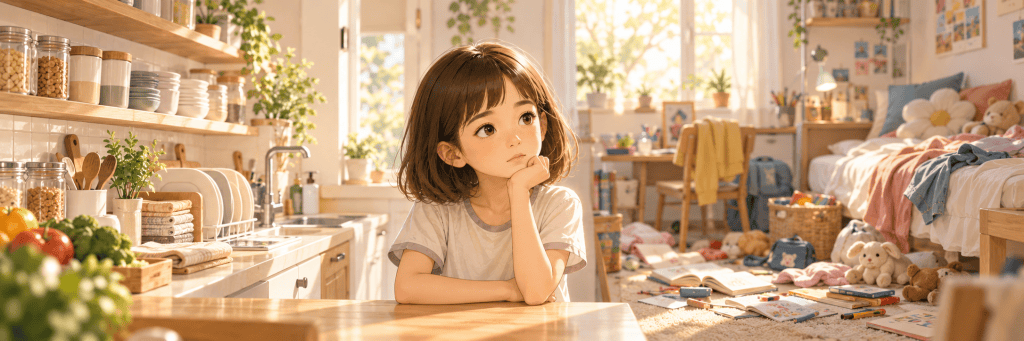
How could a child who was so good at arranging all those awkwardly shaped food packages have a bedroom that was often so messy I barely wanted to walk into it?
What made it even funnier was that Alicia had now started keeping an eye on me, too.
Sometimes, after she has just tidied the kitchen or dining table, she’ll notice that I’ve put something on it again and immediately complain, “Mum, why have you made the table messy again?”
I never know whether to laugh or feel annoyed.
Because her own bedroom is probably the hardest place in our entire home to keep tidy.
Alicia loves drawing, making crafts, and crocheting. As soon as she starts working on something, her desk quickly fills up with materials, while scraps of paper and bits of yarn end up scattered across the floor.
Her bed is often a mess, too, with a blanket here and a duvet piled up somewhere else.
And then there’s her wardrobe.
Once, when I opened the door, clothes actually fell out. Instead of properly reorganizing them, she simply stuffed them back inside.
Usually, when I finish washing and folding her clothes, I leave them on the coffee table in the living room. She rarely takes them back to her room on her own. Sometimes they sit there for ages until Chris reminds her to put them away, and then she carries the whole pile into her bedroom and stuffs everything into the wardrobe again.
Which means that the next time someone opens the door, the clothes may come tumbling out once more.
I’ve reorganized her wardrobe for her many times, and I’ve also helped her tidy her entire room.
A year or two ago, when her room had become particularly messy, I couldn’t stand looking at it any longer and decided to help her. Sometimes the two of us would spend an entire day tidying and still not finish.
Back then, Alicia would sit in the middle of a mountain of belongings, looking as though she had no idea where to begin.
Eventually, I became less and less willing to do the tidying for her.
Partly because I was getting busier, and work, cooking, and all the other household chores were already taking up so much of my energy. But also because every time I spent hours getting her room into order, it would be messy again within a few days.
I simply didn’t have the energy to keep repeating the same task.
Still, when I think about it carefully, she hasn’t made no progress at all.
These days, when Chris or I remind her to tidy her room, she can get started quite quickly. Within a few minutes, she can make it look reasonably tidy. Unlike before, she no longer seems completely lost about where to begin.
The problem is that by the next day, it’s often messy again.
In other words, she has learned to tidy a space relatively quickly, but she hasn’t yet developed the habit of putting things back after using them.
That gradually made me realize something: perhaps organizing things and maintaining order are two very different tasks.
Organizing the kitchen is a job with clear boundaries.
There is a pile of things in front of her, a couple of boxes, and a limited amount of space. She can work out how to sort everything, how to arrange it, and how to make the best use of the space available. Once she’s finished, she can immediately see the result: everything is clear and tidy.
Keeping her bedroom tidy is a different kind of work.
After making crafts, she needs to put away the scissors, glue, paper, and balls of yarn. When she changes her clothes, she needs to decide where they belong. After reading a book, she needs to return it to the shelf. After eating something, she needs to deal with the packaging and any leftover food.
These are things that have to be repeated every day, and there is usually nothing particularly exciting about them.
Perhaps Alicia simply prefers the first kind of task.
She enjoys solving a specific, visible problem, but is much less interested in repeatedly carrying out the small, monotonous routines of everyday life.
Seen this way, her behavior doesn’t seem quite so contradictory anymore.
At the same time, I don’t want to use this distinction to explain away every problem as a matter of personal preference.
Because some things are no longer just about tidiness. They are about basic hygiene.
Sometimes Alicia buys bread near her school. If she doesn’t finish it, she brings it home and eventually throws the leftovers into the rubbish bin or a rubbish bag in her room.
When I’ve cleared out her rubbish, I’ve sometimes found sweet wrappers and sticky food scraps among it.
If left there too long, food waste can become mouldy or attract insects.
I have no idea how many times I’ve reminded her about this.
I’ve told her not to leave food scraps in her bedroom, to put craft materials away when she’s finished, and to take her folded clothes back to the wardrobe promptly.
But even after repeating these things again and again, the results have been limited.
Perhaps this is one of the most exhausting parts of raising a child.
You know exactly what needs to be done, and you’ve even demonstrated it many times. Yet somehow, your child still hasn’t turned it into a habit of her own.
I used to tell Alicia that if she genuinely didn’t know how to organize things, or really didn’t understand what to do, I wouldn’t expect so much from her.
But the problem is that she clearly can do it.
Look at the kitchen. She can organize all those complicated items so sensibly. Why can’t she do the same with her own bedroom?
In the past, I always took this to mean that she simply wasn’t taking responsibility for her own things.
But recently I’ve started to wonder whether there’s another question I need to understand.
There may be a whole set of habits separating a child’s ability to do something well on one occasion from her ability to keep doing it consistently over time.
The fact that Alicia organized the kitchen so well shows that she can sort things, arrange a space, and solve practical problems.
But those abilities don’t automatically become a habit of tidying her room every day.
In the same way, the fact that she can spend an afternoon concentrating deeply on a craft project doesn’t mean she can bring that same level of concentration to schoolwork she doesn’t particularly enjoy, day after day.
And another thought occurred to me: perhaps Alicia’s wardrobe needs to change, too.
In the past, I’ve usually been the one to reorganize it, then expected her to maintain the arrangement.
But what seems sensible and tidy to me may not be the most convenient system for her.
If putting away a single item of clothing means carefully preserving an existing arrangement, she may quickly choose the easiest option and simply shove it inside.
So rather than spending another evening organizing everything for her, perhaps it would be better to let her think about the problem herself.
How could she arrange her clothes so they’re easy to take out, but won’t come falling down every time she opens the wardrobe?
After all, through two different experiences of organizing the kitchen, she has already shown how good she is at finding ways to use limited space.
I can help her clear out the things that have accumulated in her wardrobe over time. But perhaps she should have more say in how her everyday clothes are sorted and arranged.
Then we can see whether she manages to keep it that way.
Of course, even if she comes up with a storage system she likes, that doesn’t mean she’ll never need another reminder.
Organizing and maintaining order are still two different things. And the second probably has to be built slowly through daily habits.
Looking back over the past few years, my understanding of Alicia has changed several times.
At first, I thought she simply didn’t know how to organize things.
Then she reorganized the fridge so beautifully that I was surprised to discover she not only could do it, but could do it remarkably well.
This time, she arranged the items on the kitchen shelf so sensibly that I became even more convinced she genuinely has this ability.
And yet her bedroom is still frequently messy, and the situation with her wardrobe hasn’t fundamentally changed.
I’m beginning to understand that all these things can be true at the same time.
She can be excellent at organizing things while struggling to keep her surroundings tidy. She can enjoy creating order without enjoying the repetitive daily chores needed to maintain it. She can show remarkable initiative in one area of her life while still needing reminders in another.
Perhaps this is how our understanding of a child gradually becomes more complex.
At first, we judge what kind of person a child is based on a particular behavior. Then an unexpectedly impressive performance makes us overturn that judgment completely.
But perhaps a more accurate understanding lies in neither of those opposite conclusions. It lies in recognizing that a person can have strengths and shortcomings at the same time.
I still want Alicia to keep her room cleaner, especially to learn to remove rubbish promptly and put her clothes where they belong.
But I no longer want to conclude that she has no sense of order simply because her room is messy.
Because I’ve now seen for myself that when she puts her mind to solving a specific problem, she can sometimes do it even better than I can.
And perhaps what she really needs to learn next isn’t how to give her bedroom another thorough tidy, but how to gradually turn the abilities she already has into habits she can use consistently in everyday life.
This essay is also available in other languages:
Chinese version: 一个会整理厨房的孩子,为什么收拾不好自己的房间?
German version: Warum kann ein Kind die Küche perfekt aufräumen, aber sein eigenes Zimmer nicht ordentlich halten?


Leave a Reply