
By Jane Sonnenschein · October 4, 2026
I’ve been a little tired these past few days.
Work, shopping, all kinds of small things that needed taking care of—none of them seemed like much on their own, but one after another they piled up. Eventually, all I wanted to do was lie down. Even a lot of the little things at home felt like too much to deal with.
The day before German Unity Day, Alicia and I went to the supermarket and bought quite a lot because the shops would be closed the next day. Vegetables, fruit, milk, frozen food—suddenly there was another whole load of groceries to fit into the house.
The problem was that our fridge was already a mess.
Things we had bought earlier had been shoved here and there, and by the time we came home with the new groceries, there was almost nowhere left to put anything.
I was so tired that day that I said to Alicia, “Why don’t you do it? Could you put everything into the fridge? I really don’t feel like moving anymore.”
When I said it, I honestly wasn’t expecting much.
For a long time, I had thought of Alicia as a child who simply wasn’t good at organizing things.
At school, her assessment for orderliness was often only a 3—on the German scale, where 1 is the best grade and 6 the lowest. Her room was often so messy that I barely knew where to begin.
She loves drawing and making things, so her desk is always covered with paper, yarn, scissors, glue and half-finished projects. Even when we had just tidied her room, it usually took only a few days before everything looked the same again.
A couple of years ago, whenever her room became too chaotic, I would eventually lose patience and help her clean it.
Sometimes the two of us would spend almost an entire day on it.
She would sit in the middle of a pile of things without knowing where to start. I told her so many times that she needed to tidy up that eventually even I got tired of hearing myself.
At one point I tried all kinds of ideas. I told her that if she could get her room organized and keep it that way for a while, we might consider getting a cat someday, because she had always wanted one.
Of course, the effect never lasted very long.
Over time, I had quietly formed a very stable judgment about her:
She probably just wasn’t good at organizing things. She simply didn’t have much sense of order.
So when I handed the fridge over to her that day, I was really thinking, I don’t want to deal with this anymore. Let her put things wherever she wants. As long as everything fits inside, that’s enough.
The next day, I opened the fridge and was genuinely surprised.
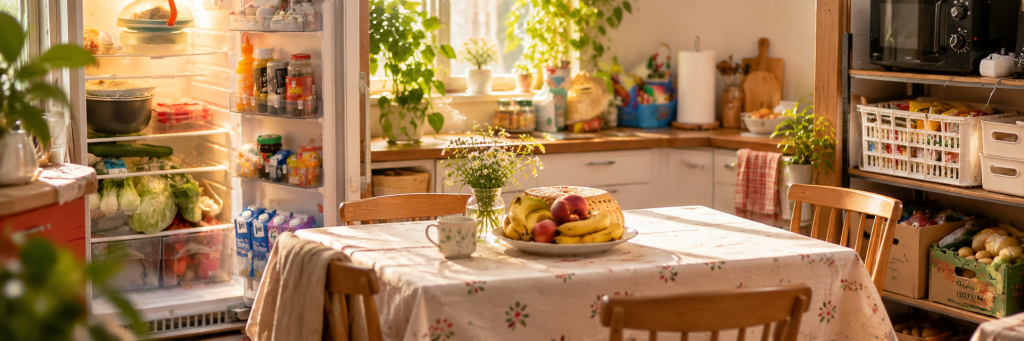
She had lined up the cartons of milk neatly. She had put bottles, jars and sauces into the plastic organizers we already owned. Meat, vegetables and other foods were separated and arranged clearly on different shelves.
We had bought a lot the day before, and the fridge had already felt almost completely full. But after she reorganized everything, it somehow didn’t look crowded at all.
It looked orderly.
She had even found a small box for the potatoes that had been sitting outside the fridge.
What surprised me even more was that she hadn’t stopped there.
A friend was coming over the next day.
Alicia saw that our dining table was messy, so she put down a tablecloth, rearranged the bottles and other things on the table, tidied part of the kitchen shelving, and set out some fruit.
She didn’t wait for me to tell her where everything should go.
She had her own idea of what needed to be done. Her friend was coming, and she wanted the house to look nice.
At that moment, I suddenly realized something I had never fully understood before:
Alicia does know how to organize.
Not only can she do it—when she genuinely wants to, she can do it very well.
It was a small discovery, but I kept thinking about it.
Because my earlier judgment that she “had no sense of order” had not come from nowhere.
Her room really was messy.
She really did leave things everywhere.
After we tidied, things really did become messy again very quickly.
And her school assessment in this area really wasn’t especially good.
All of those facts were true.
But then another thought occurred to me:
The facts may be true, while the conclusion we draw about a person from those facts may not be.
I have always been someone who likes things relatively tidy.
My desk, especially, is usually well organized. I don’t like leaving things lying around without any order.
But over the years, life has become fuller and fuller. If I don’t do the housework, much of it simply doesn’t get done. There is cooking, laundry, work and all kinds of other things to deal with.
Gradually, I have stopped caring about every corner of the house as much as I used to.
The fridge can go a long time without being cleaned.
Groceries get brought home and shoved wherever they fit.
One bottle appears on the dining table today, something else tomorrow, and eventually things just stay there.
If I really don’t feel like sweeping the floor this week, then I sweep it a few days later.
Years ago, I might have looked around and thought, How can the house be this messy?
Now I increasingly think: sometimes you simply have to keep life moving first.
But I would never look at my messy fridge today and conclude that I “don’t know how to organize things.”
So why was it so easy for me to look at a child whose room had been messy for a long time and conclude, “She just can’t organize”?
Maybe this is one of the subtle forms of pride and prejudice that can appear in parenting.
By “pride,” I don’t necessarily mean believing that we are smarter or better than our children.
It is something quieter than that: a kind of certainty.
I’m the adult.
I’ve watched you for years.
So I know you.
I know what kind of person you are.
And slowly, when a child repeatedly misses information in a math problem, we start saying she is “careless.”
When her room is always messy, we decide she “has no sense of order.”
When she needs reminders to do her homework, we say she “isn’t self-motivated.”
When she gets bored easily in class, we begin to wonder whether she “can’t concentrate.”
When a behavior repeats often enough, it can quietly change in adult language from:
“She is doing this right now”
into:
“This is the kind of person she is.”
And there is actually a very long distance between those two statements.
Something else Alicia reminded me of over these past few days is that many of her abilities depend heavily on one thing:
whether the task feels meaningful to her.
She can spend hours drawing, making crafts, knitting things or preparing gifts for other people, completely absorbed in what she is doing.
If a teacher has a birthday, she wants to bring flowers or make a card.
For Valentine’s Day, Mother’s Day or other occasions, she always wants to make something.
When a friend is coming over, she prepares gifts, tidies the table, sets out fruit and wants the house to feel welcoming.
In the past, when I watched her constantly making gifts for this person and that person, I sometimes viewed it through an adult lens and wondered whether she was trying too hard to please people.
But over time, I have started to think these may not be the same thing at all.
She has been like this since she was very little.
She simply seems to have a stronger instinct for marking important moments than either her father or I do.
And the two of us happen to be almost the opposite.
Because of my own childhood experiences, there were many years when I didn’t even celebrate my birthday. Holidays have never carried much emotional weight for me either.
But Alicia naturally seems to feel that an important occasion should have some kind of form, and that an important person should receive some kind of expression.
She likes turning feelings into something concrete:
a card,
a bouquet of flowers,
a little handmade gift,
or a tablecloth laid out before a friend arrives.
Maybe that is simply part of her temperament.
And once something enters her own system of meaning, her whole state changes.
When she finds a book she truly enjoys, no one has to make her read.
She once became completely absorbed in Alice’s Adventures in Wonderland. For several days, she would sit down and read it on her own every day.
That later reminded me of something her father once pointed out to me.
When I wanted Alicia to learn Chinese, I bought many Chinese books for her from China.
I chose them one by one because I thought they were good and suitable for her, then had them shipped all the way to Germany.
But one day her father said to me:
“These books may all be excellent. But have you ever asked her what she actually wants to read?”
He suggested that we take her to the library or a bookstore and let her choose for herself.
Because once she chooses a book, it is no longer simply:
“a Chinese book Mom wants me to read.”
It may become:
“I want to know what happens next in this story.”
The more I think about it, the more important that difference seems.
With the same task, if an adult has simply arranged it for her, she may do it, but you can often feel the reluctance.
If she has claimed it as her own, she may invest far more energy than we expected.
Learning works the same way.
On the one hand, Alicia says she really wants to attend a Gymnasium, the academically oriented secondary-school track in Germany.
On the other hand, there are homework assignments she clearly does not want to do.
I used to think there was something contradictory about that.
Now I don’t think it is contradictory at all.
“I want to go to a Gymnasium someday” is a wish she has for her future.
The boring worksheet sitting in front of her right now is a very specific task that gives her very little pleasure.
A nine-year-old can genuinely want the first thing while disliking the second.
That is completely natural.
So perhaps the real work of education is not simply telling her:
“If you want to go to a Gymnasium, then you have to take your homework seriously.”
What matters more is helping her slowly build the connection herself:
This is something I want. And because I want it, I am willing to take on some parts of the process that are not very interesting right now.
Psychologically, that is completely different from:
“Mom is forcing me to do this.”
And when I think about that, I inevitably think about myself too.
Alicia and I are actually quite similar in this respect.
If something is genuinely important to me, I am usually willing to learn even when it is difficult. I can spend a great deal of time trying to understand it.
But once something loses its meaning for me, or goes a long time without giving me any feedback, my motivation drops very quickly.
Writing itself is something I can keep doing for a long time, because thinking and expressing myself already give me a kind of feedback.
But when social-media numbers stay poor for a long time, and publishing slowly turns into a mechanical routine, one question starts appearing in my head very easily:
What is the point of doing this?
And then it is as if the car suddenly runs out of fuel.
I used to criticize myself for this too.
Why can some people repeat the same boring thing day after day, year after year, while I become discouraged so easily and so often lose momentum halfway through?
Later, after reading about differences in the brain, temperament and genetics, I slowly began to understand that human beings do not all arrive in the world with exactly the same “hardware.”
Some people naturally need less sleep. Others need longer to recover.
Some have enormous reserves of energy, while others tire more easily.
Some tolerate repetitive tasks very well. Others depend much more heavily on interest, novelty, meaning or immediate feedback.
Of course, no human behavior can ever be explained by a single gene.
Environment, physical condition, life experience and later training all matter too.
But simply acknowledging that people really do differ in temperament and in the way they function can change a great deal.
Because when we insist on measuring everyone by the same standard, it becomes very easy to turn difference into a moral problem.
Other people can persist. Why can’t you?
Other children study every day. Why do you always need reminding?
Other people keep their rooms tidy. Why is yours always such a mess?
And eventually,
“I am different from other people”
quietly becomes:
“I am not good enough.”
Maybe there is a more useful question:
How does this person actually work?
Some people are activated by rules.
Some by competition.
Some only need to know, “This is my responsibility,” and they can repeat the same thing every day.
Others clearly need interest, meaning and feedback. Their abilities are most fully engaged only when something has genuinely become part of their own inner system.
Alicia may belong more to that second group.
I probably do too.
That does not mean we can abandon every boring task just because we are “not interested.”
Nor does “this is simply how I am” excuse us from taking responsibility.
Quite the opposite.
Useful self-understanding does not mean telling yourself:
“Well, if this is how I was born, then I don’t have to change anything.”
It means:
Now that I understand how my system works, I should learn how to use that system well.
If I depend on meaning, then I need to keep rebuilding the connection between what I am doing and why it matters to me.
If I need feedback, then I should break long-term goals into smaller stages where I can actually see progress.
If I struggle to keep going for a long time in a completely unstructured environment, then I should make use of environment, habits and external rhythms instead of humiliating myself every day for not functioning the way someone else does.
The same is true for children.
Understanding a child is not about finding excuses for her.
It is about finding a way of growing that actually works for her.
That is why I increasingly feel that the hardest part of education may not be choosing the right books for a child or planning the perfect path.
Maybe it is learning to let go of the certainty that says:
“I already know what kind of person you are.”
It means allowing her to gradually make choices of her own, while also allowing ourselves to keep discovering who she is.
Because only when a person has choices does she get the chance to learn responsibility for those choices.
And only when we are willing to loosen our own prejudices can we truly see what she may actually be capable of.
Perhaps making peace with ourselves is the same thing.
It does not mean giving up on change.
It does not mean responding to every weakness with, “That’s just how I was born.”
It simply means that we stop demanding that we become a completely different kind of person.
And we stop using shame as the fuel for change.
Real responsibility may begin precisely there:
once we know what kind of person we are, we slowly learn how to use our own system well.
This essay is also available in other languages:
Chinese version: 我们以为自己了解孩子,其实很多时候只是习惯了自己的判断
German version: Wir glauben, unsere Kinder zu kennen – dabei haben wir uns oft nur an unser eigenes Urteil gewöhnt


Leave a comment