
By Jane Sonnenschein · August 27, 2026
Early this morning, I casually posted a sentence on Threads:
“If a society gradually squeezes the most natural part of childhood into something children are expected to overcome as a ‘waste of time,’ while concentrating almost everything worth praising on academic achievement, then what children lose may be more than time to play. They may also lose opportunities to understand themselves, explore the world, and learn how to enjoy being alive.”
Not long afterward, someone commented that play, of course, was not a waste of time. What was really being wasted, he said, was the time so many children now spend curled up on the sofa scrolling on their phones. Even when a group of children gets together, he said, they often do not talk or play anymore. Everyone simply looks at their own screen.
When I read the comment, I did not think he was wrong. That scene really is becoming more common: several children sitting together, each with their head down staring at a screen, sometimes looking even quieter than if they were alone.
But another question immediately came to mind.
If a child no longer knows how to play, shouldn’t we also go back a little further and ask: When did they stop knowing how?
Playing seems like something children are born knowing how to do, so adults can easily assume that if we simply send them outside, they will naturally figure it out.
But when you think about it more carefully, knowing how to play is also an ability that has to be practiced through life.
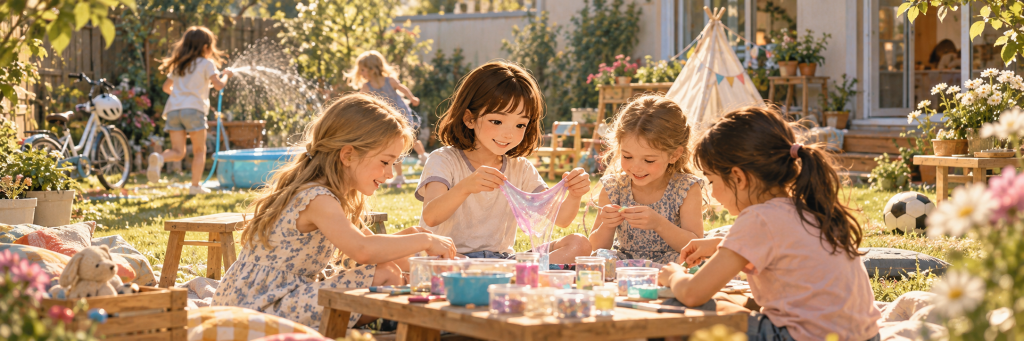
A few children run into one another downstairs, and at first there may be nothing to do. Someone suggests riding bikes, but someone else does not want to, so they come up with something different. One child brings toys up from the basement, another finds a table, and suddenly they decide to spread a blanket on the grass and turn it into a little picnic spot. Halfway through, they decide the place is not right and move everything to the backyard. If it gets hot, they find a small pool, fill it with water and start a water fight.
Of course, someone may get upset along the way. They may argue. Someone may walk away, then come back and join in again later.
There is no adult standing beside them directing the activity, and no one has planned an “objective” for the afternoon in advance.
The children simply begin with one question—“What should we do now?”—and little by little fill an afternoon that had originally been empty.
That is actually not as simple as it looks.
They have to tolerate those first few minutes of boredom. Someone has to suggest something. They have to negotiate with each other and accept that their own idea may not interest anyone else. If there are not enough toys, they have to improvise. If the rules do not work, they change them. After a conflict, they have to decide whether they still want to keep playing together.
To an adult, it may look like a few children downstairs messing around with nothing better to do.
But it is precisely during this apparently purposeless time that children learn how to be with other people—and how to create a little enjoyment for themselves.
My daughter Alicia is nine now. After we received her grades last semester, we more or less took away her tablet, and she rarely plays games anymore. Occasionally she asks to borrow my phone, usually because she wants to listen to Spotify, and sometimes to watch a few craft videos.
She even makes a point of telling me, “Mom, don’t worry. I’m not going to scroll TikTok.”
What I find interesting is that after the tablet disappeared, she never seemed distressed in that “without a screen, I have absolutely nothing to do” kind of way.
Because she still has many other things she can do.
She likes drawing, making things, crocheting, building Lego and baking cakes. A while ago, she and some of the children downstairs mixed soap, hand cream and other things together until they created a soft material that actually felt a lot like modeling clay—oily and squishy, and slow to dry. They have made all kinds of slime too.
One of the mothers downstairs found some tools for the children, and they could crouch there experimenting for hours. One moment they thought the mixture was too soft; the next they wanted to add something else. Once they were finished, they compared what they had made, then started changing it again.
Sometimes they carry a table onto the grass, spread out a picnic blanket and arrange their snacks as if it were a proper little picnic. Later they decide the backyard is better and move the entire setup there.
Sometimes they have water fights and come home with all their clothes soaked. Sometimes they run to the basement themselves and bring out toys, little electric vehicles or tracks, then carry down their bicycles and scooters too.
They are not waiting for someone else to entertain them.
They are constantly asking:
“What else can we come up with?”
To me, there is a very big difference between those two states.
If a child gets bored and already has ten possible ways out of that boredom in their head—they can find a friend, draw, build something, make a craft, go outside on a bike, or pick up a ball of yarn without even knowing what it will eventually become—then a phone is simply one form of entertainment among many.
But if a child’s daily life consists almost entirely of school, homework and extra classes, and when some free time finally appears there is nowhere they can move around freely and very little opportunity to decide for themselves what to do, then the phone becomes an extremely powerful competitor.
Because a phone is so easy.
Real-world play has a startup cost. You have to find someone. You have to think of something to do. You may need to prepare things. You even have to survive a little boredom first.
Short videos demand none of this.
One swipe, and the next piece of stimulation is already waiting. You do not have to create anything, wait for anything or negotiate with anyone. You do not even have to face that empty moment of:
“There’s nothing here. What am I supposed to do now?”
Seen this way, perhaps the phone is not simply “stealing children’s play.”
Sometimes it is more as if free play has already been slowly disappearing from children’s lives, and the phone arrives with an extremely low barrier and extremely high level of stimulation to fill whatever empty space is left.
Then a cycle begins.
Children have less and less time for free play, so they have fewer opportunities to practice dealing with boredom, starting games and creating their own enjoyment. When they become bored, they reach for a phone, and the phone in turn takes away even more of the time in which those abilities might have developed.
Eventually, real-life play starts to feel too slow and too troublesome, while the screen becomes the most familiar choice.
Then one day several children really do meet up and simply sit there scrolling separately, while the adults stand nearby sighing:
“Kids today don’t even know how to play anymore.”
But if we stop there, it becomes very easy to turn the result back into a problem with the children themselves.
Today, by coincidence, I came across another post on Xiaohongshu (a Chinese lifestyle and social platform often loosely compared to a mix of Instagram and Pinterest).
The author described two children. One had grown up with almost no limits on phone use; the other had barely been allowed to use a smartphone at all. Later, the first child wanted a phone as soon as there was nothing to do and felt uncomfortable without one. The second had never developed that habit and would instead pick up a book or find something else to occupy themselves during free time.
The discussion under the post quickly split into two extremes.
One side argued that children should ideally not have a smartphone at all before the age of eighteen. The other side said that we already live in a digital age, so completely isolating children from these devices is impossible, and we might as well let them become familiar with them early.
I think both approaches have their problems.
Having no limits at all is obviously risky.
It is not only children. Plenty of adults and older people get pulled into short videos and struggle to control how much time they spend watching them. A nine- or ten-year-old child is still developing self-control, yet they are facing systems deliberately designed to keep capturing their attention.
Expecting a child simply to resist all of that through willpower is not particularly realistic.
But on the other hand, I also do not really believe that “complete isolation until eighteen” is the final answer.
A child cannot live forever in a world without smartphones, the internet or algorithms. You can block every entrance at home, but it is difficult to make sure they will never encounter these things through friends, classmates or other environments.
If someone has never had the chance to learn gradually how to use these tools while they are still in a relatively safe environment and their parents can still be involved, then the fact that all the restrictions suddenly disappear one day does not mean they will automatically gain mature self-control simply because they have reached a certain age.
So when it comes to phones, what I think children really need to develop is neither “I must never touch this” nor “I’ll need it eventually, so I might as well use it however I want now.”
It is a different kind of relationship:
I can use it, but it is not the only form of happiness I know.
Today Alicia suddenly asked me, “Mom, didn’t you once have a phone called Nokia?”
I said of course I did. Before smartphones appeared, Nokia was one of the biggest names in mobile phones. But phones back then were mostly for calling and texting. They did not contain the entire world we now carry around on smartphones.
She thought for a moment and said:
“Then maybe you can buy me a Nokia one day. As long as it can make calls, that’s enough.”
That surprised me.
Of course, the fact that she says this at nine does not mean she will never become interested in smartphones. When she reaches adolescence, peer relationships and social needs will change.
But for now, she can still separate “I need a phone so I can contact Mom and Dad” from “I need a smart device that can entertain me whenever I want.”
To me, that at least suggests that the phone has not yet become something irreplaceable in her life.
And I doubt that this is because her self-control is somehow unusually strong.
More often, it is because she still has other things.
A while ago, her father took her to visit a friend whose daughter is thirteen, four years older than Alicia. The two immediately got along because they both loved drawing and making things.
Usually, if we visit adults who do not have a suitable child for her to play with, Alicia may start saying she is bored after a while. But that evening, she and the older girl stayed in the kitchen drawing and making things together. They barely came looking for their parents.
Afterward, Alicia seriously told me that she wanted to make toys herself one day—make toys for children—and that she hoped she could do it together with a group of “like-minded people.”
A nine-year-old obviously does not need to decide on a career now. She may change her mind completely later.
But I still found the comment interesting because no one had sat her down and asked, “What do you want to be when you grow up?”
The thought arose naturally after she had actually encountered something she loved and met someone who shared that interest.
Perhaps this is another value of play and exploration that is easy to overlook.
Children do not discover who they are only in classrooms.
Very often, it is while doing things that appear to have no purpose that they gradually discover what they enjoy, what they can do, what kinds of people they like spending time with, and what can keep them absorbed for hours.
If every hour of childhood is fully scheduled, a child may certainly acquire more knowledge and become more familiar with how tests work.
But they may also lose many opportunities to get to know themselves.
I once wrote an essay called An Interesting Soul Also Needs a Childhood with Room to Explore. At the time, I was thinking mostly about how children need time to look at leaves and ants, collect stones and do things that adults may consider completely useless.
Now I increasingly feel there is another layer to it.
A child does not only need to explore the world.
Through exploration, they also slowly learn how to become interested in the world.
That is an ability.
A child crouching on the ground looking at a chestnut may produce absolutely nothing. Mixing soap and hand cream into a strange lump of soft material will not earn an extra point at school. Spreading a blanket downstairs with a few other children will not help anyone get into a better school.
But all of these experiences are quietly telling the child:
When no one is arranging my time for me, and no screen is instantly giving me stimulation, I can still think of something to do.
Once that ability exists, a phone is simply a tool, one form of entertainment.
If that ability becomes weaker and weaker while the screen becomes the easiest escape from every empty moment, then the situation is entirely different.
So when I hear people say, “Children today just sit together playing on their phones,” I no longer feel much desire to simply blame the children.
What I want to ask instead is:
Before they started doing nothing but scrolling on their phones, how many truly free afternoons did we give them?
Did they have opportunities to go out and find friends by themselves?
Did they have somewhere to run around, get their clothes wet, carry things from one place to another, spend some time being bored and then suddenly decide, “Let’s do this”?
Did they have opportunities to do things that no teacher would grade, no parent had requested, and that perhaps did not even work out in the end?
If those experiences become increasingly rare, it is hardly surprising that phones eventually take over the empty space.
I even think that when families deal with electronic devices, the truly useful goal is not simply to make children lose access to the phone.
It is to help the phone gradually lose its monopoly on pleasure.
Children can know what smartphones are and gradually learn how to use them. But outside the screen, they should ideally already have a real world rich enough to compete with it: friends, physical activity, things they enjoy making, interests they can lose themselves in for a long time, and some empty hours in which they can practice turning boredom into something else.
Then one day, when we are no longer able to manage their devices for them, at least they will not be faced with a life that seems to offer only two choices:
Complete your tasks.
Or scroll on your phone.
They will still know there is a third possibility.
When the screen is turned off, the world outside has not disappeared.
And they still know how to play.
This essay is also available in other languages:
Chinese version: 当孩子一有空就拿起手机,我们是不是也该问:他们还有没有机会学会怎么玩?
German version: Wenn Kinder in jeder freien Minute zum Handy greifen, sollten wir uns auch fragen: Haben sie noch die Chance zu lernen, wie man spielt?


Leave a comment