By Jane Sonnenschein · First drafted March 21, 2026 · Revised September 25, 2026
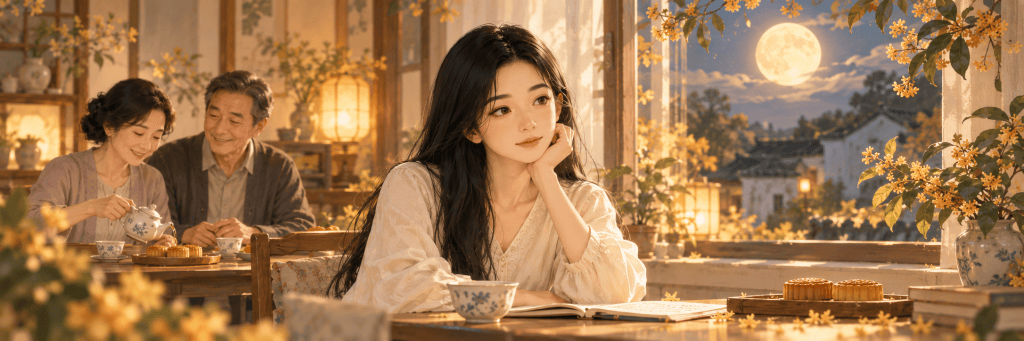
Today is the Mid-Autumn Festival. In China, it is a day for family reunion.
I don’t know why, but I’ve never been very good at holidays that are supposed to make people happy.
Chinese New Year, the Mid-Autumn Festival—especially on days when people keep talking about “reunion,” “family,” and “going home,” I tend to feel things I can’t quite explain. When I was a child, Chinese New Year was supposed to mean a lively family dinner, new clothes, and red envelopes. But many of the memories that stayed with me are of my parents arguing over things that now seem trivial, sometimes very fiercely. Maybe that is why, for many years afterward, I could never approach these holidays of reunion with the same uncomplicated anticipation other people seemed to have.
After I moved to Germany, that feeling actually became weaker. Chinese New Year is much less present here, and the Mid-Autumn Festival is quieter still. There aren’t mooncakes everywhere, and hardly anyone keeps reminding you that “when the moon is full, the family should be together.” Often, if I didn’t see photos and greetings on Chinese social media, the day would feel almost no different from any other.
And yet this Mid-Autumn Festival, I still felt a sadness I couldn’t quite name.
For the past two years, I would order mooncakes for my parents on Taobao, a major Chinese online marketplace somewhat comparable to eBay or Amazon Marketplace, and have them sent home. This year, I did nothing. I didn’t even send them a simple “Happy Mid-Autumn Festival.”
It wasn’t because I had forgotten them, or because I no longer cared. Quite the opposite. Maybe there were simply too many feelings, all tangled together, and I didn’t know where to begin. Love, tenderness, resentment, guilt, and all the things I still haven’t truly sorted out after so many years—they were all mixed together. And my own life hasn’t exactly been easy lately. Sometimes, when it comes to my parents, my instinct is to take a small step back. Not because I don’t care, but because I don’t quite know how to approach them, or what version of myself to bring with me.
Yesterday, I thought I should write something for the Mid-Autumn Festival.
Not because I wanted to write something seasonal, but because days like this always seem to bring certain things back into view—things I can normally set aside for a while. But today I was busy from morning until night, and when everything finally became quiet, I suddenly had no idea what to write. It felt as though I had so much to say and yet couldn’t say any of it clearly.
Then I came across this essay I had written several months ago, and it suddenly occurred to me that maybe the things I couldn’t put into words today had already been written here.
Especially when it came to my mother.
For many years, I wanted her to understand me. I tried explaining. I tried arguing. Again and again, I tried to make her see why I was hurt, why I felt the way I did. For a long time, I believed that if I could just explain myself a little more clearly, one day she would understand.
After certain things happened, I slowly began to accept that perhaps expecting her to understand me in exactly the way I wanted was never very realistic.
That realization did not suddenly set me free. My feelings toward my mother are still complicated. But when I stopped being so fixated on the question, “Why can’t she understand me?”, I finally gained a little space to see why she had become the person she is.
For many years, whenever my mother and I spoke, there was always a kind of resistance between us.
The truth is, I always knew what I could say to make her happier, and what I could do to make her feel more at ease. I just couldn’t bring myself to do it. It wasn’t that I didn’t know how. I simply didn’t want to.
When I was younger, I had a strong dislike of the idea of “going along with” someone. To me, it felt like pleasing people—pushing down my own feelings so that someone else could feel better. I disliked it, and I looked down on it. And when that someone was my mother, my stubbornness became even stronger.
The problem was that my mother was someone who deeply needed emotional reassurance.
She is, in many ways, someone who was never properly loved as a child. Her family of origin was difficult, and there always seemed to be something missing inside her. Even now, in her sixties, there are moments when she still seems like a child who did not receive enough love. The more someone lacks that kind of love, the more they may crave it. The more they crave it, the harder it can become to ask for it well. And the less well they ask, the more likely they are to push away the people closest to them.
She wants to feel important. She wants to feel cared for. She wants comfort and reassurance. She wants the people around her to confirm that she matters to them.
My father, unfortunately, is a very straightforward and reserved intellectual. He is not good at saying gentle things, and emotional reassurance does not come naturally to him. Ask him to do something, and he will do it. Ask him to comfort someone, and he often becomes awkward.
And my mother is not the kind of person who feels satisfied simply because someone has done what needed to be done. She asks for something and then finds fault with it. She wants others to understand her, yet often expresses that need in the most hurtful way.
So their marriage has never been particularly easy.
And I wasn’t much better than either of them.
Ever since I was young, I resisted the idea that I should be “softer,” “more agreeable,” or “sweeter with my words.” My maternal grandmother used to tell me, “Stop fighting your mother on everything. Be a little softer. She’ll feel better, and you’ll suffer less too.”
But I couldn’t hear it then.
Why should I have to live by pleasing other people? Why should I pretend to be agreeable when I was unhappy inside? In my younger self’s dictionary, people-pleasing, flattery, and going along with others were all things I rejected.
So my mother and I often ended up in the same place: neither of us felt good, and neither of us was willing to step back first.
She thought I wasn’t thoughtful enough, that I wouldn’t go along with her, that I didn’t understand her.
I thought she was difficult, contradictory, impossible to satisfy.
We were mother and daughter, yet so often we felt like two people standing very close to one another, pulling against each other because neither of us wanted to soften first.
For all these years, I haven’t lived near my parents. Distance was part of it, but my own life was a mess too. My child was still young, there were always things happening at home, then the pandemic came, and later I went through a series of setbacks in my own work.
I didn’t talk about it much, but underneath everything there was always a sense of guilt. Especially as my parents grew older, that feeling—“I should be there, but I can’t be”—slowly became a heavy knot inside me.
A few days ago, while going through some old writing, I found something I had posted thirteen years ago on WeChat Moments, the social feed inside WeChat, somewhat like a private Facebook or Instagram feed.
Reading it now, I realized that even back then, I was already hurting over this:
A while ago, I saw some photos of Mom and Dad, and my mind filled with thoughts. When did time leave such deep marks on their faces? It feels as though, during the ten years I was away, they aged at an astonishing speed, carried farther and farther into the current of time.
All these years, we have always been rushing forward. But we forgot to stop, even for a moment, and look at the scenery of their lives—to ask whether the road of life could still be beautiful and happy without us beside them.
Time, you pass so quietly, like a little stream flowing past us. You carry away the days and the years, leaving behind only faces worn by the water of time, radiant in the fading light and yet somehow lonely.
If only you could stop for a while and let me return to those years again. Let me walk beside them for part of the road, watch a sunrise together, and reach toward the hopes they carry inside.
It is late at night. The autumn wind carries the faint promise of rain, cool against my face, sweet with the smell of earth. Leaves stumble down through the wind and gather at my feet, rustling when I step on them. On a road like this, on a night like this, rows of streetlights stand along both sides, as though offering a little warmth of home to people who have lost their way.
Who is sighing in this late-autumn night? Are you, like me, searching for something that can still move you amid this lonely bustle, this lively desolation?
Who is crying? Tears quietly gather in the eyes and then fall, one by one, into the earth. If I had always stayed beside you, would time have been a little kinder? Would it have treated you more gently?
The night is so deep, and the road so long, yet I am not beside you…
The years we walked through together are carved into the soul of my life. I will take them out often and read them carefully.
Even now, reading those words still hurts.
Back then, I didn’t yet know how to be with my parents, or how to truly come close to them. I only felt pain for them instinctively—pain at watching them grow older somewhere I could not see, pain at knowing that time never waits, pain at always being far away and missing everything.
Ten years ago, I was already grieving the fact that they were growing old.
But at the time, grief was more or less all I knew how to offer.
Some time ago, my mother’s trigeminal neuralgia became severe again. She has been suffering from it for years, and when the pain comes, it can leave a person completely helpless.
But my mother has always had a deep distrust of hospitals. Because of things our family experienced in the past, she tends to believe that going to the hospital, taking medication, and receiving treatment may not actually solve the problem and might even make things worse. On top of that, she once had a very bad reaction to medication herself, which made her even more resistant to conservative treatment. She felt that taking medicine only treated the symptoms, not the cause.
Eventually, the pain became too much to bear. My father contacted my younger sister and asked her to help arrange treatment in Shanghai.
My sister has done so much for our parents over the years. She didn’t grow up with us, but since reconnecting with the family, she has taken very good care of them. She books tickets, makes hospital appointments, accompanies them to consultations, and looks after them throughout the process. She handles all of it carefully.
Because I have not been there all these years, many things that should have been my responsibility have ended up falling to my sister. She didn’t grow up with us, and yet when our parents need someone, she is there, steady and dependable.
Whenever I think about that, I feel a mixture of gratitude and guilt that is difficult to put into words.
And perhaps because of that, after that phone call I understood even more clearly that staying beside my mother from far away, patiently explaining things, and helping her feel a little less afraid might have been the most practical thing I could offer at that moment.
This time, my mother went to Shanghai believing that she would simply have the surgery and get the whole thing over with once and for all.
But after evaluating her condition, the doctor felt that the surgery carried risks. He recommended conservative treatment first—medication and observation rather than immediate surgery.
My mother could not accept that.
In her mind, medication was useless, and waiting was useless. She wanted the problem solved once and for all. After she returned that day, she was deeply upset. No one could talk her out of it. She became trapped inside that one thought and couldn’t move past it.
Later, my sister told me how she was doing, and something in me sank.
That was when I called my mother on video.
In the past, it was very easy for the two of us to start arguing almost as soon as we began talking. Even from so far away, sometimes it only took a few sentences before we were pushing against each other again. She had her grievances and stubbornness. I had my temper and impatience.
Helping her seemed wrong. Not helping her seemed wrong too. Going along with her made me uncomfortable; pushing back could make her explode.
For many years, that was simply how we were.
But that day, for some reason, the old resistance in me wasn’t there.
It wasn’t that I forced myself to comfort her, or tried to turn myself into some perfectly sensible, dutiful daughter. It wasn’t like that.
It was more that, over the past few months, as I wrote and looked back at my own life, I had slowly begun to see things I could not see before.
Some of the things I used to think were simply “her problems” now looked different to me. I could see that underneath them were wounds she had carried for a lifetime, wounds that had never really found a place to settle.
So that day, for the first time, I didn’t immediately push back against her.
I spoke to her slowly in our hometown dialect.
I explained, piece by piece, what I had found in my research.
I told her the doctor was not refusing to treat her, and that none of us were dismissing her pain. The problem was that the area involved nerves and blood vessels, and the surgery was not as simple as “do it and everything will be fine.” There were risks, and some of the possible consequences could be worse than what she was already going through.
I told her that starting with medication was not giving up. It was simply the safer approach.
I also told her I would keep looking into it. I would read more reliable medical information. I would not leave her to struggle through it alone without understanding what was happening.
I explained things to her like that, one sentence at a time, patiently.
To be honest, when I thought about it afterward, even I found that kind of patience unfamiliar. The old version of me could not really do that.
It wasn’t that I didn’t care. I just used to get trapped too quickly inside my own emotions.
But that time, I didn’t.
We talked for a long time that day—for several hours.
After we hung up, my feelings were complicated. A little later, my sister told me that Mom was doing much better. She was no longer resisting everything so strongly, and she was willing to accept the plan of trying medication first.
In that moment, I felt something rise inside me that was difficult to name.
It wasn’t a sense of achievement.
It wasn’t, “See? I finally managed to persuade her.”
It was the first time I truly realized that I wasn’t incapable of speaking gently to my mother.
For many years, I simply had not been able to get past something inside myself.
I used to think that being “softer” meant giving in. I thought going along with someone meant sacrificing myself, and comforting someone meant pleasing them.
Now I am slowly beginning to understand that softness does not always mean lowering yourself. Patience does not always mean sacrificing yourself either.
Sometimes it simply means that you have finally begun to see why the other person became who they are.
My mother is still my mother.
She is still stubborn. She still gets trapped in her own thoughts. She still sometimes expresses what she needs in ways that hurt the people around her.
And I am still me.
I did not suddenly become someone who knows how to handle every relationship perfectly. Nor did that one conversation mean there would never be friction between us again.
But that time, for the first time, I felt that maybe even people who have been tangled up with each other for so many years can slowly move a little closer.
Ten years ago, when I watched my parents grow older, all I knew how to do was feel heartbroken. All I knew was that I was far away.
Many years later, I finally learned something more concrete—not simply to stand at a distance and feel sad, but to try to speak a little more gently, explain things a little more clearly, and stay with my mother while the knot inside her loosened, even if only a little.
Relationships do not usually become better through one great moment of reconciliation.
More often, it happens in one specific moment when you finally stop trying only to prove that you are right, and choose instead to finish the conversation with care.
Many years later, I finally learned how to talk to my mother.
Not because I had become better at pleasing people,
but because I had finally grown enough to understand her a little better.
This essay is also available in other languages:
Chinese version: 很多年后,我终于学会了怎么和妈妈说话
German version: Viele Jahre später habe ich endlich gelernt, wie ich mit meiner Mutter reden kann


Leave a comment