By Jane Sonnenschein · March 4, 2026
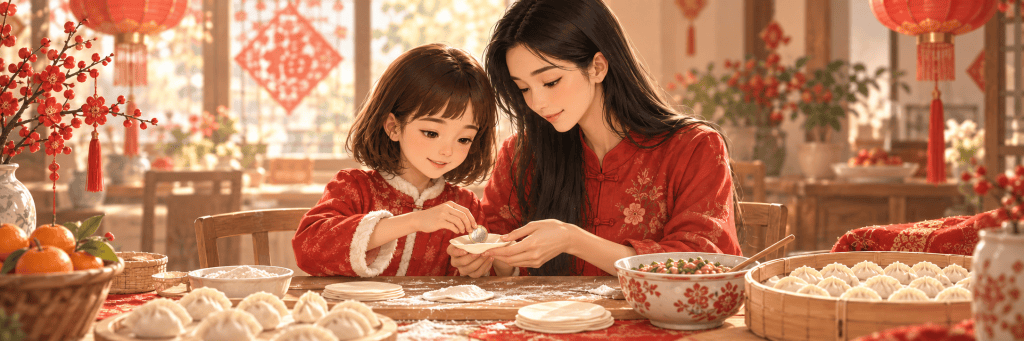
Last Chinese New Year, I put coins inside dumplings for the first time.
Dumplings are not actually part of the traditional New Year food where I come from. I grew up in Linhai, Zhejiang, a hilly place where one mountain rises after another. In my parents’ generation, walking over hills and mountains just to get somewhere was part of everyday life.
For New Year, we ate mai you zhi¹, bianshi², rice cakes, and a whole table of dishes prepared in advance. From the first through the eighth day of the Lunar New Year, we would simply heat up the mai you zhi and keep eating.
My ex-partner was from northern China. During the years we lived together in Germany, I slowly learned from him how to roll dumpling wrappers, make steamed buns, make roujiamo—Chinese flatbreads filled with meat—and eventually even got used to the idea that New Year somehow had to include dumplings.
On the first day of Chinese New Year last year, I told Alicia for the first time about the tradition of putting coins inside dumplings.
I told her that whoever found a coin in their dumpling would have good luck for the year.
She remembered it immediately.
Last year, I did almost everything myself. She stood nearby watching me knead the dough, roll the wrappers, and mix the filling. She stared at the dumplings bubbling in the pot, and every time she took a bite, she did it with expectation.
In the end, she did not find a single coin.
She was very disappointed, but she did not make a fuss. She simply remembered it very, very well.
This year, she started asking me several days in advance, “When are we making dumplings? I want to eat them.”
She asked almost every day.
Originally, we had planned to make dumplings with friends, but somehow we never got in touch. I thought they might be busy. Maybe they were waiting for me to say something too.
And just like that, the days passed.
But Alicia would not let it go.
Eventually, after being reminded again and again, we gave in and bought all the ingredients two days early. I think it was about two evenings before Lunar New Year’s Eve. That night, we suddenly decided to just get started in the kitchen.
As soon as the dough was ready, she went off by herself and came back with six coins.
She washed them extremely carefully.
One by one, she scrubbed them with dish soap, rinsed them clean, then soaked them in fresh water. She was so serious about it that it looked as though she were preparing for some important little ritual.
Before we started wrapping the dumplings, we divided up the jobs. I kneaded the dough and prepared the filling. She was in charge of rolling out the wrappers.
It was the first time she had really taken part in the whole process.
Her wrappers were not very even. Some were too thick, some too thin. She did not yet know how to rotate the dough with one hand while pushing the rolling pin with the other. She simply held the rolling pin with both hands and moved it back and forth.
So some wrappers became too thin in the middle and easily broke once they went into the pot, while others were thick around the edges and awkward to pinch closed.
But that evening, she worked very seriously.
She even deliberately shaped two of the dumplings like steamed buns, because she had secretly hidden coins inside those two and wanted to increase her chances of getting one.
The moment those two bun-shaped dumplings went into the pot, they broke apart.
The coins fell straight into the water.
Her cheating strategy had failed.
She was a little annoyed and sighed that she had terrible luck.
I laughed and said, “See? Cheating doesn’t work.”
After the first batch, she still had not found a single coin.
Her dad, on the other hand, bit into one coin after another and nearly cracked a tooth.
She still refused to give up. She washed the coins again and wrapped them into another batch of dumplings.
We did not eat all of that second batch that night. We froze them and cooked them little by little over the next few days.
And still, she did not find a single coin.
That first evening, she really was disappointed.
She did not throw a tantrum.
She did not cry.
It was simply that kind of disappointment you feel when you have tried very hard, even attempted a tiny bit of clever cheating, and kept hoping over and over again. Every bite carried a little hope, yet in the end, things still did not turn out the way you wanted.
I could see it on her face.
At first, she kept talking nonstop: “Maybe this one has it?”
Later, before every bite, there was a tiny, cautious pause.
That expression shifting back and forth between hope and disappointment is something I still remember.
She really wanted that coin.
But just when the disappointment seemed to have built up as far as it could go, she suddenly recovered on her own.
She said, “It’s okay. Actually, I’m already very lucky.”
Another time, when we were eating the dumplings again, her dad once more found several coins.
Alicia suddenly said, “Dad hasn’t had very good luck these past few years. I’ll just say I gave my good luck to him.”
For a moment, I was taken aback.
She was no longer clinging to the idea that she had to get the good luck.
She had started giving that “good luck” away.
Eventually, there was one coin-filled dumpling left.
I picked it up with my chopsticks and said, “This one is for you. I’ll give my good luck to you too.”
She smiled and shook her head.
“It’s really okay.”
Last year, she was waiting for good luck.
This year, she was beginning to understand it.
And strangely enough, not long after the dumplings, something else changed.
One morning, she suddenly started setting her own alarm.
Before that, I could barely get her out of bed at seven. I would call her again and again until I got angry. She would lie there half asleep, dragging everything out.
A few days ago, she set her alarm for 6:50 for the first time.
The next day, she set it for six.
The day after that, six again.
As soon as the alarm went off, she got up.
She got dressed, washed up, and sat down at her desk.
In Germany, third graders have almost no formal homework. Reading Chinese for half an hour every day, reading English for twenty minutes, and writing a short diary entry are all things I added myself.
Before, I had to remind her about all of them.
If I did not say anything, she simply forgot.
The moment she came home from school, she wanted to play, use her tablet, or play pretend with friends.
Homework was always pushed to the very end.
But during those few days, she suddenly said she wanted to get up at six and do it in the morning.
I was genuinely surprised.
The first morning she got up at six, I even told her dad about it.
“She set her own alarm for six and got up to do her work.”
I had not even checked what she had done. Recently, I had stopped watching her as closely as before, asking whether she had finished or checking how well she had done it.
Her dad froze for a second when he heard me.
“Really?”
Then he said, “If that’s true, I might actually start believing in Jesus.”
He was joking, of course.
Then he added, “Has she been taken over by aliens?”
Because in our family, Alicia being impossible to wake up in the morning was normal.
Dragging out her homework was normal too.
The truth is, she is not actually a slow child.
Once she really sits down to do something, she works quickly and can concentrate very well. In that respect, she is a lot like me.
She simply has very little motivation for things she has not chosen herself.
Before, reading Chinese and writing a short diary felt to her like “tasks someone else had assigned.” So she always put them off until the last possible moment.
But during those few days, she herself said she wanted to do them in the morning.
That felt different.
No one was reminding her.
No one was pushing her.
She had decided for herself.
I understand her very well.
When I was a child, I was exactly the kind of kid who refused to get out of bed until my mother got angry, and I was always arriving at the classroom just as the bell rang.
So the change during those few days did not just surprise me.
Both of us found it almost unbelievable.
Before, I could not wake her at seven.
Now, the alarm went off at six and she sat straight up.
No complaining.
No “This is so annoying.”
She said, “If I finish everything in the morning, then the afternoon is my own time.”
At that moment, I suddenly realized that she had not simply become more hardworking overnight.
She had taken back control of her own rhythm.
I asked her, “You could barely get up at seven before. How come you can get up at six now?”
She said, “When the alarm rings, I wake up. And once I’m awake, I can’t fall asleep again.”
No one forced her.
No one lectured her.
One day, at the age of nine, she simply decided for herself.
It happened just as suddenly as it had when she was six, about a month after starting school, and one day simply decided that from then on she would go to school and come home by herself.
And suddenly I understood.
Good luck was never inside the coin.
The coin was only a symbol.
Real good luck is when a person begins to take responsibility for herself. It is when a child slowly learns how to adjust her own mindset. It is being able to feel disappointed and still say, “It’s okay.”
Good luck is not the moment you bite into a coin.
It is Alicia being willing to give her good luck to her dad.
It is her setting her own alarm for six in the morning.
It is her understanding that even without the coin, she is already lucky enough.
Last year, she waited for good luck.
This year, she got herself out of bed.
Notes
1. Mai you zhi (麦油脂)
A traditional local food from the Linhai–Taizhou area of Zhejiang Province. It is made with a thin wheat-based wrapper, somewhat like a very thin pancake, which is filled with a variety of cooked ingredients and rolled up before eating. In some local families, it is closely associated with festivals and family gatherings.
2. Bianshi (扁食)
A traditional dumpling- or wonton-like food found in several parts of southeastern China, including Zhejiang. The exact shape and filling vary by region and family. In the Linhai context, it is part of the local food tradition rather than a direct equivalent of northern Chinese jiaozi dumplings.
This essay is also available in other languages:
Chinese version: 好运不是硬币,而是心态
German version: Glück steckt nicht in der Münze, sondern in der Haltung


Leave a Reply