By Jane Sonnenschein · June 13, 2026
In Kant’s sense, freedom was never simply about doing whatever you want. It meant giving yourself laws within a framework of rules. I used to find that idea rather abstract. But after living in Germany for so long, I have increasingly come to feel that freedom and order are not two things we can neatly separate.
When a society has no rules, freedom can easily become the freedom of the stronger person to do whatever they please. But when rules are everywhere, freedom can also turn into forms, permits, applications, and endless days spent waiting for approval.
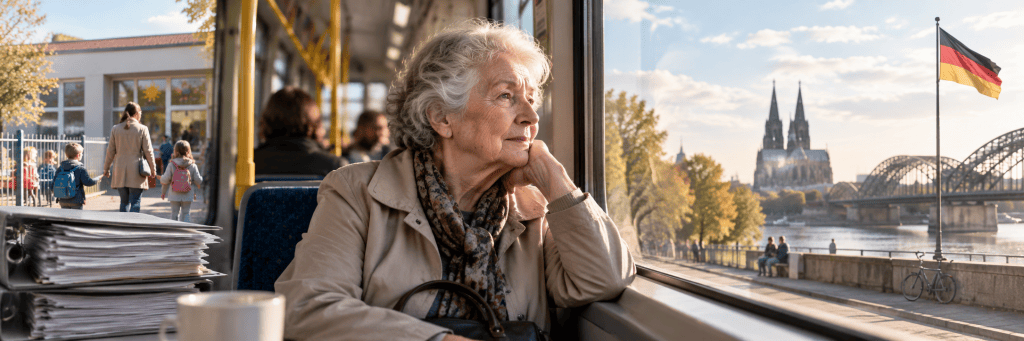
Today, on the tram home, I sat next to a woman in her seventies. She was unmistakably East German, and when she spoke about life in the former German Democratic Republic, or GDR, there was a clear sense of nostalgia in her voice.
She said that back then, many things were arranged for you. Work, childcare, education, everyday life—there was a stable system behind it all. She had worked for more than forty years. When she talked about the past, it did not sound like a political slogan. It sounded more like an ordinary older person missing a certain kind of certainty.
It was not the first time I had heard something like this.
When I was a student and worked at a Volkswagen factory, I also met colleagues who had grown up in East Germany. When they talked about the past, they often mentioned very concrete parts of everyday life: company-run kindergartens, staff canteens, childcare, work arrangements.
Childcare in particular is something I understand all too well.
When we were trying to get a kindergarten place for our own child, we waited three and a half years. In Germany today, if families do not apply very early, even after the baby is born there is no guarantee that they will find a suitable place without difficulty.
For young parents, this is not some abstract debate about social systems. It is a very real problem in everyday life.
So when older East Germans look back on the past with nostalgia, I do not think it makes sense to simply mock them as “brainwashed” or say they “do not understand freedom.”
Often, what they miss is not necessarily the surveillance, the restrictions, or the lack of trust between neighbors. What they miss may be the feeling that life was being held up by a system.
Someone looked after the children. There was somewhere to work. The path of life might have been arranged for you, but at least it felt stable.
For people who lived through the enormous changes after German reunification, growing market competition, pressure on public services, and greater insecurity, that kind of nostalgia is not difficult to understand.
Of course, we cannot pretend the other side did not exist.
The order of East Germany came at a price.
Neighbors could report on one another. Trust between people could be weak. The state reached deeply into many areas of private life.
A society in which everything is carefully arranged can also leave people with no room to breathe.
When people from West Germany, or from many other Western backgrounds, hear East Germans speak nostalgically about the past, they often immediately think of exactly these things: surveillance, control, lack of freedom, lives shaped by the state.
That criticism is, of course, justified.
But here is the difficult question.
When more and more people in today’s supposedly free society feel unsafe in public spaces, when more and more parents are desperately trying to find childcare, and when people discover that although life may be freer, it is also more isolated, less stable, and requires them to carry more on their own, they naturally begin to ask:
What exactly has freedom given us?
And what exactly did order take away?
Recently, I also came across a Chinese content creator living in Germany talking about what he called Germany’s “culture of permission.”
His point was that, in Germany, before doing many things, you first have to ask: Am I allowed to?
If you use an electric grill on your balcony, a neighbor may ask whether it complies with the rules and whether it disturbs others.
If you want to go fishing by a river, you need a license and permission.
Even if you want to do something on your own property, in your garden, or on your lawn, you may still have to think about nature conservation, environmental rules, neighbors’ rights, and all kinds of legal restrictions.
Germans are used to applying.
They are used to getting permission.
They are used to checking the rules first and only then asking whether they are allowed to do something.
At the end, the creator raised a sharp question:
If everything requires permission, then where exactly is the freedom?
It is easy to see why that question resonates.
Anyone who has lived in Germany for a while will probably have their own memories of forms, regulations, applications, waiting times, and procedures.
When you want to get something done, you often cannot simply go and do it. First you need to find out whether it is allowed, which office is responsible, which form you need, how long you will have to wait, which documents you must provide, and whether you meet a particular rule.
Germany’s sense of rules reaches deep into everyday life.
It creates order.
And sometimes it makes you feel as if you cannot breathe.
But if you look at it from the other side, the reason Germany has historically felt safe, stable, and reliable to many people is precisely because of those rules.
People know when to queue.
They know they are not supposed to make noise during quiet hours.
They know how rubbish should be separated.
They know which kinds of behavior in public spaces are considered to cross a line.
Freedom does not mean the absence of boundaries.
It means that once everyone recognizes certain boundaries, individuals can move freely within them.
In other words, German-style freedom has never meant, “I can do whatever I want.”
It is closer to: “Within a set of shared rules, I have my space, and you have yours.”
The real difficulty begins here.
When there are more and more rules, people feel restricted.
But when the rules stop working, people begin to feel unsafe.
The elderly woman on the tram was not trying to make some grand political comparison.
She was responding to something she feels in everyday life: a loosening of order.
More people on public transport whose behavior seems unstable or unpredictable. More situations in schools that make people uneasy. More moments in public spaces that make older people, women, and children instinctively more alert.
To some extent, what she misses is a world she knew—a world that felt more orderly.
This is one of the most complicated parts of social change.
The more a country emphasizes freedom, diversity, and inclusion, the more it also needs strong rules and the ability to enforce them in order to hold those differences together.
Otherwise, freedom can easily slide from “everyone is allowed to be themselves” into “everyone can behave however they like without caring how it affects anyone else.”
Diversity should make a society richer.
But without shared boundaries, it can also make public space feel chaotic.
This is precisely the difficulty Germany is facing now.
Germany has developed a highly rule-based way of life over a long period of time, and Germans themselves are accustomed to those rules.
But when more and more people from different cultures, different childhoods, and very different social experiences enter the same public space, whether those rules are understood, accepted, and enforced becomes a very practical question.
Not everyone automatically understands the German sense of boundaries.
And not everyone is willing to fit their personal behavior into the German idea of social order.
If, at that point, a society talks only about inclusion but not about rules, people’s sense of safety in public life can slowly be worn away.
But if a society talks only about rules and ignores people’s circumstances, it moves toward a different kind of rigidity.
Many people who come to Germany carry trauma, poverty, war, broken families, interrupted education, and social marginalization with them.
If society simply confronts them with cold rules and expects them to adapt immediately, without enough education, support, or capacity for integration, the problems will not disappear on their own.
Freedom, order, inclusion, safety—put these words together, and the reality is far more complicated than any slogan.
That is why I do not want to simply say that older East Germans are wrong to miss the past.
Nor do I want to say that Germany’s system of needing permission for everything is simply ridiculous.
Both sides often see a real part of the picture.
Those who miss order see the security of having life arranged and supported by a system.
Those who criticize East Germany see the price of being controlled by that system.
Those who complain about Germany’s culture of permits see the absurdity of freedom surrounded by paperwork.
And those who insist on rules see what happens to public life when rules disappear.
The real question is not whether freedom or order is more important.
It is whether a society is capable of finding the boundary between them.
Without freedom, order becomes oppression.
Without order, freedom becomes chaos.
Without public services, “freedom” simply becomes: You are on your own.
Without shared rules, “inclusion” can become a situation in which those who follow the rules are constantly the ones expected to give way.
Germans are used to rules, permits, applications, and fitting daily life into institutional procedures.
Chinese people who come here sometimes find these rules annoying, slow, and rigid.
But when we see increasingly unpredictable behavior on public transport, when parents wait years for a kindergarten place, and when older people begin to miss an era in which life was more carefully arranged, we are reminded that rules are not automatically unnecessary.
They are frustrating, but they also protect people.
They restrict people, but they also make it possible for strangers to share the same public space.
Perhaps this is one of Germany’s deepest contradictions.
It celebrates freedom, while writing that freedom into countless rules.
It emphasizes individual rights, while also asking you to apply, wait, prove, and comply.
It wants to remain diverse and open, while also having to confront the anxiety that appears when public order is challenged.
And the nostalgia of that elderly East German woman is, in a way, like a mirror.
She is not necessarily praising the past.
She is reminding us that when ordinary people find it increasingly difficult to feel stable and safe, they begin looking back toward the system that once held them up—even if that same system once made it hard to breathe.
When someone misses the past, it does not necessarily mean the past was better.
Very often, it means the present makes them feel uneasy.
So when we talk about freedom, we cannot only ask, “Am I allowed to do what I want?”
We also have to ask: Does my freedom come at someone else’s expense?
And when we talk about order, we cannot only ask, “Is society safer?”
We also have to ask: Is that safety being created through too much control?
A genuinely good society may not be one that chooses either freedom or order.
Perhaps it is one that gives freedom boundaries, keeps order from becoming suffocating, and makes sure that rules do not merely restrict ordinary people but actually protect them.
Otherwise, people end up searching for permission in forms while searching for safety on the tram.
They say they live in a free society while beginning to miss a time when almost everything was arranged for them.
This is not simply one elderly woman being nostalgic.
It is a question that society still has not finished answering:
How much freedom can exist without order—and how much order can exist without taking away freedom?
This essay is also available in other languages:
Chinese version:当自由也要申请,德国人为什么还怀念秩序?
German version: Wenn selbst Freiheit eine Genehmigung braucht – warum sehnen sich Deutsche trotzdem nach Ordnung?


Leave a Reply