By Jane Sonnenschein · August 27, 2026
Today I came across an article about why so many young people seem to be losing motivation. The author argued that this generation is not incapable of working hard. Rather, they are beginning to see the problems in the life path that once seemed so obvious: study hard, get into university, find a good job, buy a home, get married, and keep moving forward one step at a time, only to discover that none of this necessarily brings the happiness people were promised.
I agreed with parts of the article, but as I kept reading, something about it began to feel a little too abstract. It explained young people’s lack of motivation as a kind of psychological withdrawal after “seeing through the rules of the game,” as if they had understood too early that success, consumption, and the grand narratives of life were ultimately empty, and therefore no longer wanted to participate.
But I kept wondering whether the explanation really needed to be that philosophical. Sometimes the reason may be much simpler: perhaps some children grow up without having many chances to discover that being alive can actually be fun.
My daughter Alicia is nine now. After school, she often runs around downstairs with the other children in our neighborhood. One moment they are having a wonderful time, the next they are arguing, and not long after that they may be friends again. Sometimes she insists that she does not feel like going outside, but as soon as she hears the other children playing below, she can hardly sit still. Before long she is gone, and when she finally comes home, she is sweaty, dirty, and usually in a very good mood.
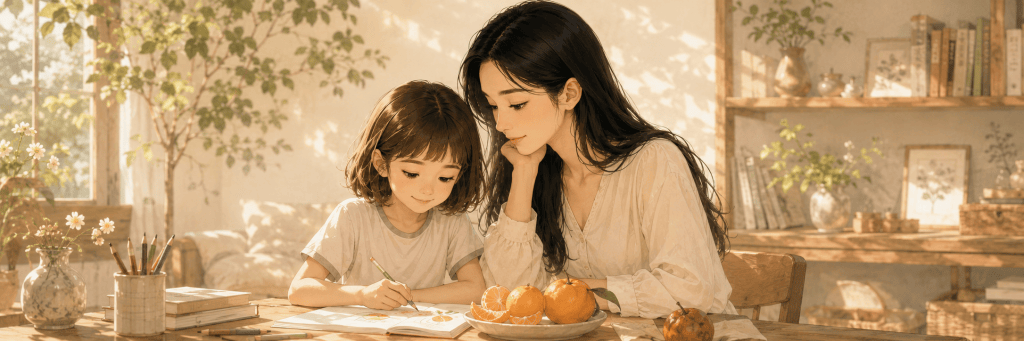
She also loves making things. Every Wednesday she goes to a youth center near our home, where Wednesday happens to be a girls’ day. She paints the staff members’ faces, does their nails, puts makeup on them, and the adults are quite happy to let her experiment. Once, she even came home carrying a self-portrait she had painted there.
Today she asked me in the supermarket what kind of cake I wanted. She bought a cake mix, then found the milk, butter, and everything else she needed, made the cake herself, and brought it home. Later that evening, she pulled out some yarn and a crochet hook and announced that she was going to make something. Somewhere along the way, the original plan changed completely, and whatever she had meant to make somehow turned into a headband.
She put it on her head, struck poses, made silly faces at her father and me, and had us both laughing. I told her it actually looked pretty good and that she could even wear it to school the next day.
She was delighted.
What struck me was that this kind of happiness was difficult to explain in terms of “getting” something. I had not bought her anything new, and no teacher had given her a good grade. She had simply taken a ball of yarn and, without a correct answer, without anyone assessing her, and without even knowing at the beginning what the final result would be, made something that had not existed before.
Later I thought that perhaps this kind of happiness contains one very simple thought:
I made this myself.
Not long ago, her father took her to visit a friend. That friend has a thirteen-year-old daughter, four years older than Alicia, but the two of them immediately got along because they both love drawing and making things. Usually, when adults visit friends and there is no child Alicia connects with, she gets bored after a while, comes looking for her father, and starts asking when they are leaving. That evening was completely different. She and the older girl spent almost the entire time in the kitchen drawing, making things, and talking, and barely bothered the adults at all.
For those few hours, the four-year age difference seemed almost irrelevant. Alicia had found someone who shared her interests. No adult needed to design an activity for them or tell them how to spend the evening. Give them some paper, pens, and materials to work with, and the hours passed naturally.
What surprised me even more was what Alicia said when she came home that night. She told me that one day she wanted to make toys herself, make toys for children, and work together with people who shared the same interests.
Of course, a nine-year-old does not need to know what profession she will eventually choose, and this idea may change many times. Still, I found it fascinating, because through something she genuinely enjoyed doing, she had already begun to glimpse a possible future.
It was only later that I realized this may be one of the most valuable things about free exploration. It does not necessarily produce a skill that can immediately be written on a report card, but it gradually helps a child answer much deeper questions: What do I actually like? What am I willing to spend my time on? What kind of people do I feel comfortable around? And what kind of person might I want to become?
I once wrote an essay called An Interesting Soul Also Needs a Childhood Full of Exploration. Thinking about that title again today, I realized that the word “exploration” has become even more important to me than it was when I first wrote it.
A child lies on the ground watching ants carry food back to their nest, sits quietly watching leaves fall, picks up a chestnut under a tree and cracks it open with a shoe to see what is inside. A child builds with Lego, then halfway through decides to try a completely different structure. They pick up a pencil and start drawing without knowing what the picture will become. A group of children runs outside and invents a set of rules that makes sense only to them.
Most of these things have no obvious purpose.
A child does not watch ants while thinking, “Today I am developing my observational skills.” Nor do they crack open a chestnut while wondering whether the experience might one day belong on a résumé.
They stop simply because something has caught their attention.
The older I get, the more I think this is one of the most important parts of childhood. In those hours that adults often regard as producing “nothing,” children are slowly learning about the world and, just as importantly, about themselves. They discover what makes them curious, what kind of people they enjoy being with, and which activities can hold their attention for hours without feeling boring. Through arguments and reconciliation with friends, they learn about relationships. Through trying, failing, and trying again, they discover that an idea in their head can sometimes become something real in their hands.
All of that is learning too.
It simply does not come with a test or a grade.
And yet we increasingly narrow the word “learning” down to something much more specific: sitting at a desk, doing exercises, correcting mistakes, taking tests, and then repeating the cycle. In highly competitive education systems, children go to school during the week, come home to homework, spend weekends moving from one extra class to another, and discover that school holidays are often little more than a change of location for more studying.
Parents have their reasons. Everyone is afraid that if their child slows down, someone else will keep running and leave them behind.
I do not believe that all children dislike academic learning. Some genuinely love mathematics and can spend a long time thinking about a difficult problem. Some are fascinated by history, programming, or science. Those interests are completely real. But “liking to learn” and “liking to be made to complete endless exercises” are not the same thing. For most children, free play, physical movement, friendships, and time spent on things they genuinely enjoy are also natural parts of childhood.
I get anxious too.
Alicia is now in fourth grade, and before long we will have to make decisions about which type of secondary school she will attend. Her grades last term were not especially strong, and based on those results alone, she would not be comfortably on track for a Gymnasium, Germany’s academically oriented secondary school.
What frustrates me is that I know she is capable of the work.
She learns quickly, especially when something genuinely interests her. Her problems often lie in tiny details during tests: copying one letter incorrectly, forgetting a capital letter, overlooking some small rule. Half a point disappears here, another half point there, and by the end of a test, something she actually understood has quietly lost enough points to affect the final grade.
As a Chinese mother, I find it very easy to fall into that particular kind of frustration: she can do this, so why should she lose out because of details like these?
I start wondering whether she should practise a little more Chinese every day, whether we should make sure her English does not slip, whether we need to work specifically on those half-point mistakes in German and mathematics.
Her father also wants her to keep as many options open as possible. He once told her that if she grows up with the ability to attend university, study a profession, and choose from different paths, but ultimately decides to work at Burger King making burgers because that is genuinely the life she enjoys, he would not be disappointed. That would be her choice.
What he does not want is for her to reach adulthood without having developed enough skills or qualifications, and then end up in a job she does not want simply because no other choice is available to her.
I agree with him.
One of the most important purposes of education should be to expand a person’s future choices, not to decide in advance which choice that person must eventually make.
But that is exactly where the difficulty begins.
How much of a child’s present are we allowed to take away in the name of preserving her future choices?
I come home and ask whether she has finished her homework. I wonder whether she should read a little more Chinese, whether we should keep her English going, and whether those small mistakes in maths and German need more practice. Yet sometimes I see her sitting there with a ball of yarn, or hear the children playing downstairs and watch her rush out the door, and I think: these things are not disposable leftovers that can simply be sacrificed once “real learning” begins. They may matter far more than we realize.
Because I was also a child who loved making things.
I liked cooking. I liked making clothes and doing all kinds of handwork. Nobody formally taught me. I simply watched my mother and secretly learned by copying what she did. I became very good at sewing by hand. My stitches were not literally as perfect as a sewing machine, of course, but they were very neat, and I could sit quietly sewing for hours.
Years later, my former partner once took a photo of me after I had taken down the curtains in our home and started altering and sewing them myself. I had been sitting there for half the day when he laughed and said I looked like an old grandmother bent over her sewing.
But when I was a child, my mother did not allow me to do these things.
She thought they distracted me from school, so I had to do them secretly. If she caught me, I was scolded, and sometimes she would even take apart things I had already made. Her expectation was actually very simple: there would be plenty of time for all of this later. For now, I should forget everything else and concentrate on studying.
From the perspective of many parents of her generation, that way of thinking was not difficult to understand. If a child did not do these things at nine, she could do them at nineteen. If nineteen was too busy because of university, then surely twenty-nine would be different. By then she would have money, a home of her own, and enough freedom to do whatever she liked.
What I eventually found so sad was that by the time I really grew up, when nobody could stop me anymore, when I had the money to buy materials and the freedom to do these things whenever I wanted, I no longer wanted to.
The things that once could keep me absorbed for hours had lost their pull.
And it was not only sewing. For a long time, I struggled to feel genuinely interested in many things around me. I became less and less certain about what could actually make me happy, and it became difficult even to explain what “being happy” was supposed to feel like.
It was only much later, when writing slowly became part of my life, that I began to recover a little of that old feeling. I could think for myself, organize something in my own way, start with nothing, and eventually leave behind a piece of writing that had not existed before.
On the surface, writing is completely different from sewing clothes as a child. But underneath, the feeling is surprisingly similar: making something yourself, creating something from nothing, and being allowed to remain for a while in a place where there is no single correct answer.
Over the past few years, I have begun to understand that interest is not money in a bank account.
If a child is not allowed to do something at nine, that interest does not automatically sit there untouched until she is twenty-nine, waiting to be returned in full once the circumstances are finally right.
Childhood does not work that way either.
Some things belong to a particular time in life.
That thought always brings me back to my grandmother.
My grandmother grew up in a period of real material scarcity. Whenever there were oranges at home, she could never bring herself to eat the good ones first. When they were fresh, she would think it was a shame to eat something so nice right away. Better to save it for later.
But oranges do not wait forever.
Eventually one would begin to rot. She could not bear to throw it away, so she would cut off the bad part and eat the rest. By the time she had finished that orange, another one nearby might already have started to spoil.
And so something absurd happened again and again throughout my childhood: the person who was most reluctant to eat the good oranges ended up constantly eating the ones that were already beginning to go bad.
It was not because she did not like good things.
It was precisely because she valued them so much that she could never bring herself to enjoy them now.
The older I become, the more this habit reminds me of a very familiar way of thinking in Chinese culture: xian ku hou tian¹ — first bitterness, then sweetness.
There is another saying many Chinese children grow up hearing: chi de ku zhong ku, fang wei ren shang ren². Roughly speaking, it means that only those who endure the hardest suffering can rise above others.
So childhood is not the time to play. First, study hard. Once you get into a good university, things will get better.
At university, do not think too much about enjoying yourself. First, find a good job.
Once you start working, save money and buy a home. When life is stable, then you can relax.
But then there is the mortgage. Then marriage. Then children. Perhaps things will be easier once the children are older. Perhaps after retirement.
Life keeps being pushed one station further into the future, and at every stage there is a perfectly reasonable explanation for why this is still not the moment to eat the good orange.
I am not against delayed gratification.
Nobody can have everything immediately. Adults have responsibilities, and children also need to learn that they cannot always do only what they enjoy. They need persistence and they need to understand that many worthwhile things require long-term effort.
But delaying gratification and delaying life are not the same thing.
The first usually has a clear purpose and a boundary. I spend less money today because there is something important I want to achieve two years from now.
The second can slowly become a habit: no matter which stage of life I reach, I never quite allow myself to enjoy the present because there is always something more important waiting in the future.
The problem is that some kinds of sweetness also have an expiry date.
Oranges go bad.
A nine-year-old afternoon passes too.
The curiosity that allows a nine-year-old to crouch on the ground and study an insect for half an hour may not simply wait patiently until she is twenty-nine. The joy she feels today while crocheting something without knowing what it will become, then putting the strange result on her head and making silly faces, cannot necessarily be stored intact for twenty years just because adults tell her, “There will be plenty of time for that later.”
Even the ability to feel joy may be something that has to grow through practice.
For a long time, I believed that once a person’s circumstances improved, happiness would naturally follow. Eventually I realized it was not that simple.
If someone grows up mostly completing tasks, checking what is still not good enough, and thinking constantly about the next standard they are supposed to meet, but rarely gets the chance to notice what they actually enjoy, then one day, even when nobody is telling them what to do anymore, they may still have no idea how they want to live.
People often ask why children today have so much materially and yet still seem unhappy.
I do not think the answer can simply be, “They have too much, so they do not appreciate anything.”
Many children today do receive material things far more easily than previous generations did. Their meals are prepared, their clothes are bought for them, parents try to give them the foods they like, and if the family can afford it, toys, electronics, and entertainment are often provided generously.
But at the same time, children may not have gained more control over their own lives.
Adults decide when they get up, when they study, what they do on weekends, which classes they attend during school holidays, and eventually which schools they should aim for.
Sometimes I wonder whether what many children are missing is not an earlier or more detailed “career plan,” but enough opportunities to get to know themselves.
From primary school through secondary school, the route they take, what they study, which activities fill their weekends, and even what they eventually choose at university may all be repeatedly evaluated and decided by adults around them. Then, when they finally reach the point where they are expected to make their own choices, some suddenly realize that they know how to get a good grade but do not know what they actually like or what kind of life they want.
Those answers cannot simply be invented while sitting at a desk.
They often emerge from experiences that looked pointless at the time: drawing, making things, playing sports, reading, talking to different people, joining activities, failing at something, and trying again. A child needs to encounter enough of the world before she can slowly discover what she wants to move toward and what she wants to move away from.
Parents often say, “You do not need to worry about anything else. Your only job is to study.”
It sounds as though we are freeing children from every burden.
But a child is not a guest staying in a hotel.
She needs to participate in her own life. She needs to do some things for herself, experience consequences, and discover that happiness is not always something adults buy, arrange, and place in front of her. It is also something she can create.
If parents provide everything materially while parents and schools make most of the important decisions, a strange contradiction can emerge: the child appears to lack nothing, yet very little of her life truly belongs to her.
At the same time, today’s parents are exhausted too.
Economic slowdown, layoffs, salary cuts, the “996” work culture³, and uncertainty about the future leave many adults under enormous pressure themselves. The less controllable the future feels, the more tightly people tend to hold on to the things that still appear controllable. In many Chinese families, children’s grades, educational qualifications, and school placements are among the things parents find hardest to loosen their grip on.
I once had a customer in Beijing who told me something similar. He knew perfectly well that his child was exhausted from being sent from one extra class to another during school holidays, but he said, “I have no choice.”
What he was really afraid of was this: if everyone else keeps running and his child slows down, then ten years later it will still be his child who pays the price.
I understand that anxiety completely, because I fall into it myself sometimes.
But I increasingly think we need to keep reminding ourselves that preparing children for the future cannot mean mortgaging their entire present.
A child does need to study and develop skills. She needs to learn that the world will not always run according to her preferences. She needs self-discipline, responsibility, and the ability to face difficulty.
But she also needs afternoons that genuinely belong to her.
She needs friends. She needs time to run until she is sweaty. She should be allowed to spend some hours on things that appear useless to adults.
She can draw a picture that will never make money. She can crochet something crooked. She can bake a cake that does not turn out especially well. She can spend time examining a chestnut on the ground, or argue with a friend over something trivial and then work out for herself what to do next.
None of these things seems to have much to do with getting into a good school.
And yet they are quietly telling her something important:
The world is not only testing me.
I can touch it too. I can explore it. I can change a little piece of it. And somewhere inside it, I may find things I genuinely love.
Children do not usually sit around searching for the “meaning of life.” They do not even know what that phrase means.
They simply explore, without a clear purpose, and little by little discover that the world contains all sorts of interesting things and that they themselves are capable of caring deeply about some of them.
Perhaps this is what we most need to preserve for children.
Not a promise that they will never suffer. That would be impossible.
Not permission to avoid every difficulty, because life inevitably includes responsibility, disappointment, and things that simply have to be done.
What matters may be something much simpler: that while growing up, they have genuinely experienced what joy feels like; that they know what it is like to become absorbed in something they love; and that they have some sense of how to live when nobody is evaluating them.
Then one day, when work exhausts them, when a relationship falls apart, or when life temporarily loses direction, they may still remember that life is not only about grades, salary, property, or what other people think of them.
They once genuinely liked being in this world.
And they know something about how to find their way back into it.
Because the good oranges do not all have to be saved for later.
Some sweetness should be tasted while it is still sweet.
Notes
1. Xiān kǔ hòu tián (先苦后甜) — Literally, “bitterness first, sweetness later.” It is a widely used Chinese expression built around the idea that hardship, restraint, and effort should come first, while comfort and enjoyment are postponed until later. In everyday family and educational contexts, it is often used to encourage children and young people to endure present difficulty for a better future.
2. Chī de kǔ zhōng kǔ, fāng wéi rén shàng rén (吃得苦中苦,方为人上人) — Literally, “Only by enduring the bitterest of bitterness can one become a person above others.” The saying reflects a traditional belief that exceptional achievement, upward mobility, or social success requires extraordinary endurance and sacrifice. Today it can still be heard in conversations about education, work, ambition, and perseverance, although attitudes toward this ideal are increasingly mixed.
3. 996 (九九六) — A shorthand for a work schedule of 9 a.m. to 9 p.m., six days a week. The term became widely used in China to describe extremely long working hours, especially in parts of the technology and private-sector economy, and has since become closely associated with debates about overwork, burnout, and work-life balance.
This essay is also available in other languages:
Chinese version: 我们总说先苦后甜,可有些甜也是有保质期的
German version: Wir sagen immer: Erst das Bittere, dann das Süße – doch manches Süße hat ein Verfallsdatum


Leave a Reply