By Jane Sonnenschein · August 10, 2026
Last night, I did a trial shift at a restaurant.
Upstairs, there were two tables of Chinese guests—one table of adults and one of children. The adults were around my age. Many of them, like me, had come to Germany more than twenty years ago.
They were eating hot pot and chatting about their businesses, e-commerce, and people they knew. I even recognized some of the names they mentioned. Quite a few people from our generation who came to Germany later went into e-commerce, opened shops, or started businesses of their own. Some of those companies gradually grew quite large.
As I worked and listened to them talk, I suddenly felt a little sad.
It was not because they were sitting there eating while I was standing there serving them.
I do not think there is anything shameful about working as a server.
What really hurt was that I suddenly thought back to more than twenty years ago.
Back then, we all seemed more or less the same. We were young people who had come to a foreign country to study. Our German was not particularly good, and none of us really knew what the future would look like.
More than twenty years later, when I look back, I realize how completely different our paths have become.
I, too, ran a business. I had my own company, and for a long time I thought my life would simply continue along that road. But then my marriage fell apart, and the things that had once been held up by two people fell apart with it.
Later, I started over again, only to have a business partner cheat me and disappear, leaving me with a terrible mess. I ended up deeply in debt, and the tax problems that followed have still not been fully resolved. On top of that, someone in my family was hit hard by COVID twice and eventually became unable to work.
I have taken many detours over the years.
And now, after all of that, I am working for someone else again.
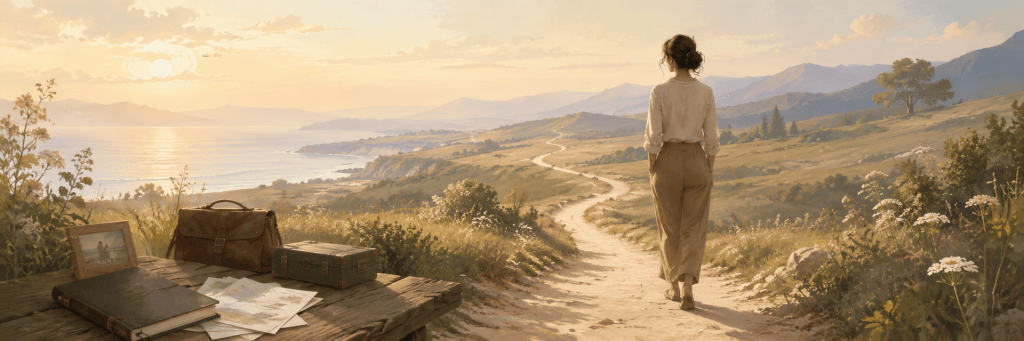
When you reach your forties, perhaps there are moments when, without warning, you suddenly turn around and look at the road you have travelled.
Last night was one of those moments.
When I got home, Chris asked me how work had been.
I told him it had been very quiet. Then I told him about the two tables of Chinese guests and about what I had felt while standing there.
I asked him, “When you look back at your life, do you ever wonder how we ended up where we are today?”
He did not try to comfort me.
He simply said that sometimes, when he thought about everything he had experienced in his own life, he found it almost unbelievable too. Some of those experiences, he said, were things many people might never encounter in an entire lifetime.
Then he started talking about the years when he worked on military training rotations at U.S. Army bases.
We had both done that work.
A “rotation” was essentially a large-scale field exercise designed to prepare U.S. and NATO troops for deployment. We worked as role players, acting as local villagers, civilians, interpreters, casualties, and people in all kinds of simulated situations. The scenarios changed depending on where the troops might later be deployed.
Kosovo was only one of them.
The Kosovo exercises focused more on urban situations—riots, demonstrations, roadblocks, and confrontations with crowds. When Chris worked as an interpreter, he would sometimes travel with the soldiers in their military vehicles.
Last night, he remembered one occasion when a soldier lit a cigar for him.
Even now, when he tells that story, he still thinks he looked incredibly cool.
One of the rotations I remember most clearly was based on Afghanistan.
It was a snowy winter night.
We were playing a group of civilians whose car had broken down on the road. In ordinary life, there would have been nothing unusual about that situation. But in the context of Afghanistan at the time, a stopped car and several people waiting by the roadside were not a simple problem for soldiers passing through.
The people might genuinely need help.
Or they might be bait.
Armed fighters could be hiding nearby. There could be an explosive device concealed somewhere.
Different units reacted to us in very different ways. Some rushed in quickly to help but failed to maintain enough security, and in the simulated attack that followed, they were quickly “wiped out.” Others put safety first and refused to approach for a long time, which exposed a different set of problems.
We stayed in the same scenario and went through it again and again with different units.
Whenever a simulated firefight broke out, we would hide inside the armored vehicles. They were using blank ammunition, but hearing gunfire from such close range was still incredibly intense.
On another exercise, I even flew in a U.S. military helicopter.
Talking about these things last night, I suddenly realized that many experiences I had pushed into some forgotten corner of my memory really were not things everyone gets to live through.
Chris and I had both worked on rotations, but we actually spent very little time working there together.
I had started doing the job much earlier and continued on and off for many years. Later, when my company became busier, I stopped going.
Chris started working there later than I did.
After my divorce, I applied for rotation work again.
That was the time I met him.
Later we got together, I became pregnant, I found other work, and I never went back again.
So if you looked only at the timeline of that job, our lives were almost like two lines that ran separately for a long time and crossed only briefly in the middle.
Sometimes when I think about it, life feels very strange.
It almost feels as though I returned to that job one last time, after having been away for so long, simply so that I could meet someone there. Once we met, that job disappeared from my life.
Of course, that is only how it feels when I look back now.
When we are young, we do not know what the ordinary day we are living through might one day come to mean.
Last night, our conversation moved from those rotations to the job Chris later had at DHL’s airport cargo hub.
And that was when I realized, perhaps for the first time, just how much he had loved that job.
He had told me before.
He had talked about standing beneath enormous cargo planes wearing a headset and communicating directly with the pilots in the cockpit. He had told me what it felt like to stand beneath an aircraft that large and coordinate ground operations according to strict procedures.
But when he told me those things in the past, they did not mean much to me.
I know nothing about airplanes, and I never really understood why someone would feel so excited simply standing underneath a huge aircraft.
Last night, I finally began to understand.
It was not only the airplanes that he loved.
It was a job that suited him.
His English is very good, and he is good at communicating with all kinds of people. The pilots at the airport came from many different countries and spoke with all kinds of accents. Sometimes other people struggled to understand them, while he managed quite well. He also knows bits and pieces of several European languages—sometimes only a few sentences—but even those could occasionally be useful in conversation.
He once told me about two pilots who were speaking Spanish to each other in the cockpit, assuming that the person below could not understand them.
Then he suddenly answered them with a few words of Spanish.
They were completely taken aback.
Years later, he still finds that story funny.
More importantly, at the time, he could already see where his career might go next.
From Ramp 1 to Ramp 2, gaining qualifications to operate more equipment, then learning pushback procedures. From there, he could eventually apply to become a supervisor or move into training.
His trainer thought highly of him. With his language skills and previous work experience, training other people was certainly something he could have done.
But large companies have their own rules.
Ability is one thing. Seniority and formal qualifications are another.
He had not been at DHL long enough, and because there were certain roles he had not yet done, he could not simply skip ahead.
Still, there was a road in front of him.
He knew what the next step was.
Then, suddenly, he developed severe vertigo.
One day, the entire room began spinning around him. He even thought he might be having a stroke. An ambulance took him to the hospital, where they ran all kinds of tests, but no clear cause was ever found.
Because of the vertigo, it was no longer safe for him to do certain jobs that involved working at height or operating equipment. For a while, he was mainly assigned to headset duties.
And he happened to be very good at them.
Even his manager asked whether he might be allowed to do headset work exclusively.
But DHL did not have a standalone position like that. People who worked on headset usually also had to do other ground-handling tasks or hold additional qualifications such as pushback.
For a large company, the priority is the efficiency of the whole job structure. It is not going to create an entirely new position simply because one person happens to be especially well suited to one part of an existing role.
Later, his health gradually improved, and he was preparing to return to his original loading group.
Then we got COVID.
His post-COVID symptoms were severe.
Even walking a short distance left him breathless.
The physical work he had once been able to do was no longer possible.
The career path that had once been so clearly visible in front of him ended there.
Listening to him talk about it last night, I realized how much he still regrets that loss.
He said that just thinking about those days might keep him awake that night.
I did not cry when he said it.
By the time we finished talking, it was already late. I was tired, and I went to sleep.
It was only today, when I started thinking about our conversation again, that I suddenly began to cry while writing.
More than once.
And only then did I realize that last night, he had not been trying to comfort me at all.
Seeing those people my own age had made me turn around and look at my life.
And the question I asked him had made him turn around and look at his.
The things we regret are not the same.
But the feeling behind them somehow is.
It is the feeling of reaching middle age and suddenly seeing a road that once existed in front of you, but that you never got to keep walking.
I wonder what my life might look like today if my marriage had not fallen apart, if the business we once built together had continued.
And perhaps he wonders what would have happened if he had never developed vertigo, if he had never suffered so badly from COVID, if his body had allowed him to continue.
Would he have reached Ramp 2?
Would he have learned pushback?
Would he eventually have become a supervisor or a trainer?
No one knows.
We do not get to live our lives twice.
And that is why some regrets will never have an answer.
But last night, Chris said something else.
He said, “If you really love writing, then haven’t all the things you have been through become part of what you write about?”
It was only today that those words slowly began to mean something to me.
When we judge a life, we are used to looking for things that can be measured.
Income. Job titles. Houses. Companies. Social status.
These things are clear. They are easy to compare.
So when I stood there last night listening to people my own age talk about business, it was natural for me to feel that gap.
By those standards, some people’s lives seem to have followed a clear and successful path, while mine has taken far too many detours.
But there are many other things that cannot be measured that way.
On a snowy night, I once sat in a car in a simulated Afghan conflict zone, waiting to see whether one military unit after another would decide to rescue us.
I have heard blank gunfire at close range.
I have flown in a military helicopter.
In my twenties, I came to Germany alone to study. I arrived at Jena Central Station at midnight with no one waiting for me, dragging thirty kilograms of luggage around while barely able to speak the language, trying to find somewhere to stay.
I have run a business and owned a company.
I have made money, and I have lost money.
I have lived through the beginning and end of a marriage. I have watched a business grow and then fall apart. And I have been through things that I can only now, looking back, begin to understand.
None of those experiences gave me a more impressive job title.
They did not automatically turn into wealth.
If life came with a report card based only on conventional measures of success, most of them would probably be impossible to score.
But they happened.
And they became part of who I am.
I do not want to say that everything happens for a reason, or that every painful experience eventually becomes a gift.
If I could choose again, there are things I would absolutely wish had never happened.
There are detours I would rather never have taken.
But now that my life has reached this point, I am beginning to see that perhaps the past cannot be understood only through the categories of “success” and “failure.”
Especially if I truly love writing.
Writing seems to give me a chance to return to those experiences and slowly understand things I could not understand at the time.
Like last night.
Chris had told me many of those stories before.
But it was only last night that I truly understood for the first time why he missed the feeling of standing beneath that enormous airplane.
And it was only today, when I began telling the story again, that I suddenly understood how much sadness he had been carrying when he spoke about those years.
It is strange.
Sometimes, when something happens, we do not know what it means.
Sometimes, when we first hear someone say something, we are not yet able to truly understand it.
We have to live for many more years and experience many other things before, one day, we look back and suddenly understand.
Perhaps that is one of the most extraordinary things about life.
Last night, because of two tables of guests in a restaurant, I happened to turn around and look at the road I had travelled.
I did not expect that one glance backward would also make the person beside me turn around and look at his own.
And today, as I write all of this down again, I suddenly feel that the experiences that never became job titles, wealth, or social status did not disappear.
They have simply been there all along.
Waiting for the day when we are finally able to understand them.
This essay is also available in other languages:
Chinese version: 那些没有写进人生成绩单里的东西,终有一天,会成为你人生里无法替代的经历
German version: Die Dinge, die nie auf dem Zeugnis deines Lebens standen, werden eines Tages zu unersetzlichen Erfahrungen


Leave a Reply