By Jane Sonnenschein · August 12, 2026
“Some things are up to us, and some things are not.” — Epictetus
A few days ago, a stranger sent me a private message on Instagram asking how I made my AI character dialogue videos.
She did not follow my account or like the video. She simply messaged me to ask how it was made. I could easily have ignored a message like that. On Instagram, you have to accept a message request from a stranger before the conversation can continue. I also do not think that someone who watches my video somehow owes me a follow. But if I were the one approaching a complete stranger to ask how they did something, I would probably at least follow them first, or say thank you after getting an answer. It is not about exchanging favors. It is just a very ordinary kind of courtesy between people.
In the end, I replied anyway.
I told her that I mainly used Jimeng and Jianying. She then asked what she was supposed to do, since they were Chinese apps and not very convenient for her to use in Germany.
At first, I simply found it a little annoying. The process of making this kind of video cannot really be explained in a few messages, and I was obviously not going to give a complete stranger a free step-by-step tutorial through Instagram DMs.
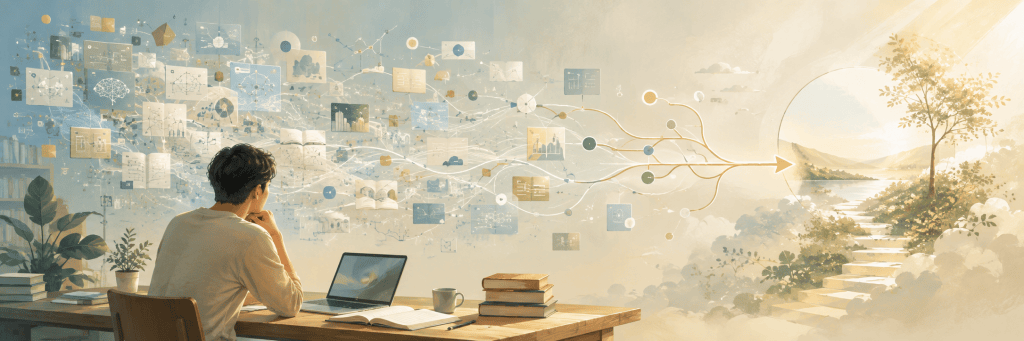
But then I realized that the interesting part was not whether she had been polite, or even whether I found her questions annoying. What interested me was something else: in an age like ours, if someone genuinely wants to learn how to make a certain kind of AI video, why is the first instinct still to keep asking a stranger, “What do I do next?” instead of first thinking about what problem they are actually trying to solve?
When I told her that I used Jimeng and Jianying, I was only telling her my solution.
My solution might not be right for her.
I am Chinese. I speak Chinese, and I am familiar with the Chinese software environment. If I do not know how to do something, I can search for tutorials on Bilibili (a major Chinese video platform with strong creator and community features, often loosely compared to YouTube), Xiaohongshu (a Chinese lifestyle and social platform combining elements sometimes compared to Instagram and Pinterest), or other Chinese platforms. How to buy a subscription, where a function is located, how other people use it — none of those things creates much of a language barrier for me.
But she lives in Germany. She does not speak Chinese, and she is unfamiliar with Chinese software ecosystems.
So perhaps the real questions she needed to ask were not, “Which apps does Jane use?” but:
What kind of video am I actually trying to make?
What steps are involved?
Which programs can perform those functions?
Are there tools that are better suited to German- or English-speaking users?
If a piece of software keeps creating obstacles because of language, region, payment methods, or the way it is designed to be used, do I really need to keep struggling with it, or should I find another route?
Once those questions become clear, the whole problem changes.
What she actually wants to make is an AI character dialogue video. Whether she ends up using Jimeng, Jianying, or several international tools is only one possible route to that goal.
It reminded me of the way I have always learned new things.
Before AI existed, if I needed to deal with some procedure I had never handled before, I would search online forums for posts written by people who had already been through it. If it was a visa, an administrative issue, or something similar, I would save useful information and come back to it when I needed it.
Later, when I started making books for KDP, I knew nothing about that either. So I found a detailed video on Bilibili showing the entire process of creating, formatting, and uploading a book. I saved it, and whenever I reached a step I did not understand, I went back and watched that part again.
Of course I was not born knowing how to do any of these things.
I have simply always had a fairly natural reaction to not knowing something:
If I do not know how to do it, I go and find out how.
Today, with AI, that should actually be much easier than it used to be.
Someone who has no idea how to make an AI character dialogue video does not even need to know the name of a single program at the beginning. They could simply ask an AI:
“I want to make short videos with two consistent characters talking to each other. I have no experience. Can you break down the whole process into steps?”
Of course, not every detail an AI gives will be accurate, and software changes constantly. But at the very least, it can help someone draw a basic map: generating characters, keeping them visually consistent, animating still images, adding voices, lip-syncing, editing, subtitles, and so on.
A huge question like “How do people make videos like this?” suddenly becomes several smaller problems that can be solved one by one.
And the more I think about it, the more I feel that this may be one of the most important abilities in the age of AI.
It is not about memorizing the names of dozens of AI tools, or collecting hundreds of supposedly “perfect prompts.”
It is about knowing how to learn.
For a while, prompt tutorials were everywhere online. Many people seemed to believe that if you could just find a sufficiently clever prompt, AI would suddenly understand you perfectly, write amazing articles, generate stunning images, or even complete an entire project for you.
But after actually using AI over a long period of time, I have become less and less convinced by that idea.
In May last year, I started experimenting with AI to create trilingual coloring books and joke books. At the beginning, like many people, I thought the key to producing an image I truly liked must be finding some magical, highly sophisticated prompt.
I saved quite a few prompts that other people had shared online. I thought that perhaps if I learned how to use the right words, AI would simply start producing extraordinary results on its own.
Over time, however, I realized that what really mattered was not some magical prompt.
It was whether I knew what I wanted.
What kind of visual style did I want — soft and comforting, or closer to realism?
How old should the character be? What kind of personality should they convey? What expression should they have?
If the same characters appeared throughout a series, how consistent did they need to remain?
Should the scenes feel bright and light, or calmer and more restrained?
What kind of overall feeling did I want the entire book to have from beginning to end?
If the creator does not know the answers to these questions, AI can certainly generate a large number of attractive-looking images. But those images may not really feel like the creator’s own work, and they may not come together as a coherent whole.
The more I used AI, the more I came to feel that it can be a tool, but it cannot replace human thought.
If someone already has a visual imagination, ideas, and something they genuinely want to express, but simply lacks the ability to draw, AI can indeed help bring what is in their mind into visible form much more quickly. It can carry out ideas, help test different directions, and create visual effects that might otherwise have been impossible for that person to produce.
But AI cannot decide for you what kind of work you actually want to create.
If that decision does not come from you, then whatever comes out in the end will often struggle to have a real sense of soul.
A good workflow rarely exists from the beginning either. Most of the time, it grows slowly through repeated trial and error.
Why did a character’s appearance keep changing? Eventually I realized that I needed to define the character’s basic features much more clearly from the start.
Why did several images in the same series look as if they belonged to completely different stories? Gradually I understood that the atmosphere, clothing, hairstyle, facial features, lighting, and other visual elements all needed a certain degree of consistency.
And sometimes the direction was already wrong at the very beginning. If I did not stop and rethink it early enough, everything that followed only became more chaotic.
Many of these rules were not things someone taught me in advance. I worked them out little by little through using the tools myself.
Looking back now, I think what mattered was never whether I had learned a few brilliant prompts. What mattered was whether, through using AI, I was gradually developing my own judgment, my own sense of aesthetics, and a way of working that suited me better and better.
These may all sound like very small things.
But if a small problem stops repeating itself the next time, then it is no longer just a problem that happened to be solved once. It has become part of a workflow.
The more I think about learning, the more I feel that this is what it really looks like: an experience should not only solve one problem once. Whenever possible, it should become a method that can be used again the next time.
Reading works in much the same way.
Today, many people measure how much they have learned by how many books they have read in a year. But reading a hundred books does not, by itself, mean very much. Before reading, it may be worth asking one simple question:
Why am I reading this?
If I am reading simply to relax, then a novel that gives me a pleasant evening has already done its job.
If I want to improve my literary sensibility, I may pay more attention to language, structure, and characterization.
If I am reading to learn about time management, writing, or some particular area of knowledge, then what matters is what I actually take from the book and whether any of it finds its way into my life.
Different goals require different information.
What is scarce today is no longer information.
Quite the opposite. We are surrounded by too much of it.
In the past, if someone wanted to learn a craft, they might have had no choice but to become an apprentice to a single master. How much the master was willing to teach, and when he was willing to teach it, could determine how much the apprentice ever learned. Knowledge was tightly limited by time, place, and personal relationships.
Today, the situation is completely different.
Google, YouTube, Bilibili, forums, online courses, AI — every one of them can give us an enormous amount of information almost instantly.
The problem has changed from:
“I cannot find the knowledge.”
to:
“Out of all this, what do I actually need?”
If someone does not know what problem they are trying to solve, and does not understand their own abilities, language, resources, and limitations, then the more information they receive, the easier it may become to lose their way.
Someone recommends ten books, so they read all ten.
Someone says a certain AI tool is amazing, so they immediately start learning it.
A few days later, another creator announces that a different tool is the future, so they switch again.
They save endless tutorials and collect hundreds of prompts, yet the thing they originally wanted to create still never gets made.
So knowing how to learn does not mean learning everything.
In fact, it begins with having a reasonably clear understanding of yourself.
What level am I at right now?
What problem am I actually trying to solve?
This method works for someone else — but does it work for me?
If I have spent two hours getting nowhere, should I keep pushing, or was the route I chose wrong from the beginning?
What do I genuinely need to learn right now, and what can I safely leave alone?
These judgments are what determine whether an ocean of information becomes a tool or simply noise.
Eventually I realized that the same logic applies not only to learning, but to almost every kind of problem in life.
When something happens, perhaps the first step should not be immediate anxiety. Perhaps the first question should be:
Is there anything I can actually do about this right now?
Some problems leave plenty of room for action.
If I want to keep writing, I can write, revise, publish, and try different ways of reaching readers. If I put a book on the market and nobody buys it, I can change the description, look for other ways to promote it, or, if I have the budget, test advertising.
But I cannot command the market to accept a book at a certain time, just as I cannot decide when a particular article will finally be noticed.
Some problems are, for the moment, entirely in someone else’s hands.
If I have already submitted the documents and someone else is investigating or processing the matter, and there is no further action I can take, then sitting there every day thinking, “Why is there still no result?” does not mean I am still solving the problem.
Very often, because our minds keep returning to something, we mistake thinking about it for doing something about it.
But we are not.
We are simply exhausting ourselves.
I increasingly think that there are three kinds of things we need to distinguish between: what we can control, what we can influence only partly, and what we cannot control at all.
What we can control, we should do.
What we can influence, we should do our part.
What we cannot control at all, at least until something changes, we have to leave where it is.
This sounds simple, almost like one of those truths everyone already knows.
Actually doing it is much harder.
I used to check my video statistics constantly, watching whether one piece of content had gained a few more views or lost a few followers. If an article had very few readers, I would start wondering whether I was going in the wrong direction. If I finished a book and it did not sell, I would keep asking myself what had gone wrong.
Slowly, I began to realize that whether one video goes viral today does not decide what will ultimately happen to an entire account. The number of people who read one article today does not determine whether a writer will have readers several years from now.
Sometimes even a suddenly viral video does not immediately change a person’s life.
So why hand over today’s mood to a number that keeps changing?
These days, I barely look at my Instagram statistics compared with before. Whether the numbers are good or bad, what I need to do has not really changed.
The writing still needs to be done.
What needs to be published still needs to be published.
Today’s life still needs to be lived.
In the end, perhaps it comes down to a very ordinary phrase: live in the present.
Not because we have finally figured everything out, but because so many questions in life simply cannot be answered today.
Whether writing eventually becomes successful depends on ability and persistence, of course, but also on the market, timing, circumstances, visibility, opportunity, and perhaps whether someone encounters a guìrén at a crucial moment.[1]
No one can arrange for all those conditions to appear at the same time.
We are especially drawn to stories of huái cái bù yù[2] because of the contrast they contain.
If an ordinary person ends up living an ordinary life, few people see it as a story worth telling for generations. But if someone was called a genius as a child, clearly gifted and full of talent, and later faded into an ordinary life — or even ended up struggling badly — people naturally ask:
“How could someone so talented end up like this?”
The story Shāng Zhòngyǒng[3] has remained memorable for so long largely because of that contrast.
But if we turn the question around, having ability does not mean that the world has signed a contract with us promising that our ability will eventually be exchanged for an equally impressive social outcome.
It can be true that I am talented.
It can also be true that I never achieve the kind of success that seems to match that talent.
And it can be true that, in the end, I simply live an ordinary life.
These things do not contradict one another.
The outcome of a life is never determined by a single variable. Ability, action, personality, health, family, financial circumstances, the era we live in, the market, our choices, relationships, and simple chance can all affect the direction a life takes at different moments.
Sometimes one missing condition is enough to change the result entirely.
Recognizing that does not have to make us passive.
It may simply make us a little less cruel to ourselves.
Not becoming successful does not automatically mean that we had no value.
And having ability does not mean that the world owes us success.
What we can do is prepare as well as we can.
If an opportunity really does appear one day, I hope that by then I will already have something in my hands, and the ability to take hold of it.
If it never appears, I do not have to spend every day asking:
“Why me?”
Most people in this world are ordinary people living ordinary lives.
If we truly accept that, perhaps it is not nearly as frightening as we imagine.
We can still work seriously. We can write, learn, raise children, cook meals, enjoy things that have no commercial value at all, and still hope that something good may happen in the future.
We simply do not have to demand that the future prove the value of today’s life through some enormous version of “success.”
Lately I have increasingly felt that when people have something concrete to do with their hands and their attention, they are less likely to spend all day thinking themselves in circles.
When work is busy, do the work well.
When you get home, cook if there is food to make, spend time with your children if they need you, write when you want to write.
And if you are tired and occasionally want to watch some sweet, unrealistic short dramas in which none of life’s ordinary troubles exist, that is not such a terrible thing either.
Many problems cannot be solved today.
And life does not have to be completely understood today.
At first, that stranger’s private message only made me think:
“Why doesn’t she just search for a tutorial on how to make this kind of video?”
By the end of all these thoughts, I realized that what I was really thinking about was something much larger.
Whether we are dealing with AI, learning, reading, work, writing, or all the unresolved things life puts in front of us, perhaps they all require the same basic ability: knowing where we are, knowing what we are trying to do, knowing what is worth spending our energy on, and knowing what, for now, has to be left alone.
Information keeps multiplying.
Our tools keep becoming more powerful.
Answers are easier to find than ever.
But in the end, the thing that still has to steer a person through all of it is their own mind.
As for the things we cannot control yet, we can leave them to time.
Life is long.
Do what can be done today.
And for what cannot be done yet, live today well first.
Notes
[1] guìrén(贵人) — Literally “a noble or important person,” but in everyday Chinese it often refers to someone whose appearance at a crucial moment brings help, opportunity, guidance, or a turning point in one’s life. The idea can carry a sense of luck, timing, or fate, and is broader than simply “mentor” or “benefactor.”
[2] huái cái bù yù(怀才不遇) — Literally, “to possess talent but fail to encounter recognition or opportunity.” It is a long-standing expression in Chinese culture for someone who has real ability or talent but never finds the circumstances, position, or people that allow that talent to be recognized.
[3] Shāng Zhòngyǒng(伤仲永) — A well-known prose piece by the Northern Song writer Wang Anshi about a child named Fang Zhongyong who showed remarkable literary talent at a very young age but eventually became ordinary after his development and education were neglected. In Chinese cultural memory, the story is often used when discussing wasted talent, lost potential, and the distance between early ability and later achievement.
This essay is also available in other languages:
Chinese version: AI时代真正稀缺的,不是答案,而是知道自己要解决什么问题
German version: Was im KI-Zeitalter wirklich knapp ist, sind nicht Antworten, sondern Klarheit darüber, welches Problem man lösen will


Leave a Reply