By Jane Sonnenschein · August 11, 2026
Over the past few days, my hometown of Linhai in Zhejiang Province has once again gone into emergency mode because of a typhoon and flooding. My parents live in the old city, very close to Wangjiang Gate and the Lingjiang River. In the days before the storm, local community workers kept coming to their door, urging them to move temporarily to an evacuation shelter.
At first, neither of them really wanted to go. Their house sits on relatively high ground for that part of the neighborhood, and they can always stay upstairs if necessary. But the workers came back again and again. No one knew exactly how severe the typhoon would become, they said, and it would be safer to leave in advance. There would be food at the shelter and somewhere to sleep.
Eventually, my parents agreed. They spent two nights at Zheshang Primary School, sleeping on the classroom floor with more than a dozen other people. Once the water had gone down, they returned home.
When I video-called them, my father told me that this time things had turned out all right. The house had not flooded the way it did in 2019.
That year, Linhai suffered an exceptionally severe flood, and the entire ground floor of our house was submerged. My childhood bedroom had been downstairs. By then I had long since left China, but many of my old school papers, books, and other things were still stored there. My father later told me that they had all been ruined by the water. The flood rose too quickly, and it happened at night. My parents simply did not have time to carry everything upstairs one by one. They had to think about their own safety first.
Strangely, neither that flood in 2019 nor hearing about another flood in my hometown now gives me the kind of shock I might expect.
It is not because floods are not dangerous. It is because I grew up with them.
For part of my childhood, I lived with my grandmother in the countryside, in the kind of detached house common in rural China. It was also close to the Lingjiang river system. One night, I woke up and found water already covering the ground floor. It kept rising, and eventually we had no choice but to go upstairs. By the next day, the entire first floor was unusable.
Back then, rural areas did not have as many embankments, pumping stations, and flood-control facilities as they do today. Once the river rose, the farmland along its banks was often the first thing to disappear under water, followed by houses in low-lying areas.
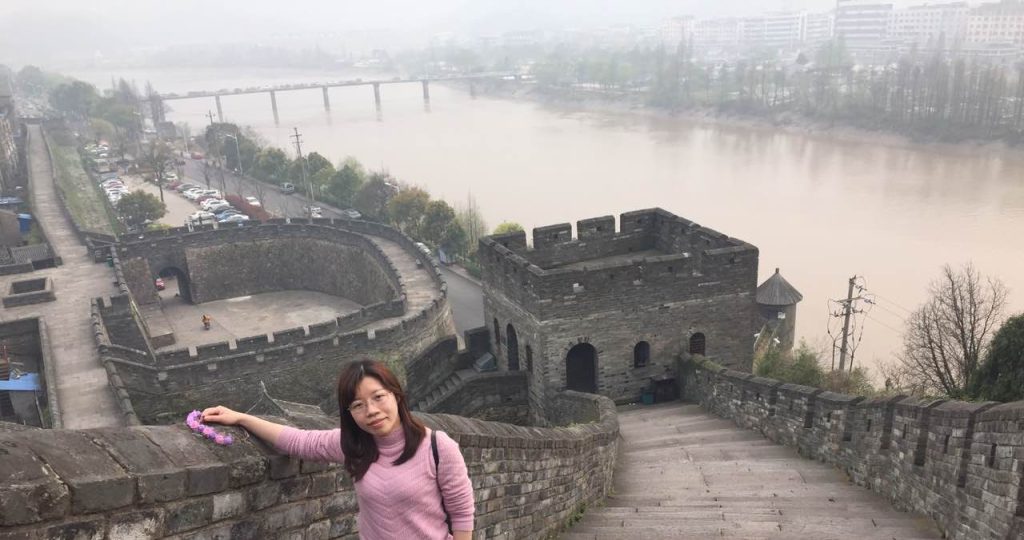
Later, after I moved back into Linhai’s old city, my memories of floods became tied to the ancient city wall and Wangjiang Gate. Our home was very close to the gate, and just outside it was the Lingjiang River.
Whenever a typhoon came and the river rose badly, we children would stand on the city wall and look down. On ordinary days, there were fields, bamboo groves, and low houses along the river. During a major flood, almost all of that vanished. There was nothing but a huge expanse of muddy yellow water stretching into the distance. It really did look like a yellow sea.
One image has stayed with me all these years. A raincoat somehow fell into the floodwater. It spun around several times in the violent current, and then it was gone.
For a child, the message was very simple: once water became powerful enough, almost anything people put in its path seemed helpless against it.
And yet, back then, I never once asked myself a basic question: Why does Linhai flood so often?
I only knew that it had something to do with the terrain. I knew that summer meant typhoons, and typhoons could mean rising water. The only real difference from year to year seemed to be whether the flood was large or small.
It was not until this time, while talking about my parents with Chris, that I began to take the question apart properly. For the first time, I started wondering why a city that has lived with flooding for more than a thousand years still has not been able to “solve” it once and for all.
Chris’s questions were very straightforward.
I told him that Linhai is surrounded by mountains on three sides and has a great deal of hilly terrain. Water flows down from the hills toward lower ground. Water from upstream also enters the Lingjiang River. During a typhoon, there may be intense local rainfall at the same time, while downstream water levels are affected by the tides.
Later, we simply opened Google Maps.
Last night, the two of us sat in front of the computer for about an hour and a half to two hours. Chris asked me exactly where our home was in Linhai, so I started searching for places one by one. The larger place names were not difficult to find, and some of them came up simply by typing their pinyin names. Slowly, we found Wangjiang Gate and Ziyang Street, and then Fuqian Street near my home. I pointed at the map and told him that our house was somewhere around there, very close to the ancient city wall and the Lingjiang River.
Then I wanted to narrow it down further and find our actual house number, but no matter what I tried, I could not get it to appear. I asked Chris whether the problem might be that we had been using pinyin, and whether entering the full address in Chinese might work better. But his computer did not have a Chinese input method at all, so he simply downloaded a Chinese language pack for Windows. Once I could finally type in Chinese, I entered our full address again. Google Maps still could not locate the exact house number.
Even though we never actually found our front door, we had already come close enough.
There was another little moment in the middle of all this that I found especially interesting.
After Chris found Wangjiang Gate, he opened the photos attached to the location. Wangjiang Gate is one of the most recognizable landmarks in Linhai’s old city, and the enormous gate and ancient wall were very clear in the pictures. As soon as he saw them, he suddenly said, “I know this place.”
At first I was a little surprised. He had never been to Linhai, so how could he possibly know Wangjiang Gate?
Then I realized why. Many years ago, I had shown him photos of myself on the ancient city wall, as well as photos of me there with my daughter and my parents. At the time, they were simply pictures from my hometown to him. He had no idea where those walls actually stood within the city. But this time, when Wangjiang Gate appeared on Google Maps in front of him, the city on the map suddenly matched the photographs in his memory.
He said that the moment he saw it, he knew this was the area where my family lived.
I found that strangely moving. Someone who had never been to Linhai was sitting thousands of kilometers away in Leipzig, Germany, and through a map he was able to place family photographs he had seen years earlier back into the real landscape where they had been taken.
After that, using satellite images and the 3D terrain view, we followed the Lingjiang downstream. We watched the river pass the ancient city and continue east toward the sea. We looked at Jinshan, the ancient city wall, the surrounding mountains, and Zheshang Primary School, where my parents had been evacuated this time.
Many things that I had previously only been able to explain in words suddenly became much easier to see. Why I always said Linhai was surrounded by mountains, why the city collected water coming from different directions, and how the city, the mountains, and the river all fit together gradually became visible on the map.
Chris found it fascinating too. He said he had never imagined that one day he could sit at a computer in Leipzig, without ever having visited my hometown, and see so clearly what the city where I grew up actually looked like. He could even follow a river he had never seen in real life all the way to the place where it eventually reached the sea.
And it was during this process that his questions became more and more specific.
We kept rotating the map, looking things up, and asking one question after another. By the time I finally looked up at the clock, it was almost four in the morning.
His first question was: if there are so many mountains around the city, why not divert the water through them?
I told him that today, this is in fact already being done. Modern engineering makes it possible to build flood-diversion tunnels through mountains and send part of the water along a different route.
He immediately asked: then why not send it straight to the sea?
At first, I did not really know how to answer. I only had the feeling that it could not be that simple.
My hometown is full of hills and mountains. Today, we drive through tunnel after tunnel, and places that once took a very long time to reach may now be only a few dozen minutes away. It is easy to forget that before those tunnels existed, a mountain was a real barrier.
When my mother was young, she once had to walk for days through mountain roads to sell sweet potatoes. My father has also told me how difficult it was to travel to Hangzhou when he was a student. On steep mountain roads, buses sometimes struggled so badly that passengers had to get out and help push.
Today, we look at a map and see that two places are only a few dozen kilometers apart. But in the past, if there were mountain ranges between them, those few dozen kilometers could mean literally climbing over mountains and crossing rivers.
So the question, “Why not just tunnel through the mountain?” is itself a very modern question.
It is not that people in the past could not imagine that there might be an outlet on the other side. The real question was whether an idea could be turned into an actual engineering project with the technology, machinery, money, and organizational capacity available at the time.
But even today, when we can dig through mountains, the problem does not end there.
Chris then asked: if the Lingjiang River is already so high that the city’s drainage system cannot discharge water into it, why not build a separate drainage tunnel and send the city’s rainwater somewhere else?
There is nothing wrong with that idea in principle. But once you follow it a little further, every “Why not?” leads to another question.
Where exactly would the water go?
If it went to the sea, the sea itself might be rising during a typhoon because of storm surge and high tide. If the water level at the outlet became too high, gravity drainage would stop working properly. You would then need tidal gates and powerful pumping stations.
How long and how wide would the tunnel have to be? How much water would it need to carry every second? What level of extreme rainfall should it be designed for? And what happens if the next storm produces more water than the system was designed to handle?
Water does not disappear just because we give it another route.
All engineering can really do is change where the water goes, how quickly it gets there, and when it passes through.
Something my father told me this time made that complexity much more concrete.
Linhai’s old city already has a wall, and in the past the city gates were closed whenever the river rose. I remember that very clearly from childhood. The gates would be shut, but the water could still come into the city very quickly. The catastrophic flood of 2019 made it even more obvious that under extreme conditions, simply closing the gates was not enough.
This time, the city had clearly learned from past experience. My father told me that the main gates had been reinforced with large numbers of sandbags together with flood barriers, so the water from the Lingjiang River did not pour directly into the old city the way it had before.
But once the outside water was successfully kept out, another problem became more visible.
The typhoon brought intense rainfall over a short period of time. Normally, rainwater from inside the city would drain outward. But the Lingjiang River was already extremely high, so the normal difference in water level between the city and the river was gone. In some places there could be backflow; in others, the drainage outlets could no longer release water naturally. Large amounts of rainwater then accumulated inside the city and had to be pumped out mechanically.
In other words, after one weakness exposed by the 2019 flood had been strengthened, another weak point became easier to see.
That was when I began to think that perhaps this is what living with nature really looks like.
We often imagine “disaster management” as solving a problem once. A flood happens, we find the cause, build something, and then the problem is finished.
But natural disasters are not like exam questions with fixed conditions.
Rain is still rain. Tides are still tides. Upstream flood peaks, reservoir capacity, river levels, and urban drainage systems are all familiar factors. What cannot be fully predicted is how intense each one will be next time, when they will occur, and in what combination.
One year, the main problem may be unusually heavy local rainfall. Another year, the water coming from upstream may be much greater. Sometimes the high tide and the flood peak miss each other, and the city manages. Another time, several of the worst possible factors may arrive within the same few hours, pushing a system that normally works beyond its limits.
So nature does not necessarily invent a completely new card every time.
Sometimes it simply takes cards we already know and deals them in a combination we have never truly experienced before.
This also made me think about Donghu, the East Lake in Linhai.
A few days ago, I happened to see an AI-generated historical short video about Linhai. It mentioned Qian Xuan, who served as the governor of Taizhou during the Northern Song dynasty. Because Linhai was low-lying and prone to waterlogging, he had Donghu excavated on the eastern side of the city so that some of the water flowing toward the city would have somewhere to collect.
Today, people in Linhai mainly think of Donghu as a beautiful place. The children’s park I went to as a child was there too. But a thousand years ago, its first purpose reflected a very simple idea about water management: if this place is going to have water, then give the water somewhere to go.
Modern retention ponds and flood-storage areas are based on much the same principle.
If we put Donghu, the ancient city wall, later reservoirs, embankments, pumping stations, drainage gates, flood-diversion tunnels, and today’s early evacuation measures on one long timeline, something becomes clear.
Linhai is not a city that has “spent a thousand years managing floods and still failed to fix the problem.”
In a sense, it has been managing floods for a thousand years precisely because the problem never stops changing.
Every era has had different tools available to it, and every major disaster has shown people where the existing answer was still not enough.
While talking with Chris, I also realized that if I replaced Linhai with many other places in the world, the basic idea would not change very much.
Germany has floods too. European cities can also experience intense rainfall that overwhelms drainage systems and floods streets and underground spaces. Wildfires return every year in the United States, Canada, and southern Europe. Many parts of the world live with long-term drought. Around the Pacific, people also face earthquakes and tsunamis.
If we believe that “once something has been managed, it should never happen again,” then we could ask the same question everywhere.
Why do wildfires return the year after firefighters put them out?
Why do countries that have spent decades improving earthquake-resistant construction still lose buildings in major earthquakes?
Why do better tsunami warning systems not make tsunamis themselves disappear?
Once you look at it that way, the answer becomes obvious.
Floods, earthquakes, tsunamis, droughts, and wildfires are natural processes that have existed throughout human history. They have never truly disappeared from human life.
What we can change is not whether these events exist, but what happens when they reach us.
A flood in 2019 may reveal where one layer of protection can fail. The next time, that layer can be reinforced. In the past, people might have ended up waiting on rooftops after the water had already arrived. Today, when forecasts show that the risk is rising, local workers may spend several days going door to door, persuading elderly residents to leave before the storm arrives.
In the past, many responses began only after the water came.
Now, at least some of the warning, evacuation, and preparation can happen before it does.
That is also why I now see my parents spending two nights sleeping on the floor of a school differently from how I might once have seen it.
They did not wait until water entered the house before leaving.
They had already gone.
For a society that can never remove every natural risk, that change itself is a form of progress.
Of course, people cannot simply wait for disasters to happen and then patch the weaknesses afterward. Modern engineering uses models. Infrastructure is designed for floods expected once in several decades, once in a century, or even more extreme events. Engineers try to imagine different kinds of compound risks before they happen.
But every system still has limits, and no one can know every possible combination the future may bring.
A city cannot keep raising every embankment forever. It cannot relocate its entire population because of one extreme event that might happen only once in several hundred years. Every tunnel, every pumping station, and every reservoir has a finite capacity.
Perhaps that is why mature disaster management is ultimately less about promising that disasters will never happen again, and more about making the whole system more resilient within the limits of our technology and resources.
When the water comes, there is somewhere to store part of it.
When the river rises, there are embankments to hold it back.
When the water outside becomes too high, there are pumps to move the water inside.
And when the engineering itself reaches its limit, there are warnings and evacuation plans.
After the disaster passes, people look again at what failed and what still needs to change.
As a child, all I knew was that when the flood came, we went upstairs.
It was only many years after leaving Linhai that I finally began to ask why the water kept coming. And once I followed that question far enough, it changed the way I understood the old idea of “human beings fighting against nature.”
Perhaps it was never really a war that could end with a final winner.
Human power is limited in the face of nature. An extreme flood can transform a city within hours. An earthquake can destroy in seconds what people spent decades building.
But human strength is not only measured by whether we can control nature.
We can record what happened. We can learn. We can turn the weaknesses exposed by one disaster into preparations for the next.
A thousand years ago, people dug Donghu so that water would have somewhere to go. Later generations built walls, embankments, reservoirs, and river channels. Today, people can tunnel through mountains, build powerful pumping stations, and move residents to safe schools before a typhoon even arrives.
Nature has not stopped setting new problems because of any of this.
And human beings have not stopped trying to answer them simply because the test never ends.
Perhaps this is one of the ways civilization has always grown: we cannot know what hand nature will deal us next, but we can at least try to make sure that the last disaster leaves us with more than loss. It can also become one more line of defense before the next one arrives.
This essay is also available in other languages:
Chinese version: 一座治水千年的古城,为什么今天仍然会发洪水?
German version: Warum gibt es in einer alten Stadt, die seit tausend Jahren Hochwasser bekämpft, heute noch Überschwemmungen?


Leave a Reply