By Jane Sonnenschein · December 24, 2025
This Christmas Eve felt strangely unreal.
On WeChat Moments¹, there were still the familiar holiday wishes, glowing lights, and smiling faces. Our home, however, was very quiet. My husband had gone to bed early because he was seriously ill. My daughter was asleep as well, and I was the only one still awake. There was no Christmas tree, no special decoration, and almost nothing in the house that deliberately reminded us that it was Christmas.
Outside, the temperature had fallen to minus six degrees Celsius, and a thin layer of condensation had formed on the windows. A cold spell had arrived, but there would be no white Christmas this year. Everyone in the family was ill. My husband was in the worst condition. He could barely speak, and he looked as though someone had pulled him out of a deep well, only to push him back down again.
The day was never an easy one for him. Christmas Eve is also his birthday. In previous years, we would bring the Christmas tree up from the basement, prepare some traditional holiday food on Christmas Eve, and invite friends over on the twenty-fifth or twenty-sixth. This year, none of that happened. The tree remained in the basement, none of our plans were carried out, and the house was unusually still.
That was how the year came to an end—not with a dramatic new beginning, but not with a complete collapse either.
It is difficult to sum up this year in a single sentence. So much seemed to happen, and yet at the same time, it felt as though nothing had happened at all. There was no clear turning point and no definite outcome that could be given a name. But if I had to describe what changed, I would say that three separate lines had been quietly shifting beneath the surface.
The first change took place in my daughter
This year, my daughter finally learned that Santa Claus, the Tooth Fairy, and the Easter Bunny do not exist. One stage of her childhood came to an end, not through a sudden collapse, but through a gradual process of understanding and letting go.
Nobody exposed the truth to her, and she did not react with disappointment. It happened through a very natural conversation.
One evening before bed, she told me that the class representative had also said there was no Santa Claus. I asked her what she thought about it. She looked at me and asked, “But if Santa Claus really does not exist, does that mean he has no mother or father?”
After thinking for a while, she added, “Even though Santa Claus does not exist, I think mothers and fathers are Santa Claus.”
At that moment, I realised that she had not lost her childhood. She had simply entered a new stage of life. The end of childhood does not always arrive with sadness. Sometimes the world merely becomes a little more real.
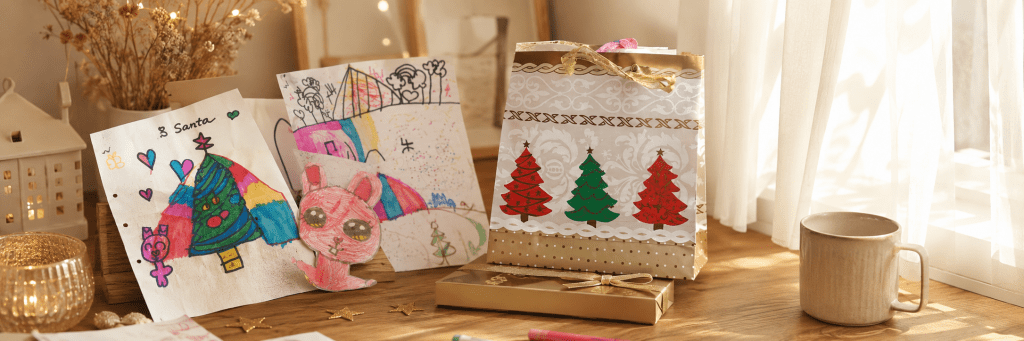
She had once believed that Santa Claus possessed magical powers. She thought he could hear every child’s wishes, and she worried that he might fall over in the dark when he came at night. She would therefore leave food for him, keep a small light on, draw pictures, and write letters. She now knows who prepared the presents, but the feeling of having been heard, remembered, and responded to will remain with her.
Her childhood was not interrupted. It simply found another way to exist.
She also told me that she had always believed her Aurora dress had been a present from Santa Claus. She was surprised to discover that I had bought it, but she did not seem disappointed. She simply moved the idea of “magic” away from an imaginary figure and placed it back into the hands of real people.
Then she leaned towards me and said mysteriously, “Mum, I did not tell Charlotte the truth. She still believes the coins came from the Tooth Fairy.” After saying this, she gave me a proud little wink.
That day, I understood something: childhood had not ended. It had moved from imagination into growth.
The second change took place in my husband
If my daughter’s change was natural, my husband’s was much heavier.
This year, it felt as though fate had pressed him back into the mud once again.
He had nearly completed his IT vocational training, and an exit from years of uncertainty had finally begun to appear. But he had still not recovered from the long-term effects of his first COVID infection when he became infected a second time. The way forward once again moved far out of reach.
The collapse of his health took away not only his physical strength, but also his confidence in the future. His birthday falls on Christmas Eve, but this year he was too ill to celebrate anything.
He did not bring the Christmas tree up from the basement.
He said that a Christmas tree did not define Christmas, just as a marriage certificate did not determine whether people were truly a family. He said it calmly, but I knew that there was also helplessness behind those words. It was not that he no longer cared. He simply did not have the strength to maintain the usual forms.
Over the course of this year, his priority changed from “keep moving forward” to “stay alive first.” That was not a step backwards. It was an adjustment forced upon him by circumstances.
The third change took place in me
Objectively speaking, my own life has not been easy. My business partner committed fraud and disappeared, bringing the business to a halt. The debt problem has been hanging over me for more than three years, and the tax crisis that followed remains unresolved. The problems have not disappeared, but neither have they reached a conclusion. It feels like living with a sword suspended above my head.
This kind of uncertainty can be more exhausting than a single, decisive blow.
The person responsible for creating this situation has still faced no consequences. During the first two years, I would sometimes wake in the middle of the night and repeatedly blame myself for having trusted the wrong person.
Many people living under this kind of pressure might already have become consumed by anxiety, self-reproach, and emotional disorder. Yet this year, I did not.
It was not because the problems had been solved. It was because I had stopped trying to fight them with emotion.
Even I was surprised by this change.
I began to understand that some hardships cannot be solved by becoming more anxious, and some problems do not improve simply because we exhaust ourselves thinking about them.
I had not given up trying. I had merely stopped mistaking constant tension for responsibility.
At the same time, I could clearly feel that something at my core had changed. I was beginning to know who I was, what I could do, and what lay beyond my limits.
There was no Christmas tree this year, but I did not feel that anything essential was missing. In the conversations I had with my daughter and my husband, I felt more clearly than ever that our relationship no longer needed to be proven through appearances.
I began to accept that life does not always have to be packaged into a complete and beautiful narrative.
This year, I stopped rushing to define myself, and I stopped forcing myself to arrive at a conclusion. Many problems are still unresolved, and many questions remain unanswered, but I am no longer thrown into panic by that uncertainty.
Some things have already ended. Other things have already begun. But I am not yet ready to write a complete narrative about the life that is taking shape.
This is not confusion. It is a pause.
That is precisely why I feel such a strong need to record this year.
I am not doing it to summarise what I have learned, to present an argument, or to prove anything. I simply want to be able to look back one day and know that I once stood here.
On a Christmas Eve that was not especially bright, surrounded by cold, illness, uncertainty, and the pressure of reality, I was not completely broken. I do not know what will happen next, but I am no longer facing the unknown through panic.
For me, that alone is a turning point.
If this year has taught me anything, perhaps it is only this:
What ultimately determines whether a person can endure is not whether life goes smoothly, but whether, when every path seems blocked, they still know that they have not been entirely abandoned by the world.
This is not a conclusion.
It is only a record.
— Christmas Eve, 2025
Notes
- Pengyouquan(朋友圈): Literally meaning “circle of friends,” this is the social-feed feature within WeChat, China’s most widely used messaging and social-media platform. Users share photographs, short posts, personal updates, and links with contacts they have added. In everyday Chinese conversation, “looking at one’s pengyouquan” often means scrolling through the lives and updates displayed by friends, relatives, acquaintances, and professional contacts.
This essay is also available in other languages:
Chinese version: 2025年|没有圣诞树的圣诞夜
German version: 2025 | Ein Heiligabend ohne Weihnachtsbaum


Leave a Reply