— What if keeping a little distance is not a failure to integrate, but a way of preserving one’s language, cultural memory, and inner compass?
By Jane Sonnenschein · March 12, 2026
During dinner this evening, I casually brought up the subject again.
I said that perhaps one major reason our daughter’s Chinese had not declined after the age of six or seven, as many other mothers had warned it might, was that I myself had never truly “integrated” all that thoroughly.
My husband immediately disagreed.
He said that after living in a country for more than twenty years, a person should communicate more with local people and participate more fully in local society. To him, that was simply the normal thing to do.
He said he thought the way I lived was not right. I had few friends, little social contact, and often preferred to be alone. In his eyes, that was not what “normal integration” looked like.
Eventually, he no longer seemed interested in continuing the conversation. From his perspective, I was once again trying to find an excuse for my unwillingness to integrate.
But that was not what I was actually trying to say.
I brought it up again because of something I had felt very clearly that afternoon when I went to pick up our daughter from school:
She has never treated speaking Chinese as something she needs to hide.
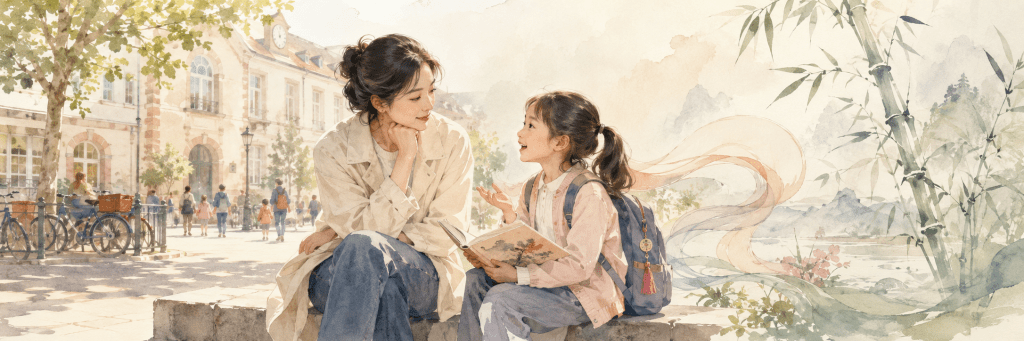
When I picked her up, many of her classmates were standing nearby, yet she still spoke to me loudly and excitedly in Chinese, just as she always does.
Later, she pulled me into her classroom. It was being used as a games room at the time, and there were many children and teachers inside. Still speaking Chinese as naturally as ever, she said to me, “Look, this is my desk.”
I could not help reminding her, “Keep your voice down a little. You don’t need to speak so loudly.”
But she did not think there was anything unusual about it.
To me, this matters enormously.
I have encountered many families whose children gradually become less willing to speak Chinese. It is not always because they cannot speak it or because their vocabulary is limited. Often, they have slowly begun to associate speaking Chinese with awkwardness, embarrassment, or the feeling of not fitting in.
They start to feel that speaking Chinese while other people are nearby makes them look strange.
The older they become, the less they speak it.
The less they speak it, the less able they are to use it.
Eventually, Chinese recedes into a language they can still more or less understand at home but rarely want to speak themselves.
At least so far, I have not seen that happening with our daughter.
At school, beside her classmates, and in front of other people, she continues to speak Chinese with me naturally.
That tells me at least one thing:
In her mind, speaking Chinese is not something to be ashamed of.
And I increasingly believe that this did not happen automatically.
It may have something to do with the way I have lived and thought during all these years in Germany.
Only after thinking about it for a long time did I realize that my husband and I were not talking about the same thing when we used the word “integration.”
To him, integration means something like this:
You speak the local language.
You can work, live, and communicate normally within the local society.
You can interact naturally with local people.
You do not remain enclosed within the social circle you came from.
Measured by that definition, of course he thinks I have not done particularly well.
I am genuinely not a very sociable person.
I do not have many Chinese friends, German friends, or friends from anywhere else.
I have always been someone who prefers solitude and tends to process things on my own.
And honestly, although I have lived and worked in Germany for many years and can speak German, I have never turned myself into the kind of person usually presented as a model of successful integration.
Chinese remains the language in which I express myself most naturally.
I still instinctively understand many things through Chinese cultural experience and ways of thinking.
My connection to Chinese history, culture, and emotional logic has also remained very deep.
My husband sees this as evidence that I have never had a strong enough desire to integrate.
But that is not what I am trying to say.
What I mean is this:
I never handed over everything I originally carried within me.
That is the crucial point.
Over the years, I have seen a very different example.
I have a friend whose German was not particularly good when he first arrived in Germany. He could not even say something as simple as his shoe size properly.
If we compared only our starting points, my German foundation was much stronger than his.
But after all these years, his German became noticeably better than mine.
Why?
Because his entire life gradually moved in that direction.
Almost everyone in his workplace was German.
He watched large numbers of German films.
He watched German DVDs, listened to German radio, and followed German news.
Little by little, he immersed his entire life in that language and information system.
Later, it was not only his German that changed.
I could clearly sense that even his way of thinking was becoming increasingly German.
There is nothing inherently wrong with that.
Language naturally changes the way people express themselves.
What began to concern me was something else. Over time, I noticed that he increasingly viewed complicated issues through a very narrow, single-track framework.
This was particularly obvious whenever China came up. He often made sweeping judgments.
Within that narrative system, many complicated matters seemed to have only one possible answer.
The more layered way of thinking he once had — the instinct to compare different perspectives and return to a question repeatedly — gradually seemed to disappear.
That was when I first understood something very clearly:
Learning another language and allowing the narratives behind that language to rewrite your entire way of thinking are not the same thing.
This is why I have always retained a certain caution toward the idea of “integration.”
I am not opposed to learning the language.
I am not opposed to participating in local society.
Nor am I saying that everything German is wrong and everything Chinese is right.
I have simply come to believe that when a person lives in another country for a long time, the most difficult task may not be learning the language well. It may be this:
While learning the language and adapting to the local way of life, can you still preserve your own structure of judgment?
By a “structure of judgment,” I mean the way you approach a question and whether you can still imagine it from different positions.
Can you still recognize that one event may have more than one explanation?
Can you continue to understand the things that came from your original culture, rather than casually discarding them altogether?
Perhaps the fact that I never integrated quite so completely helped me preserve this part of myself.
Of course, this way of living also has a price.
My German, for example, has clearly stopped progressing in recent years.
At first, I was learning quickly. But later, because of my living environment, the languages we chose to use within our family, and my own habits, I used German less and less frequently.
After our daughter was born, we wanted to create a home environment in which she would receive plenty of English and Chinese. As a result, we often used very little German at home.
I know perfectly well that my German has not continued moving forward in recent years. Sometimes, I even feel that it has declined a little.
My husband often criticizes me for this.
He asks, “How can you still be like this after living in Germany for more than twenty years?”
But I increasingly feel that this cannot be explained simply as either “progress” or “decline.”
Because at the same time, the Chinese connection between my daughter and me has remained alive.
And it is not merely surviving. It is strong and stable.
Speaking Chinese with my daughter has never felt like a task.
I do not wake up thinking, “I must remember to speak Chinese with her today because I need to teach her.”
I speak Chinese with her because it is the most natural, easiest, and most authentic way for me to communicate.
And because that connection has remained steady within me, it has been easier for it to remain steady within her as well.
Had I gradually followed the surrounding environment more completely, as many people do, and allowed German to become the more automatic, convenient language in our home — the language that required no explanation — then the Chinese connection between my daughter and me might not look the way it does today.
So ultimately, I am not saying that failing to integrate is somehow better.
I simply believe more and more strongly that whether parents preserve a place for their mother tongue and original culture within themselves truly affects whether their children can retain that language.
If the connection within a mother is already unstable, then the linguistic connection between her and her child can easily loosen as well.
Perhaps I am simply the kind of person who does not easily give something up once I have decided that it matters.
I know I can be stubborn.
Once I have made up my mind about something, it is difficult for other people to change it.
That personality trait is not always an advantage. In other parts of my life, it has sometimes caused me difficulties.
But when it comes to language and culture, perhaps it has become one of my strengths.
Preserving a minority language within a family is not something that happens by simply following the surrounding environment.
To some extent, it requires precisely this kind of determination — a refusal to surrender too easily.
That is why I eventually realized that the real disagreement between my husband and me was not about whether a person should integrate.
It was about this:
How far should integration go before it becomes enough?
Learning the local language is, of course, important.
Understanding the society in which you live is also important.
But if a person eventually retains only that society’s way of interpreting the world, is that still integration — or has it become assimilation?
I do not have a definitive answer.
I only know that, at least so far, I do not regret preserving a little distance.
Perhaps it was precisely because of that distance that I did not lose everything I originally carried within me.
And perhaps because I did not lose it, the Chinese connection between my daughter and me is still alive.
This essay is also available in other languages:
Chinese version: 在德国生活二十多年,先生说我“融入不够”,我却松了一口气
German version: Nach mehr als zwanzig Jahren in Deutschland sagte mein Mann, ich sei „nicht genug integriert“ — und ich war erleichtert


Leave a Reply