——Why outsiders often mistake “China in the records” for “China as ordinary people actually lived it”
By Jane Sonnenschein July 9, 2026
I had not originally planned to write a third article about butter.
The first article was about where common knowledge comes from. The second was about why a kind of food, even if it once existed somewhere, may still never grow into the everyday life of ordinary people. But last night, after my husband read the first article, he felt very uncomfortable. He thought I had written him as someone standing high above others, as if he were a bad person mocking people from the position of his own culture.
That was not what I meant.
But he could not really hear it. He kept saying that the Japanese people he knew knew it, Koreans knew it, Vietnamese people knew it, so why would Chinese people not know it? Then he went online to look up information. He said that thousands of years ago, Chinese historical records already mentioned cattle, milk, and certain dairy products; that today, Irish butter can be bought in Chinese supermarkets; that China is supposed to have five thousand years of civilization. If there were cattle, milk, and civilization, then why would ordinary people not know that butter is made from milk?
What made me want to continue writing was not that he had misunderstood me. It was that I suddenly realized that what we could not explain clearly between us was no longer a piece of butter, but how he understood China.
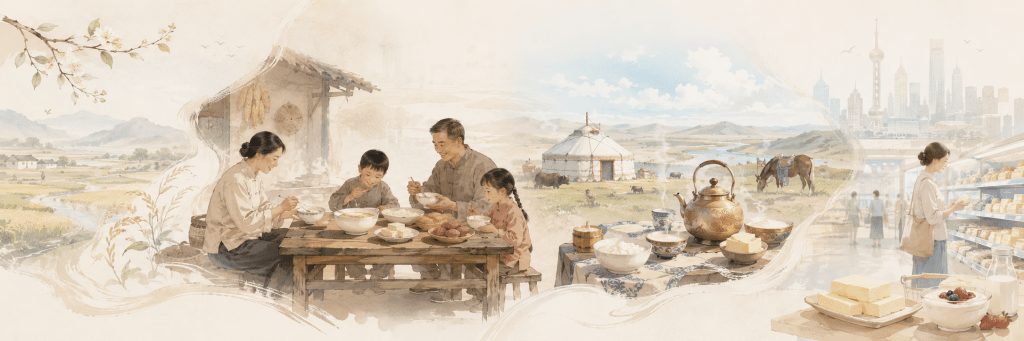
When many foreigners try to understand China, they easily mix several completely different Chinas together. There is the China of five thousand years of civilization. There is the China recorded in historical texts. There is the rapidly developing China of today. There is the China one can find through online searches. There is the China of Tibet, Xinjiang, Inner Mongolia, the northwest, and many other regions. And there is also the China lived by ordinary Han-di¹ families like my parents’ family and like the one I grew up in. Of course, all of these belong to China. But they are not the same dining table.
China is vast. So vast that something present in one place may never have entered the ordinary life of another place at all. In Tibet, Xinjiang, Inner Mongolia, and parts of northwest China, people have milk tea, suyou², yogurt, cheese-like foods, and other dairy products. That is not surprising. Those places have grasslands, pastures, and geographical conditions suitable for herding. Their food structures have always been different from those of Han Chinese agricultural regions. In those places, cattle, sheep, milk, and dairy products could become part of daily life.
But more than ninety percent of China’s population is Han Chinese, and many Han Chinese people have long lived in agricultural regions. For small farming families in Han-di, cattle were first of all not milk-producing animals. They were ploughing cattle, cart-pulling cattle, important tools that helped a family maintain agricultural production. In that social world, a cow’s main identity was not to provide milk every day, but to help people farm the land. You cannot directly use the experience of dairy cows on European pastures to understand the working cattle in a Chinese farming household.
This difference matters very much.
In European dairy culture, it is easy to move from “there are cows” to “there is milk,” and then from “there is milk” to “there are butter and cheese.” That is because there were many pastures, long dairy traditions, cows bred and raised specifically for milk production, stable sources of milk, and everyday needs for processing milk into butter, cheese, and cream. But Han Chinese agricultural society did not operate in the same way. Even if a poor farming family had one cow, that cow first had to work in the field. Even if it was a female cow and had milk during a certain period, that milk first belonged to the calf. Ordinary families did not have a stable, large, surplus supply of milk, nor did they have a practical need to process large amounts of milk into a small piece of butter.
Whether a technique becomes common knowledge among ordinary people never depends only on whether it can theoretically be known. It depends on whether there is a material basis, production conditions, a use scenario, and practical value.
If a place does not have abundant milk sources, a tradition of dairy processing, refrigeration and preservation conditions, or a habit of using butter in daily cooking, then even if a certain era, region, or social class knew how butter was made, that knowledge still might not enter most ordinary households. Technology is not knowledge floating in the air. It has to be needed by life in order to be preserved. It has to be used repeatedly in order to become common knowledge. It has to matter to ordinary people’s livelihood in order to be passed down from generation to generation.
This is also why Chinese people did not develop butter and cheese along the path of milk, but developed soy milk, tofu, dried tofu, tofu skin, fuzhu³, douchi⁴, and doujiang⁵ along the path of soybeans.
It is not that Chinese people did not know that “milk” mattered. It is that ordinary people in Han-di did not have the same milk-source conditions as Europeans. Chinese people certainly knew how to turn limited resources into food. But our path was not from milk to butter. It was from soybeans to tofu. Soybeans could be grown in large quantities. They were low-cost and much more likely to enter ordinary households. Grinding soybeans into soy milk and then setting it into tofu could feed a family and provide ordinary people with important protein. For a small farming household, tofu was much more realistic than butter.
So Europeans developed butter and cheese from milk, while Chinese people developed tofu and soy products from soybeans. Both are forms of human wisdom. They simply grew from different lands.
And besides space, there is also time.
Today, many foreigners are misled by today’s China. China now has imported supermarkets, bakeries, foods from many countries, high-speed rail, mobile payment, short videos, and e-commerce platforms. If you want to buy Irish butter, French cheese, Italian pasta, or German beer, you can find them in many Chinese cities. But today’s China cannot be projected backward onto the China of my childhood, let alone onto the China of my parents’ generation.
China’s truly rapid development is, in fact, a matter of only the past few decades.
The People’s Republic of China was founded in 1949. At that time, China had just gone through years of war. Japan’s invasion had caused enormous destruction in China. Many places were devastated, and countless families had lost loved ones. After the War of Resistance Against Japan ended, China went through a civil war. After 1949, the country had only just been founded when it soon became involved in the Korean War. The China of that era was a huge, long-poor agricultural country with a weak industrial base. It was not an industrialized country rebuilding after being bombed. It was a country that had already been very poor, with the majority of its population living in agriculture, with low education levels and high illiteracy, trying to find a path toward modernization amid the ruins of war and international blockade.
This was not the same as Germany’s reconstruction after the Second World War.
Germany, of course, also experienced ruins, poverty, and rebuilding after the war. But before the war, Germany had already been a highly industrialized country. It had technical systems, a tradition of skilled workers, an industrial foundation, modern education, and later, external aid under the postwar international order. Under the ruins, there was still the skeleton of a modern industrial country. China was different. In 1949, China was facing the reality of a poor agricultural society. For many ordinary people, the question was not whether they ate butter, but whether they had enough food at all. It was not whether they drank milk, but whether their children could survive. It was not whether they bought imported food, but how they could endure hunger, cold, and material scarcity.
I was not born in that era, but my parents were.
My father was born in 1955, and my mother in 1959. Their childhood was not the kind of childhood young people today can easily imagine. My father once said that when he was little, his family was so poor they could barely keep the pot boiling. There were many siblings. They did not have enough to eat or enough to wear. During the New Year, several children might have only one set of slightly decent clothes to share, taking turns to wear it. Their clothes were ragged, and they did not dare go out casually. In my mother’s generation, butter, cheese, and cream were not part of life either. What they knew was rice water, sweet potatoes, cornmeal, wild vegetables, lard — how to keep a family alive, how to get through life with extremely little.
Later came the San Nian Kunnan Shiqi⁶, when many parts of China experienced severe famine. When older people talk about that time, they speak of eating tree bark, grass roots, anything that could fill the stomach. That was not some distant ancient past. It was the 1960s. It was not very long ago. For Chinese people in their forties or fifties today, their parents were very likely born in that era, or directly lived through it.
So when a European asks, “China has five thousand years of civilization. Why didn’t you know butter?” I feel that the question itself has skipped over too much history.
Five thousand years of civilization is real. China’s long history is real too. But civilization is not a smooth straight line. A civilization can have brilliant writing, philosophy, agricultural techniques, handicrafts, poetry, painting, and food wisdom, while also going through war, poverty, famine, blockade, and a difficult modernization in modern history. Five thousand years of civilization does not mean that every ordinary farmer had abundant food choices. Nor does it mean that every family knew the origins of every food in the world.
Moreover, China’s real opening to the outside world and rapid economic development began only after the Reform and Opening Up in 1978. In the 1990s, many people began xia hai⁷, and the market economy gradually became more active. In 2001, China joined the World Trade Organization, and its connection with the world market became increasingly close. Imported foods, multinational brands, and overseas ways of consumption then entered ordinary people’s lives more and more. Later still, e-commerce, logistics, the internet, and short videos made information and goods spread at great speed. The fact that a Chinese urban family today can buy food from all over the world does not mean that the previous generation, or the generation before that, lived in the same world.
From 1978 to today, it has only been a few decades.
In these few decades, China has gone through changes that many European and American countries took one or two centuries to complete. My parents’ generation once went hungry. My generation still experienced, in childhood, a life with relatively limited materials and relatively closed information. But today’s children can see the whole world on a phone. The common knowledge of several generations can be completely different even within the same family. Parents may not know butter. Their children may only learn about it after going abroad. Their grandchildren may encounter butter from childhood through cakes and baking tutorials. This is not a contradiction. It is a time fracture left behind by China’s rapid change.
If one does not understand this timeline, it is very easy for a foreigner to misunderstand China. He may project the imported butter in Chinese supermarkets today backward onto the lives of Chinese people in the past. He may project historical information found online backward onto ordinary people’s daily experience. He may project the dairy traditions of Tibet, Xinjiang, Inner Mongolia, and other regions backward onto the dining tables of ordinary Han Chinese families. He may project the knowledge of some Japanese, Korean, or Vietnamese people he knows onto all Asians, as if everyone should know the same things.
But Asia is not one country, and China is not a flat map.
The modernization and Westernization paths of Japan and Korea were different from China’s. From the Meiji Restoration onward, Japan learned extensively from Western systems and technologies and became one of the earliest industrialized countries in Asia. Korea’s modernization was also deeply shaped by the United States, Japan, and the postwar international order. Vietnam has its own colonial history and its own paths of contact with food cultures. Different countries have different modern histories, and foods enter ordinary life at different times and through different routes. One cannot conclude that because a Japanese person, a Korean person, or a Vietnamese person knows butter, it is unbelievable that a Chinese person might not.
The people he knows are not all of Asia.
Information found online is not the same as ordinary life.
Today’s supermarket is not the same as yesterday’s dining table.
Five thousand years of civilization does not mean that every era, every region, and every family had the same food knowledge.
So I increasingly feel that truly understanding a country is not about knowing how many years of history it has, nor about finding a few pieces of information online. It is about knowing how many layers of time, how many kinds of geography, and how many generational fractures exist inside that country.
Five thousand years of civilization is true.
It is also true that my parents’ generation did not have enough to eat.
It is true that Irish butter can be found in Chinese supermarkets today.
It is also true that when I was a child, I did not know butter was made from milk.
These truths do not cancel each other out. They simply show that China is not a flat map, nor a straight timeline. China is too vast, and it has changed too quickly. The common knowledge of ordinary people always grows out of the small piece of land, the stretch of time, and the dining table they have actually lived with.
What truly exhausts me is not explaining butter. It is explaining why these layers cannot be flattened.
I can understand that a German person may not know many Chinese foods. Chinese people grow up with so many different things to eat: doufunao⁸, fuzhu, pidan⁹, zhuyouzha¹⁰, mijiu¹¹, ciba¹², zongzi¹³, niangao¹⁴, youtiao¹⁵, chou doufu¹⁶, xiandan¹⁷, all kinds of wild vegetables and local snacks. Many Germans may never even have heard of them. But I would not therefore think they were backward. Nor would I say, “You don’t even know this? Isn’t this something everyone should know?” Because I know they did not live inside this food culture. These things were not on their childhood dining tables. It is normal that they do not know them.
But when a Western person hears that a Chinese person did not know butter was made from milk, and instinctively finds it unbelievable, even linking it to education level, then the issue is no longer just food.
Behind this reaction lies a deep default assumption: the common knowledge of my world looks more like real common knowledge; what you do not know looks more like a deficiency.
I do not want to call this arrogance too easily, because very often it is not intentional. My husband was willing to look things up. He was willing to understand. He is not a closed-minded person. But precisely because he was willing to look things up, he was more likely to trust the “China in the records” that he found, while overlooking the China an ordinary person had actually lived through. Records can tell you that some regions of China had dairy foods, that there were historical mentions of milk products, and that imported butter can now be found in supermarkets. But records do not automatically tell you what a child of Chinese farmers born in the 1950s actually ate in childhood; how a family growing up in the mountains of Zhejiang sold sweet potatoes when transportation was poor, or how they crossed hills and valleys; how different the information world of an ordinary child in the 1980s or 1990s was from the internet age today.
Where I lived as a child, mountains were connected to mountains. In my mother’s generation, going somewhere a little farther away meant crossing hills and ridges, and transportation was very inconvenient. When my father went to Hangzhou to study, it was not like today, when one can take a high-speed train and arrive in a few hours. It was a long and difficult journey. Today, China has highways, high-speed rail, logistics, and the internet. But for a long time in the past, the food, techniques, and habits of one place did not easily flow into another. It was not only that suyou from Tibet would not naturally enter ordinary families in Zhejiang. Even within the same province, life in the mountains and life in the city could be completely different.
So if we want to understand why I did not know as a child that butter was made from milk, we cannot only ask, “Did China have cattle?” We have to ask: Which parts of China had dairy traditions? What were cattle mainly used for by Han Chinese farmers? Did ordinary families have large amounts of milk? Was there any surplus milk? Were there conditions for preservation and processing? Did butter have any use in the local kitchen? When did China truly begin to open up and globalize? When did ordinary families begin to come into contact with these imported foods? What era did my parents live through? What kind of information environment did I grow up in?
Once these questions are put together, the answer is not difficult to understand.
I am not saying China had no butter.
I am not saying Chinese people cannot understand that milk can be made into butter.
I am not saying everyone in China did not know.
What I am saying is this: in the lived experience of many ordinary Han-di families, butter did not become common knowledge.
This is a very simple thing. But to explain it clearly, one has to go around many misunderstandings.
Because outsiders often imagine a single, whole China, but fail to see the enormous spatial differences inside China. They know an ancient China, but do not understand what poverty and rupture modern China went through. They see a fast-developing China today, but forget how short that development has actually been. They find a China with dairy records online, but do not know what ordinary people actually ate in a lifetime.
So in the end, what the matter of butter reminds me of is not food, but how difficult it is to understand another person.
Truly understanding a country is not flattening its history, geography, ethnicity, class, and era into one line of search results. Truly understanding a person is not using a few Asians you know to deny her lived experience. What a person does not know is often not because she is stupid, nor because her civilization is insufficient. It is because she was born into another timeline, another piece of land, another dining table.
I wrote this not to prove who is right or wrong, nor to make anyone into a bad person.
I only want to say: when we encounter someone else’s “not knowing,” can we pause for a moment before rushing to say, “How could you not know that?” Perhaps behind that “not knowing” there is geography, history, poverty, war, transportation, economic structure, and the real life a family has walked through.
Sometimes, when a person does not know where a piece of butter comes from, it is not because she is far from civilization.
On the contrary, it is because she comes from another civilization that is just as complex, just as long, and just as real.
Only there, the cattle once stood more often in the fields. The milk did not necessarily enter the kitchen. And the wisdom of food grew into tofu, not butter.
Addendum: A Conversation on the Night of July 10, 2026
I had not planned to write a fourth essay about butter.
But on the night of July 10, we talked about this question again for a long time, probably for almost two hours. Unlike the previous conversations, this one, although still full of disagreement, was no longer an emotional argument. We were able to talk more calmly and dig one layer deeper into the question.
Afterwards, I felt that this conversation itself was meaningful. It does not need to become a separate essay, but it can be added here as a kind of summary, a final note to this whole discussion about butter, common knowledge, history, and lived experience.
By this point, butter was no longer just butter. Behind it were geography, history, food structures, production conditions, family memory, and many other layers. If we kept digging, of course we could still find more reasons: lactose intolerance, limited milk supply, the price of butter, storage conditions, cooking methods, taste preferences, social class, and whether certain techniques were preserved or lost. But all these reasons eventually return to the same conclusion: whether a food becomes common knowledge is never decided by one single cause. It is shaped by an entire system of life.
Later, he brought up another point: many East Asians are lactose intolerant, so perhaps this was the main reason dairy products never became widely popular in China. Of course, this explanation makes sense. If drinking milk gives a person bloating, diarrhea, or discomfort, it naturally becomes harder for fresh milk to turn into something people drink every day. But I also think lactose intolerance can be both a cause and a result. A society that drinks milk over many generations will put milk into daily life, and over time the body, diet, and agricultural structure will adapt to each other. A society that has not traditionally used milk as a basic food is less likely to form the habit of drinking milk every day. Besides, lactose intolerance mainly affects the large-scale consumption of fresh milk. It still cannot fully explain why butter did not enter ordinary Han Chinese kitchens. Butter was never the most convenient, affordable, or stable fat for the Chinese style of high-heat cooking. Chinese kitchens long relied on pork fat, rapeseed oil, soybean oil, peanut oil, sesame oil, and other oils that better matched local production and cooking methods.
We also talked about soybeans. I asked him: if I turned the question around and said that soy milk, tofu, dried tofu, tofu skin, fermented tofu, and all kinds of soy products are so common in Chinese life, then why do Europeans not know them? Could I also say that they lack common knowledge? He said that was because Europe did not traditionally grow soybeans on a large scale. In other words, soybeans did not enter the European agricultural system and everyday table in the same way they did in China. And that, in fact, was exactly my point. Europeans do not lack common knowledge because they do not know tofu culture. It is simply that soybeans did not grow into their traditional food system and daily meals. In the same way, many ordinary Han Chinese families did not know butter, not because Chinese people lacked common knowledge, but because milk and milk fat did not grow into our everyday kitchens. Europe’s milk became butter and cheese; China’s soybeans became tofu, soy milk, tofu skin, and fermented tofu. They are all forms of food wisdom. They simply grew from different lands.
The most interesting moment came near the end of our conversation, when he suddenly realized something. He was born in 1982, and I was born in 1983. In terms of age, we are almost the same generation. But his 1980s and my 1980s were not the same 1980s. He was born in the United States and later grew up in Germany, in a world where postwar reconstruction had already been completed and where industrialization and consumer society were already highly developed. I was born in China shortly after the beginning of reform and opening up, into a society where my parents’ generation still carried memories of hunger, poverty, material scarcity, and difficult transportation. We were born only one year apart, but the historical time behind us was not the same.
Perhaps this is one of the hardest things for many foreigners to understand about China. China has changed too fast. So fast that the China of today can easily make people forget what ordinary Chinese families were living through only a few decades ago. A country can build high-speed railways, airports, cities, and expressways very quickly. It can develop mobile payment, online medical appointments, imported supermarkets, and modern logistics very quickly. But people’s bodily memories, eating habits, family knowledge, and the ways of life inherited from their parents’ generation cannot all be updated overnight. Infrastructure can modernize rapidly, while lived experience still carries traces of an earlier time.
So in the end, what I really wanted to say about butter was not about who won the argument, nor about who knew more. Information matters, of course. Research is also one way to understand the world. But information can tell you what existed in Chinese history, what existed in certain regions, and what can be bought in China today. It cannot automatically tell you how an ordinary family once lived. It cannot tell you whether a rural child born in the 1950s had enough to eat. It cannot tell you how a family in the mountains had to travel over hills just to go somewhere. It cannot tell you what kind of information world an ordinary child grew up in during the 1980s and 1990s. And it cannot tell you why something could have existed in history, yet never entered many people’s childhood common knowledge.
If even someone who loves reading, likes doing research, and has lived with a Chinese person for many years needed this long to realize that “his 1980s” and “my 1980s” were not the same, then I can better understand why it is so difficult for many people who have never truly entered Chinese life to understand China. On the surface, we were arguing about a piece of butter. But what was truly difficult to explain was this: people from different countries, even when they are born in almost the same year, may have lived in completely different historical stages. And the same China can contain ancient civilization, memories of poverty, rapid development, and the concrete lives of countless ordinary families all at once.
So I do not want to write a fourth essay. This is enough. Butter was only an entrance. It allowed me to see once again that common knowledge is not just a piece of information; it is life training. Civilization is not a table of facts; it is the experience that grows, generation after generation, out of land, food, poverty, technology, migration, and time. When someone does not know where a piece of butter comes from, it is not because she is far from civilization. It is because she comes from another timeline, another land, and another table.
Notes
- Han-di(汉地): Literally “Han lands” or “Han regions.” In this article, it refers broadly to the agricultural regions historically inhabited mainly by Han Chinese people, especially in contrast to pastoral or semi-pastoral regions such as Tibet, Xinjiang, Inner Mongolia, and parts of northwest China. The term is not simply geographic; it also carries a cultural and historical meaning, pointing to a way of life shaped by farming, grain cultivation, and small household agriculture.
- Suyou(酥油): A butter-like dairy product made from milk, commonly associated with Tibetan and other pastoral food cultures in western and northern China. It is often used in suyou tea, sometimes translated as “butter tea.” However, “butter” alone does not fully capture its cultural place in Tibetan daily life, ritual, hospitality, and highland food traditions.
- Fuzhu(腐竹): Also known as dried tofu skin or bean curd sticks. It is made from the film that forms on heated soy milk, then dried. Fuzhu is an example of how Chinese food culture developed many protein-rich foods from soybeans rather than from milk.
- Douchi(豆豉): Fermented black soybeans used as a seasoning in many Chinese dishes. It has a deep, salty, savory flavor and is part of a long tradition of fermenting beans in Chinese cuisine.
- Doujiang(豆酱): Soybean paste or fermented bean sauce. The exact form varies by region, but it generally refers to a savory paste made from soybeans and used in cooking. It belongs to the wider Chinese tradition of turning soybeans into durable, flavorful foods.
- San Nian Kunnan Shiqi(三年困难时期): Literally “the Three Years of Difficulties.” This is the official Chinese term often used to refer to the severe famine and hardship that took place around 1959–1961. In English, it is often described as the Great Chinese Famine. The phrase carries political, historical, and emotional weight in Chinese memory, especially among older generations.
- Xia hai(下海): Literally “to go into the sea.” In the economic context of China in the 1980s and 1990s, it means leaving a secure state-sector or institutional job to enter private business, trade, or entrepreneurship. The phrase reflects the uncertainty, risk, and opportunity of China’s early market reforms.
- Doufunao(豆腐脑): A soft, very tender tofu dish, often eaten for breakfast. It may be served savory or sweet depending on the region. It is difficult to translate directly because it is not simply “tofu pudding”; its texture, flavor, and cultural associations vary widely across China.
- Pidan(皮蛋): Often translated as century egg or preserved egg. It is made by preserving duck, chicken, or quail eggs in an alkaline mixture. The result has a dark, translucent appearance and a distinctive flavor. It is a familiar food to many Chinese people but can be surprising to those who did not grow up with it.
- Zhuyouzha(猪油渣): Crispy bits left after rendering pork fat into lard. In older Chinese households, especially when food was scarce, zhuyouzha could be a precious and flavorful ingredient rather than a waste product.
- Mijiu(米酒): Rice wine, usually made through fermentation. It can refer to different kinds of homemade or regional rice-based alcoholic drinks, and in some households it is also connected to cooking, postpartum foods, or festive occasions.
- Ciba(糍粑): A sticky rice cake made by pounding glutinous rice. It is common in many regions of southern and southwestern China and is often connected with festivals, local customs, and family labor.
- Zongzi(粽子): Glutinous rice dumplings wrapped in bamboo or reed leaves, best known for their association with the Dragon Boat Festival. Fillings and flavors vary greatly by region, from savory pork and beans to sweet red bean paste or dates.
- Niangao(年糕): A sticky rice cake often associated with the Lunar New Year. The name sounds like “higher year by year” in Chinese, giving it an auspicious meaning. It can be steamed, fried, stir-fried, sweet, or savory depending on the region.
- Youtiao(油条): A long, deep-fried dough stick, commonly eaten for breakfast with soy milk, rice porridge, or doufunao. It is a very ordinary food in many parts of China, but it carries strong everyday memories for many Chinese people.
- Chou doufu(臭豆腐): Fermented tofu with a strong smell and a rich flavor. It is a famous street food in many Chinese-speaking regions. The smell can be challenging for people unfamiliar with it, but for many who grew up around it, it is a beloved local food.
- Xiandan(咸蛋): Salted egg, often made from duck eggs. The yolk becomes rich, oily, and salty after curing. It is eaten with rice or porridge and also used in pastries and other dishes.
This essay is also available in other languages:
Chinese version: 五千年文明,不等于每个普通人都拥有同一套餐桌
German version: Fünftausend Jahre Zivilisation bedeuten nicht, dass jeder gewöhnliche Mensch denselben Esstisch hatte


Leave a Reply