— Why the Existence of a Food and Its Presence in Ordinary People’s Everyday Lives Are Two Different Things
By Jane Sonnenschein · July 8, 2026
Fei Xiaotong once said, “Let each appreciate the beauty of its own; let each appreciate the beauty of others; when beauties are shared, the world becomes one.”¹ Many cross-cultural misunderstandings happen precisely before we have learned to “appreciate the beauty of others.”
When I wrote about butter in the previous essay, I actually thought I had already said almost enough.
If a person does not know that butter is made from milk, it does not mean she has no common sense. Common sense does not fall from the sky. It grows out of a person’s kitchen, dining table, language, childhood memories, and living environment.
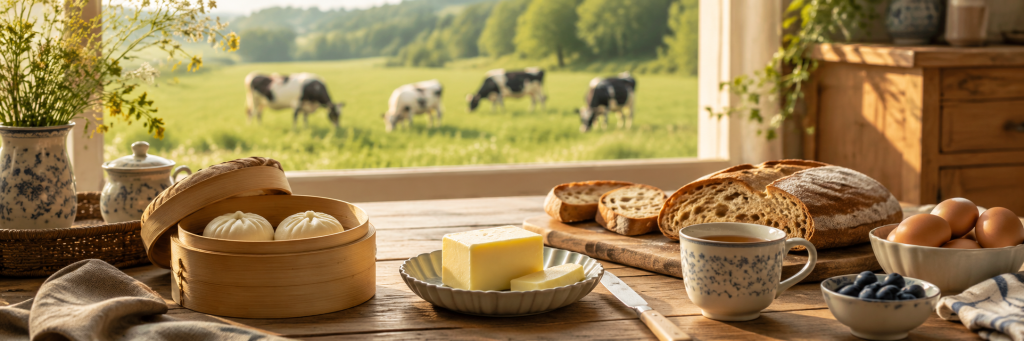
Germans grow up eating bread, butter, cheese, and yogurt, so it feels self-evident to them that huangyou² comes from milk. But when I was a child, what I knew well was zhuyou, rapeseed oil, peanut oil, doujiang, rice, and noodles. So when I saw the two Chinese characters “huangyou,” I naturally understood them as some kind of oil or fat from an animal.
But later, my husband still could not quite understand it.
He even searched online again and said that southern China clearly had similar butter-like products, dairy products, or related historical records. So why would I say that I did not know as a child that butter was made from milk?
What he probably meant was this: China has had cows for so many years. Cows produce milk. Milk can be made into butter. What is so hard to understand about this chain of logic? Besides, China is so large and has such a long history. If related information can be found online, how can someone say they did not know?
After listening to him, I became even more certain of something: what we were discussing was no longer a piece of butter, but the difference in imagination between two worlds.
Because “something once existed” and “something became part of ordinary people’s everyday experience” are two different things.
Of course China is not a country without cows, nor is it true that dairy products never existed in Chinese history. China is too vast for that. In the northern grasslands, the northwest, Mongolia, Xinjiang, and Tibetan regions, there have long been traditions of animal husbandry and dairy foods. Suyou, milk tea, yogurt, and cheese-like foods are not unfamiliar in those places.³ Court cuisine, ethnic minority food traditions, and certain specific regions and social classes also certainly included cow’s milk, goat’s milk, and related dairy products.
But the existence of these things does not mean that they entered the dining tables of most ordinary families in han di.⁴ It certainly does not mean that a child who grew up in a small town in Zhejiang should have known from childhood that butter was made from milk.
This is like saying: you cannot assume that every German should know how tofu is coagulated simply because China has soybeans. Nor can you assume that young Germans understand why Chinese people say stir-fried greens taste fragrant with zhuyou, why rice mixed with zhuyou tastes good, or why zhuyouzha once carried the luxurious fragrance of poor times, simply because lard can be bought in European supermarkets.³
Whether something has appeared before and whether it has become part of your childhood dining-table experience are not the same thing.
The question of butter must really be placed inside China’s mainstream agricultural society.
In the agricultural society of han di, the most important identity of a cow was not that of a milk-producing animal, but that of a means of production. Cows plowed fields, pulled carts, and helped a family complete agricultural work. To farmers, a cow was not a dairy cow on a European farm that was milked every day. It was labor power connected to whether a family could farm, harvest, and survive.
Even if an ordinary farming family had a cow, it was not for drinking milk, eating cheese, or making butter. In that production system, the cow’s value was first of all labor value, not dietary value.
So Europeans can easily move from “there are cows” to “there is milk,” and then from “there is milk” to “there is butter.” But across the vast agricultural regions of China, this chain did not operate in the same way at all. Cows were not a daily source of milk. Milk was not a basic food for ordinary families. Butter, therefore, would not naturally become common sense in the kitchen.
What is more, for most ordinary Chinese people, before modern times and even until quite late, the central question of life was not “Where does butter come from?” but “Can we eat enough?”
This is also the part that is hardest for my husband to truly imagine.
He knows that China used to be poor. I have also told him many times that China’s rapid development is really a matter of only the last few decades. But knowing this as information is one thing. If a person has never lived inside such a society, it is very hard to truly imagine what “poverty” meant.
Germans may also say that after the Second World War, Germany was in ruins and had to rebuild from the rubble. But “the postwar reconstruction of an industrialized country” and “the modernization of a long-poor agricultural country” are not the same thing.
Germany was destroyed by war, but before the war it had already been an industrialized country. It had a technological system, an industrial foundation, modern education, an engineering tradition, skilled workers, and later also the opportunity for reconstruction within a certain international order and with external assistance. Beneath its ruins lay a country that had already been modernized.
China was different.
After the founding of the People’s Republic of China, what it faced was an extremely poor country with a huge population, a heavy agricultural base, and a very weak industrial foundation. For many ordinary people, the real concern was grain, warmth and food, whether children had enough to eat, and how a family could keep life going.
In the life experience of my parents’ generation, butter, cheese, and cream had almost no place.
They were not ignorant. They simply lived in that kind of era.
In those years, many families did not even drink milk. If there was rice water, rice porridge, sweet potatoes, or cornmeal, and if children could be kept alive and fed, that was already not easy. When there was no breast milk, some children were slowly raised on rice water and rice porridge. Older people would say that the layer of mi you on top of rice porridge was nutritious and good for babies.⁵
If you talked to people from that era about milk, butter, and cheese, perhaps they would not have been incapable of understanding. It was just that those things did not belong to their world of life.
So when a European person asks, “You had cows, so why didn’t you know butter?” he does not realize that he is not asking a simple question about food knowledge. He is directly placing his own dairy-food experience onto someone else’s agricultural society.
In his world, milk is an everyday food, and butter is a basic ingredient on the breakfast table and in the kitchen.
In our world, cows were once more often partners in plowing the fields, while fats came more often from zhuyou and plant oils.
In his childhood, cheese, butter, and yogurt may have been things that were always available in the refrigerator.
In my parents’ childhood, whether one could eat enough may have been the truly important question of life.
These two worlds cannot be fully understood by searching a few pieces of information on Google.
Of course the internet can find many things. You can find what existed in some places in southern China. You can find records of dairy products in Chinese history. You can also find food materials from a certain region, class, or dynasty. But the existence of information is not the same as the life experience of ordinary people.
The internet saying “China had it” does not mean “my family had it.”
Something appearing in historical documents does not mean my parents ate it.
Some people in history knowing about it does not mean ordinary people grew up knowing about it.
This is also a mistake that many foreigners easily make when they try to understand China.
They flatten today’s China, online China, urban middle-class China, and China in historical documents into one single China. But China is not flat. China has eastern coastal areas and inland villages; first-tier cities and remote regions; court cuisine and farmers’ dining tables; supermarket shelves today filled with imported butter, and also the childhoods of the previous generation, in which even milk was rarely drunk.
China has changed so quickly that within only a few decades, the common sense of several generations may be completely different.
It is not strange that I had not eaten butter before I left China as a child. At that time, the internet had only just begun to rise, and information was far less fluid than it is today. The diet of ordinary families was not as globalized as it is now. Western food, baking, cheese, and butter entered many people’s lives much later.
Children today may encounter these things very early in supermarkets, short videos, baking tutorials, and school activities. But that does not mean these things have always been everyday common sense for Chinese people.
After gaige kaifang, Chinese life changed very quickly.⁶ Milk began to enter more households. Bakeries, cake shops, baking ingredients, and Western restaurants became more and more common. Many young people today, of course, know butter. They use butter to make cookies, cakes, and steak.
But we cannot reverse today’s changed urban life backward and say that ordinary Chinese people in the past should also have known. A society’s common sense changes together with its economy, trade, media, and food structure. It is not static, and it certainly does not synchronize across the whole world.
So I feel that what is truly worth writing about here is not proving whether China had butter, nor proving who knows more history. It is to remind us of something else:
The hardest thing for human beings is to imagine a life they have not lived.
A person who grew up in an environment rich in dairy products finds it hard to imagine why a society with cows did not drink milk.
A person who grew up in an industrialized society finds it hard to imagine why a cow in an agricultural society was first of all labor power.
A person who grew up with supermarket shelves and globalized food finds it hard to imagine why the previous generation’s dining table was so narrow.
A person living in China today can also easily forget that China’s escape from widespread poverty was not as long ago as it may seem.
This lack of imagination sometimes appears as a very hidden kind of arrogance.
It is not necessarily malicious. Many people do not intentionally look down on you. They are simply too used to treating their own world as the default answer. They feel that butter is basic common sense, milk is basic common sense, and cheese is basic common sense, because these things have been on their breakfast table, supermarket shelves, and in their school education since childhood.
They do not realize that what they call “basic” is only basic in their world.
What they call “common sense” is only something repeatedly confirmed by their own life experience.
If such a person is open enough, he will ask:
“Why didn’t you know this as a child? What kind of oil did your family use? What were cows mainly used for where you lived? Did you drink milk when you were young? What were ordinary families like in that era?”
If he is not open enough, he will only say:
“You don’t even know this?”
The difference between these two sentences is not knowledge.
It is respect.
I increasingly feel that the most important ability in cross-cultural relationships is not how many facts you know about another culture. It is whether you can realize that another person’s “not knowing” often has historical reasons, life reasons, reasons related to modes of production, and class reasons.
A person does not know that butter is made from milk not because she is stupid, nor because she lives in a country without cows, but because in the world in which she grew up, butter did not become something repeatedly used, repeatedly explained, and repeatedly confirmed.
It is like my parents’ generation. They did not eat butter, and they did not eat cheese. This was not because they lacked common sense. It was because these foods had no place in their lives.
They knew how to farm. They knew how to save grain. They knew what should be done in each season. They knew how to render zhuyou. They knew how to use rice water to feed a child. They knew how a family survived through difficult years.
These are also forms of common sense. They simply do not appear on a European breakfast table.
So do not lightly judge another person’s not knowing with your own common sense.
Having cows does not mean having a dairy-food culture.
Having historical records does not mean ordinary people ate it every day.
Having modern supermarkets does not mean the previous generation knew it from childhood.
The existence of something does not mean it has grown into the lived experience of a culture.
In the end, this small matter of butter is no longer really about food. It is about common sense, history, and imagination.
Each of us stands in our own kitchen to understand the world. Some people begin from butter and cheese. Some people begin from zhuyou and doujiang. Some begin from bread. Some begin from rice.
True worldliness is not laughing at others for not knowing the things from your own world.
It is understanding that the world has never had only one dining table.
So if someone asks me now why a Chinese person might not know that butter is made from milk, I would probably answer like this:
Because we had cows, but our cows were long in the fields.
Because we had history, but ordinary people’s dining tables were narrow.
Because we had records of dairy products, but they did not become everyday life for most han di families.
Because China becoming truly wealthier, more open, and more globalized did not happen as long ago as you may imagine.
And also because a person’s common sense is ultimately fed by the world in which that person lives.
## Notes on Chinese Context
¹ Ge mei qi mei, mei ren zhi mei, mei mei yu gong, tianxia datong(各美其美,美人之美,美美与共,天下大同)is a well-known phrase associated with the Chinese sociologist and anthropologist Fei Xiaotong(费孝通). It means that each culture should appreciate its own beauty, learn to appreciate the beauty of others, and eventually allow different forms of beauty to coexist. In this essay, it points to the need for humility in cross-cultural understanding.
² Huangyou(黄油)literally means “yellow oil” in Chinese. In modern Chinese, it means butter, but the word itself does not contain any character meaning milk or dairy. For someone who did not grow up with butter, cheese, and cream as everyday foods, the word can easily sound like a kind of animal fat rather than a dairy product.
³ Suyou(酥油)usually refers to butterfat or clarified butter, especially associated with Tibetan and other pastoral food cultures. Naicha(奶茶)means milk tea. Zhuyou(猪油)means lard, oil rendered from pork fat; zhuyouzha(猪油渣)refers to the crispy pieces left after rendering pork fat. These words carry very different food memories in different Chinese regions and communities.
⁴ Han di(汉地)refers broadly to the traditional Han Chinese agricultural regions, especially areas where settled farming culture was historically dominant. It is not the same as all of China. China includes many regions with different ethnic, ecological, and food traditions, including pastoral regions where dairy foods were far more common.
⁵ Mi you(米油)literally means “rice oil,” but it does not refer to cooking oil. It is the thin, creamy layer that forms on top of well-cooked rice porridge. In many older Chinese households, it was considered nourishing, especially for babies, the elderly, or people recovering from illness.
⁶ Gaige kaifang(改革开放)means “Reform and Opening Up,” referring to the period of economic reforms and opening to the outside world that began in China in the late 1970s. It profoundly changed ordinary life, including food, consumption, trade, media, and access to foreign products.
This essay is also available in other languages:
Chinese version: 有牛,不等于有黄油
German version: Kühe zu haben bedeutet nicht, Butter zu haben


Leave a Reply