By Jane Sonnenschein · April 20, 2026
This text is a personal introduction, written before A Chinese Way of Seeing officially begins.
Hello, I am Jane Sonnenschein.
I am Chinese, and I have lived in Germany for more than twenty years.
Many years ago, I came here to study. Later came work, marriage, and a child — and step by step, Germany became the place where much of my life truly happened. After so many years, Germany is no longer a foreign country where I once stayed for a short time. It has become a place where many important chapters of my life have unfolded. And yet, I still know very clearly: deep inside, I remain Chinese. In many things — the way I see the world, family, marriage, education, language, and relationships between people — my starting point is still a Chinese instinct.
Perhaps it is exactly because of this that one thing has become more and more clear to me over the years:
Many things that look, on the surface, like simple differences in lifestyle often carry much deeper cultural differences underneath.
And these differences are not only between China and Germany. Very often, they are also part of a deeper difference between Eastern and Western ways of thinking.
Sometimes it appears in a very ordinary sentence.
Sometimes in the way people eat a meal together.
Sometimes in questions such as: Should a child walk by herself? Should she eat by herself? Should certain ideas be taught to a child very early?
Sometimes it is about the boundary between a mother-in-law and a daughter-in-law, about who makes decisions in a marriage, about what it means for family members to be “involved,” and what it means to show “respect.”
And sometimes it is only a word, a poem, a character, or a small scene in a television drama that suddenly makes me realize: many things we Chinese people take for granted do not work the same way in another culture at all.
Over the years, I have often had this feeling:
It is not that people outside China do not want to understand China. Very often, they simply have never really encountered how a Chinese person thinks.
Of course, there is already a great deal of information about China in the outside world.
There is news, commentary, research, documentaries, and all kinds of positions and interpretations.
But having a lot of information is not the same as having deep understanding.
What defines a country is not only its system, its economy, or the latest news events.
The deeper layer often lies in how the people of that country understand fate, how they face family, how they deal with marriage, how they raise children, how they understand responsibility, dignity, renqing³, fenggu², boundaries, hurt, sacrifice, and love.
And these things often cannot be explained by information alone.
They are hidden in stories, in history, in poetry, in the words parents say to their children, and in the spiritual temperament passed down from one generation to the next.
At some point, I slowly understood that what I wanted to create was not really a parenting blog in the ordinary sense. Nor was it simply a blog about life abroad.
What I really wanted to create was a window.
A window through which others can slowly see how Chinese people think.
What Will I Write About Here?
I will write about the differences between life in China and Germany.
I will write about family, marriage, in-laws, and boundaries.
I will write about multilingual families and multilingual upbringing.
I will write about my own experiences as a Chinese mother, a wife, and a Chinese woman who has lived in Germany for more than twenty years — and about the frictions, questions, and reflections that arise from concrete moments in everyday life.
I will also write about books, films, television dramas, and characters.
But not simply to recommend certain works. Rather, I want to use the people and stories in these works to talk about something deeper in Chinese culture: the moral backbone of scholars, the idea of family and nation, the resilience of ordinary people at the bottom of society, and the complicated way Chinese people face fate — believing in fate, and yet never fully surrendering to it.
Some words I may deliberately keep in Chinese in the future — sometimes even in pinyin.
Because some things cannot be carried cleanly into another language.
For example, yuanfen¹, fenggu², renqing³, or mianzi⁴.
Very often, it is not enough to simply replace them with an English word.
Behind these words is an entire way of feeling and understanding the world.
I will try to explain them. But I will not smooth them flat.
Because I increasingly feel that meaningful writing does not mean translating oneself completely into something familiar and comfortable for others.
What matters more is to speak one’s own reality honestly — and then, little by little, build bridges so that others can slowly come closer.
This is probably also one of the things I most want to hold on to with this website:
I do not want to make this place loud or overloaded.
There will not be too much exaggerated packaging. Nor do I want to turn everything here into a machine for quick monetization.
First of all, this should be a place for reading.
A little cleaner. A little quieter. A little simpler.
The writing comes first. Everything else comes after.
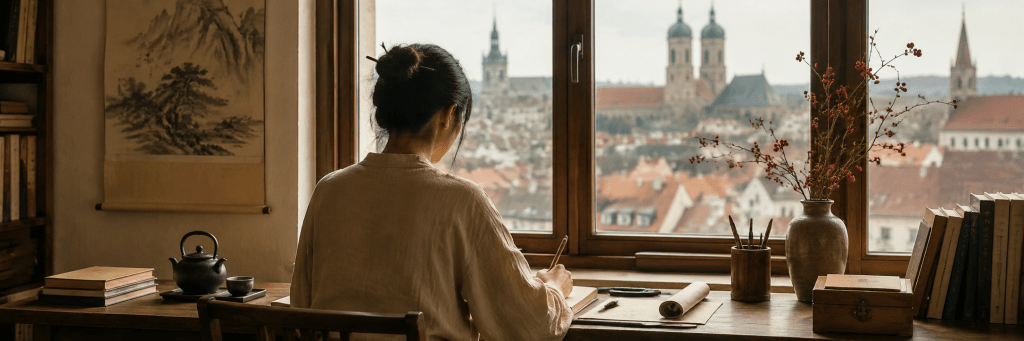
I hope this place feels like a window beside a writing desk.
When you open it, you may not understand everything at once. But at least you can see some real light.
If you are a Chinese reader, perhaps you will find many familiar things here — only told again from a slightly different angle.
If you are not Chinese, or if you have grown up in another culture, perhaps this place can help you slowly understand why Chinese people think in certain ways, why some things feel so heavy in our hearts, and why certain characters, sentences, and spiritual attitudes move us again and again.
Of course, I do not believe that one article can make someone truly understand another civilization.
That is not something that can be done quickly.
Understanding is always slow.
Prejudice is often very fast.
So I do not intend to rush toward conclusions here, nor do I want to pretend that I have all the answers about China and Germany, East and West, or cultural differences in general.
What I want to do is write down, with care, the things I have truly lived through, collided with, felt confused by, and slowly come to understand in part over all these years.
If these writings can make some people think for the first time:
Oh, so this is how Chinese people think.
Oh, behind this word, this story, or this reaction, there is such a cultural background.
Then this website already has meaning for me.
So, before everything truly begins, I want to first say clearly who I am.
I am Jane Sonnenschein.
A Chinese woman who has lived in Germany for more than twenty years.
A person who still thinks in Chinese, and who wants to write, with care and honesty, about the part of the Chinese spiritual world that lives within her.
From here, we can begin slowly.
Notes on Several Chinese Terms
¹ Yuanfen means more than “fate” or “coincidence.” It describes a particular connection between people or events that cannot be fully planned, forced, or explained. In Chinese thinking, yuanfen can help explain why certain people meet, why relationships begin — or why, despite all effort, they do not remain.
² Fenggu is difficult to translate directly. Literally, the word evokes “bones” and “bearing,” but it refers more to inner dignity, moral backbone, and spiritual integrity. When people speak of fenggu, they often mean a person who does not easily lose their integrity, even under pressure.
³ Renqing refers to the human side of social relationships: favors, consideration, emotional obligations, and the understanding that relationships do not function only according to abstract rules. Renqing is not simply “feeling,” nor merely “a favor.” It is a cultural understanding of how people meet, respond to, and owe one another within social life.
⁴ Mianzi is often translated as “face,” but it means more than outward reputation. It involves dignity, social recognition, self-respect, and the way a person is perceived within a relationship or community. Mianzi is fragile because it is not only individual; it is also created and affected by the social world around a person.
This essay is also available in other languages:
Chinese version: 写在开始之前:我是谁?
German version: Bevor du weiterliest: Wer ich bin?


Leave a Reply