By Jane Sonnenschein · April 23, 2026
Over the years, I’ve become increasingly aware of a particular quality among Chinese people, one that often goes unnoticed: a willingness to do things that may bring no visible benefits in the short term, or may not even produce results within a single generation.
And I’m not talking about anything abstract.
On a large scale, this means building roads, high-speed railways, dams and canals, reclaiming deserts, and planting trees. On a smaller scale, it means improving local governance, gradually changing people’s attitudes, and taking on difficult, slow, demanding work that someone still has to be willing to do.
If we judge these efforts by their immediate returns, many of them don’t seem particularly worthwhile. Some may bring almost no benefit at all in the short term.
Building a road costs a great deal of money. A high-speed railway requires an even greater investment. Some projects may not look financially worthwhile after ten or even several decades.
Desert restoration is another example. You plant trees, but you may see little change this year or next year. It might take decades before the landscape truly begins to look different. Yet people in China are still willing to plan, invest, and carry on the work from one generation to the next.
I never used to think very deeply about why this kind of thinking comes so naturally to us. But looking back, I’ve gradually come to believe that it may have a great deal to do with how Chinese people learn history from childhood.
When we study history in China, we’re not simply learning what happened in a particular year or which famous figures lived during a certain dynasty.
We’re also learning something else: to look further ahead, and then further still, rather than focusing only on what’s immediately in front of us.
So many historical stories, the rise and fall of dynasties, and lessons drawn from past successes and failures keep returning to the same idea: the things that truly change a country’s future rarely happen overnight. They take years, sometimes generations, of steady work.
Chinese history is full of examples.
Building canals and irrigation systems, constructing flood defenses, reclaiming farmland, governing frontier regions, planting forests, and controlling desertification were often enormously demanding undertakings. They cost money, labor, and sometimes lives.
Many of the people involved never lived to see the full results. Yet when later generations look back, they can see how these efforts transformed a town, a region, or even the country itself.
Perhaps because our history contains so many such examples, long-term thinking is more than just an idea we talk about.
We didn’t suddenly learn to think long-term because it became a fashionable expression. Throughout our history, we’ve repeatedly seen that some things which seem least worthwhile at the time can turn out to be the most valuable in the long run.
So why are Chinese people often more comfortable with Five-Year Plans or Ten-Year Plans? Why does the idea of getting something started, even without any immediate return, make sense to us?
I think this goes beyond political or institutional arrangements. It also reflects a way of understanding time, shaped again and again by history.
We’re familiar with the idea of planting something today so that future generations can enjoy the harvest. In our historical experience, many of the things that matter most were never meant to deliver immediate results.
This way of thinking runs against a mindset that seems increasingly common in modern life.
Today, people often begin by asking: What’s the immediate benefit? How long will it take to recover the investment? If I do something today, will I see results tomorrow?
And if the answer is no, many instinctively wonder whether it’s worth doing at all.
But much of China’s experience has taught us something different.
We know that some things are worth doing today not because they make life easier right now, but because they may prevent problems ten years from now, remove obstacles twenty years down the road, or make life a little easier for the next generation.
That applies to roads, high-speed railways, desert restoration, institution-building, and many forms of long-term governance.
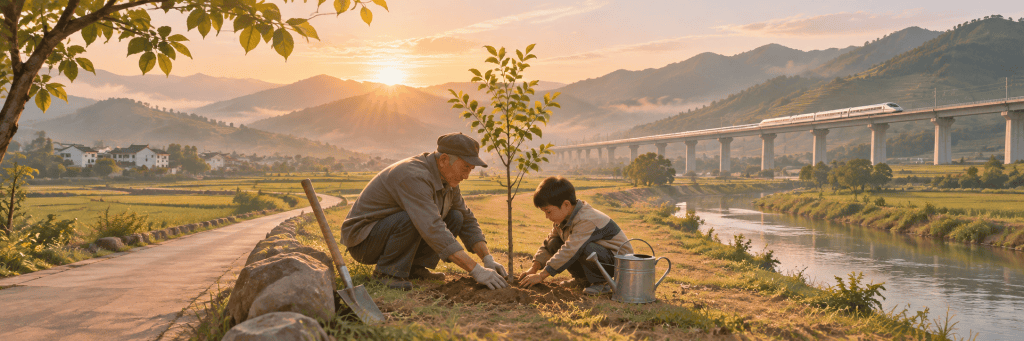
Perhaps this is why the Chinese saying qián rén zāi shù, hòu rén chéng liáng¹ carries such deep meaning for us.
It’s not simply a moral slogan. It reflects something many Chinese people genuinely believe, based on both everyday life and their understanding of the country’s history.
We know that some things are painful, slow, and difficult when they first begin. They may even be misunderstood by many people. But if the direction is right, someone has to take the first step. Otherwise, nothing will ever change.
I’ve come to think that what history education gives Chinese people goes beyond patriotism or an awareness of past dangers.
It also gives us a much longer sense of time.
It teaches us that not everything worth doing must bring an immediate reward. Not every investment that looks unprofitable today will turn out to be a waste. And not every important achievement has to be completed within our own generation.
I think this also has something to do with how a people understand their own place in history.
A people without such a long historical memory, or much experience of sustained investment and governance over generations, may naturally find it easier to trust what they can see in the present.
But China’s experience is different.
Chinese civilization has existed for so long that many things have never been completed within a single generation. They have taken shape gradually, through the efforts of several generations, sometimes more than a dozen.
And perhaps this long history has made Chinese people particularly sensitive to changes that happen slowly, almost invisibly.
We understand that something which seems insignificant today may look completely different fifty years from now.
That’s why I’ve increasingly come to believe that Chinese people’s willingness to think long-term isn’t simply about being more patient or more accustomed to hardship.
It’s because our history has reminded us, again and again, that some truly important things cannot be rushed, and that doing them properly takes real investment.
Avoiding the work today might save some effort in the short term, but the price we pay later could be much greater.
Perhaps this also explains why many Chinese people approach things that seem to have “no immediate use” with an almost stubborn seriousness.
Our history offers so many examples of projects that eventually benefited the country precisely because people kept working on them, even when others didn’t understand their purpose and the results were nowhere in sight.
In the end, long-term thinking has never been just a nice idea. It’s a difficult ability to develop.
What makes it difficult is that you know perfectly well you may see no results today. You may not even live long enough to see them. Yet you still choose to invest your time and effort, to keep going, and to move things forward, even if only a little.
And perhaps Chinese people are often willing to accept this way of thinking because, when we study history, we’re not just learning what happened in the past.
We’re also learning that many things worth doing were never meant to be for today alone. They were meant for the future.
Maybe this is one of the deepest ways history shapes us. It teaches us not only to live in the present, but also to wonder, almost instinctively, what the work of our generation will leave behind fifty years from now.
Cultural Note
¹ Qián rén zāi shù, hòu rén chéng liáng (前人栽树,后人乘凉)
Literally, “Earlier generations plant trees; later generations enjoy their shade.”
This traditional Chinese saying expresses the idea that one generation’s efforts can benefit those who come after it, even when the people doing the work may never enjoy the results themselves.
It is often used to recognize the contributions and sacrifices of earlier generations and to encourage people to think beyond their own immediate interests. In the context of this essay, it represents a belief that meaningful progress often depends on work carried out across generations.
This essay is also available in other languages:
Chinese version: 为什么中国人更容易接受长期主义
German version: Warum fällt es Chinesen leichter, langfristig zu denken?


Leave a Reply