By Jane Sonnenschein First written on April 21, 2026 Revised on October 31, 2026
Some time ago, I came across a news report, or perhaps it was a discussion about how companies recruit people. I can no longer remember exactly which company was involved, but one idea stayed with me.
Apparently, some large companies in China had begun exploring a different approach to recruitment. Instead of waiting until students graduated from university, they were considering selecting promising young people straight out of high school and helping them develop their abilities through practical work and ongoing training.
When I first read about it, I wasn’t particularly surprised. My immediate reaction was that it actually seemed quite reasonable. And almost at once, another thought occurred to me: had these companies finally begun to realize that people with genuine potential might not be standing neatly at the end of a standardized educational path, waiting to be chosen when they graduate from university?
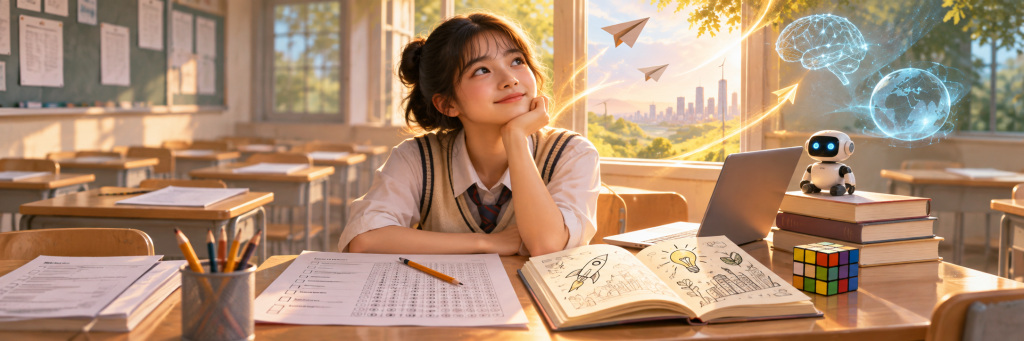
Over the past few years, I’ve increasingly felt that many education systems, especially those built around standardized requirements, examinations, rankings, and repeated selection, are very good at identifying people who fit the system. But they may not be equally good at recognizing people with real potential.
To me, those are two different things.
When people talk about educational selection, they often take certain assumptions for granted. A student who gets good grades must be smarter. Someone who fails to enter a desirable school must lack ability. And when a child is eliminated at a particular stage, it is easy to assume that the children who remain are simply more capable.
But can a person’s abilities and potential really be judged so easily?
The more I think about it, the less convinced I am.
In some education systems, children begin being compared and ranked from a very young age. As they move through secondary school, they face further rounds of selection. In China, for example, the zhongkao¹ and gaokao² not only influence which schools students can attend, but also shape the educational opportunities available to them afterward.
Of course, I understand that any education system responsible for large numbers of students needs some form of standardized assessment. There are many students, high-quality educational resources are limited, and society needs a way to make decisions about who can enter different educational pathways. Unified examinations at least provide a relatively clear set of rules that makes comparison possible.
From an administrator’s point of view, such a system has obvious advantages. Common teaching standards, schedules, examinations, and marking criteria make schools easier to organize and manage. They also reduce assessment costs and allow large numbers of students to be evaluated.
The problem is that when a system has to prioritize efficiency, fairness, and practicality, what it can measure is often only one part of a person’s abilities.
It can tell us who performs well under established rules, but it cannot necessarily tell us who has the greatest potential to grow when facing real problems in the future.
One reason I care so much about this distinction is my own experience at school.
As a child, I was never the kind of student who consistently achieved high marks. That doesn’t mean I did particularly badly. Compared with other children in my neighborhood, people might even have considered me a reasonably good student. But I found it difficult to maintain the steady performance expected of someone who was always supposed to do well.
My grades might be excellent for a while, only to fall again after some time. After being criticized, I would work harder, and my results would improve. But sooner or later, I might become less disciplined, and my performance would fluctuate once more.
For a long time, I assumed this meant I wasn’t hardworking or self-disciplined enough. Only as I grew older did I begin to realize that the problem might not be so simple. Perhaps I was never the kind of person who could remain motivated over long periods by standardized examinations, rankings, and external evaluations.
I was especially poor at multiple-choice questions, true-or-false questions, and reading comprehension exercises that required choosing one correct answer from several possibilities.
For example, I often got multiple-choice questions about classical Chinese poetry wrong. The same happened with reading comprehension. Sometimes I felt I understood a text perfectly well, yet I still couldn’t select the answer the examiner wanted. Strangely enough, when I was allowed to write my own analysis instead, my teachers often said I had done a good job.
It took me many years to understand what this might mean.
Perhaps the problem wasn’t that I had failed to understand the text. Perhaps I simply wasn’t very good at reducing my interpretation to a handful of predetermined options and identifying the one that most closely matched the examiner’s thinking.
Of course, reading comprehension does require standards of judgment, and multiple-choice questions are not necessarily limited to testing memorization. Some are very well designed and can genuinely assess whether students have read carefully, understood a text’s structure, and recognized what its author intended to express.
Still, I believe that when someone has their own understanding of a piece of writing, and the available options don’t fully reflect that understanding, an examination may fail to capture the full extent of their abilities. This is especially true of literary reading, where interpretation, personal response, and expression can be open to different possibilities, while standardized questions must reduce that complexity to a limited set of answers.
Why, then, do schools rely so heavily on such questions? I think one very practical reason is that they are easier to mark.
When large numbers of students are involved, asking everyone to write an open-ended analysis takes considerably more time from teachers. It also creates difficulties with consistent marking, differences in subjective judgment, and disagreements over scores. Multiple-choice and true-or-false questions, by contrast, can be marked quickly, produce clear results, and make it easier to compare students on a large scale.
So it isn’t necessarily that educators fail to recognize the value of open-ended expression. Rather, when an assessment system must balance efficiency, cost, and comparability, standardized answers are often the most convenient solution.
These tools certainly serve a purpose, and in many situations they work well. But being useful doesn’t mean they can measure a person completely.
I’ve gradually come to believe that what needs questioning about many education systems today isn’t that they have no value, but that they still carry a great deal of the thinking that shaped education during the industrial age.
Industrial societies needed large numbers of workers who could receive relatively uniform training and perform their jobs according to established procedures. Whether they were technicians in factories, office clerks, accountants, or people in many other occupations, workers were expected to acquire a fairly stable set of knowledge and skills and carry out their responsibilities within clearly defined organizations.
Under those conditions, large-scale standardized education made sense. Common textbooks, teaching schedules, examinations, and the use of qualifications and grades to direct students toward different schools and careers allowed societies to educate large numbers of people with relatively limited resources.
I don’t think this model was fundamentally wrong. In fact, standardized education has played an important role in making mass basic education and professional training possible.
But society’s expectations of people’s abilities are changing, and education systems may not always be adapting at the same pace.
This is especially noticeable today, when artificial intelligence is developing rapidly, new tools are constantly appearing, and access to knowledge has become easier than ever. Many tasks that once required years of training are becoming much simpler to perform.
Being able to complete standardized tasks accurately is still a valuable skill, of course. But it may no longer be enough, on its own, to give someone a lasting advantage in the future.
I’ve become increasingly interested in a different set of abilities: whether someone can recognize a problem without being prompted, begin working without having every step arranged for them, explore an unfamiliar tool independently, continue learning when their existing knowledge is no longer sufficient, and keep looking for solutions even when there is no ready-made answer.
These abilities are not mysterious, nor do they necessarily belong only to exceptionally intelligent people. Often, they develop gradually through dealing with real problems, trying different approaches, making mistakes, and having the freedom to adjust.
Yet these are precisely the qualities that standardized examinations find difficult to measure.
What worries me even more is that when children spend years following highly uniform learning schedules, becoming accustomed to teachers assigning tasks, textbooks setting the pace, and examination papers defining the correct answers, they may gradually become very good at completing other people’s instructions without becoming equally good at raising questions of their own.
Of course, I’m not saying that students who get good grades lack initiative, or that standardized teaching inevitably weakens creativity. Many excellent students also have strong independent learning skills. A solid foundation of knowledge and systematic training can also provide essential support for independent thinking.
What concerns me is that when an entire evaluation system places too much emphasis on measurable results, abilities that are difficult to demonstrate on an examination paper may receive too little attention.
A child may be excellent at completing clearly defined tasks and know exactly how to achieve high examination scores. But one day, when faced with a situation in which nobody tells them what to do first, and even the problem itself is not fully defined, will they still know how to begin?
This brings me to an interesting contradiction.
We hope education will produce capable people who can think independently, take the initiative to learn, and solve complicated problems. But if the main way children gain recognition throughout their school years is by completing predetermined tasks correctly, where are they supposed to find enough opportunities to practice dealing with situations that have no standard answers?
To me, this is a question education needs to take seriously.
It also explains why I could understand the reasoning behind companies experimenting with selecting young people directly from high school and training them earlier.
This doesn’t mean university education has become useless, or that high school graduates are necessarily more capable than university graduates. Universities provide systematic knowledge, research environments, and professional resources, and many careers genuinely require years of rigorous higher education.
But if what a company really needs is someone willing to learn, able to solve problems independently, and capable of growing through practical experience, perhaps educational qualifications and examination results shouldn’t be the only criteria used to decide whether that person is worth investing in.
After all, people don’t necessarily develop according to the timetable set by schools.
Some children stand out from primary school onward. They learn steadily, achieve excellent grades, and seem to know what they want from an early age. Others may need much more time to discover a direction that suits them.
They might be particularly strong in some subjects and weak in others. They might struggle with standardized examinations or fail to show their strengths within a fixed teaching schedule. Yet in a particular field or a real-life situation, they may demonstrate unexpected understanding and initiative.
Some people need to develop a genuine interest before they become fully engaged. Others can only connect separate pieces of knowledge when they encounter a concrete problem. Still others may have outstanding abilities in one area, but their overall grades remain low because they struggle in other subjects.
Of course, these children may also have real gaps in knowledge or skills that need to be addressed. I don’t believe that everyone who performs poorly at school must secretly possess an undiscovered talent.
But I also don’t believe that someone’s performance at a particular age, in a particular examination, or along a particular educational path is enough to determine how far they may eventually develop.
An education system can make an assessment of someone’s current performance, but that assessment should not become a premature judgment of their entire potential.
Many people who are not selected first are not necessarily incapable. They may simply have failed, at a particular stage, to develop in the way the system finds easiest to recognize.
When I think about it this way, many education systems today remind me of a sieve.
A sieve certainly serves a purpose. We also need rules to help distribute educational opportunities and resources among different people. But what a sieve keeps and what it lets fall through depends largely on the size and shape of its openings.
If it has been designed according to one particular standard, anything that doesn’t fit that standard is naturally more likely to fall through.
Yet not everything that falls through is worthless.
Some people have perfectly good comprehension skills but struggle with standardized answers. Others have interests and potential that don’t translate into consistently good grades at the expected age. Some are especially talented in one area but are held back by weaker performance elsewhere. And others may not fit the orderly, predictable pattern of development that schools expect, yet may flourish through practical experience in the wider world.
What I find most regrettable is that these people may lose certain opportunities too early in life, and may even gradually come to believe that they really aren’t capable enough.
Of course, the real world doesn’t reward only innovation, independent learning, and problem-solving. Many jobs still require a solid foundation of knowledge, rigorous training, and the ability to perform tasks consistently over long periods. Society needs different kinds of people, and no single method can recognize every kind of ability.
But the more rapidly the world changes, the more important it becomes to acknowledge that people’s abilities take different forms, and that no one evaluation method can suit everyone.
Especially now that artificial intelligence can handle an increasing number of standardized tasks, shouldn’t we create more room for abilities that are harder to measure through standardized assessments, allowing them to develop and be recognized?
Looking back at that discussion about companies recruiting and training high school graduates, perhaps the reason I didn’t find the idea particularly surprising was that it raised a question I had already been thinking about.
If the people companies need cannot always be accurately identified through traditional educational pathways, shouldn’t recruitment methods that rely mainly on qualifications, examinations, and standardized evaluations gradually become more open?
Of course, a news item whose precise source I can no longer remember is not enough to prove that recruitment practices are changing across the business world. Nor does it justify concluding that education systems have lost their ability to identify capable people. Still, I believe the idea itself is worth discussing.
Because it reminds us that a person’s abilities do not suddenly become valuable only after they have completed a prescribed educational path.
Education systems certainly continue to serve important purposes, and they will remain essential for organizing educational resources and developing professional skills for a long time to come. Perhaps what we really need to be careful about is not that these systems have stopped working, but that they continue to operate so efficiently that we may mistake that efficiency for accuracy in identifying talent.
When a system consistently selects people who meet its standards, it is easy to believe that it has also selected those most worth nurturing.
But there is always a gap between those two judgments.
I think the real question today isn’t whether we should have examinations or whether grades should matter. It’s whether we can maintain necessary standards of evaluation while also creating more opportunities for people who develop at different speeds, have different combinations of abilities, or think in different ways to be recognized.
After all, education should do more than establish which standards a person has reached at a particular moment. It should also help us discover what that person might become.
If a system grows increasingly good at selecting those who meet its existing standards, while leaving too little space for people who have not yet met them but still have the potential to grow, then what it misses may be more than certain students’ opportunities to continue their education.
It may also miss abilities that could have developed gradually in a different environment.
Notes
1. Zhongkao (中考)
The zhongkao is China’s examination for admission to upper secondary education, usually taken at the end of junior secondary school, around the age of fifteen. Results play an important role in determining which educational pathways students can enter, including academically oriented high schools and vocational education. Admission arrangements and available options vary by region. Unlike a simple end-of-year school examination, the zhongkao can significantly influence a student’s subsequent educational opportunities.
2. Gaokao (高考)
The gaokao is China’s national college entrance examination, generally taken at the end of senior secondary school. It is one of the main factors determining admission to universities and different levels of higher education. Because university places and institutional reputations vary considerably, examination results can have a major influence on students’ future educational options. Although admissions policies differ across provinces and institutions, the gaokao remains a central part of China’s university selection system.
This essay is also available in other languages:
Chinese version: 为什么今天的教育制度,越来越像在错过真正有潜力的人
German version: Warum das heutige Bildungssystem immer häufiger Menschen mit großem Potenzial übersieht


Leave a Reply