By Jane Sonnenschein · June 19, 2026
Futurist Alvin Toffler is often paraphrased as saying that the illiterate of the future will not be those who cannot read or write, but those who cannot learn, unlearn, and relearn.
I had read that idea before and more or less understood what it meant. But until today, it had never felt quite so concrete to me. Sometimes a huge question about the future does not enter your mind through a grand speech or a complicated theory. Sometimes it begins with an old pair of shoes that your child has just washed and put back on.
The shoes had already been worn for quite a while. They looked a little dirty, even somewhat worn out. Alicia was still very fond of them because the soles were slightly thick, and wearing them made her feel a little taller.
She is 129.5 centimeters tall now, while some of the taller girls in her class are already close to 150. I used to casually say things like, “Why aren’t you growing taller yet?” Looking back, I think I should say things like that less often. A child’s body has its own pace. Something an adult says without thinking can easily become pressure in a child’s mind.
The shoes had become so dirty recently that I could barely stand looking at them. The laces kept coming undone too, and I had been putting off washing them for ages. Eventually I finally cleaned them and left them out on the balcony to dry.
The annoying part was that once I had taken the laces out, threading them back through the holes was surprisingly difficult. So I simply left them out.
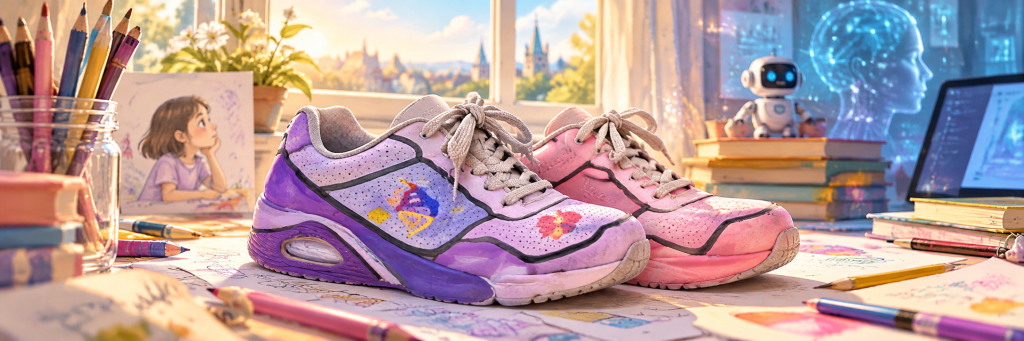
Then today, Alicia somehow managed to put the laces back in herself. At school, she had also colored the shoes.
While we were sitting in the car, she looked down at them and said quite naturally, “Wow, why do my shoes look so pretty now?”
At first I thought she meant they looked better because I had washed them. Only later did I realize that she had painted them herself.
I am not telling this story to say, “Look how talented my child is at drawing.” Nor do I want to turn one small interest into some grand statement about talent.
What made me stop and think was how naturally she had done all of it.
She liked an old pair of shoes because they were comfortable, so she wanted to keep wearing them. The laces were difficult to put back in, so she figured out how to do it herself. The shoes did not look quite the way she wanted, so she added her own colors.
She was not completing an assignment, and she was not working toward a correct answer. She was simply taking an old object from real life and slowly turning it into something that felt like her own.
That little moment could easily have ended there.
But on the same day, I happened to listen to a podcast about AI, Chinese immigrant families, and layoffs in the tech industry. Somehow, the two things suddenly connected in my mind.
The podcast mentioned American technology companies, Chinese engineers, the proportion of executives of Indian origin, and the way AI automation is changing jobs. I only heard the figures once and did not verify them one by one, so I do not want to repeat specific numbers here.
What stayed with me was not any particular statistic. It was the larger question behind them:
A path to upward mobility that many families of Chinese heritage have trusted for decades may now be starting to shift under the pressure of AI.
We know this path very well.
Parents study relentlessly, leave small towns through academic success, enter top universities, move to the United States or Europe, and climb into the middle class through careers that seem stable, respectable, and well paid—engineering, medicine, law, finance, research.
Then they pass the same expectations on to the next generation.
Children take extra classes from an early age, drill problems, enter competitions, aim for elite universities, study computer science, join major companies, earn high salaries, buy homes, and eventually enter what looks like a secure middle-class life.
This path was not invented out of nowhere.
For many immigrant families, it genuinely worked. In some cases, it was a path tested through years of sacrifice, hard work, and pain.
But now the problem is that the lowest rung of that ladder may be disappearing.
In the past, a young person entering a large company could start with basic work and slowly build experience. An ordinary junior engineer might begin by writing code, executing specific tasks, or handling one small part of a larger project.
At least there was an entry point.
There was somewhere to begin, somewhere to “level up.”
But if AI agents and automation tools increasingly take over some of the standardized, repetitive, entry-level technical work, many young people may find that the first rung is gone before they even have a chance to step onto it.
Parents used to believe that as long as a child worked hard enough, they could climb upward step by step.
The problem in the future may not be that children are unwilling to work hard.
It may be that the ladder itself is no longer as stable as it once was.
That, I think, is where parents’ real anxiety should be directed.
Not simply toward whether a child gets high grades, chooses a popular major, or enters the supposedly “right” field.
The deeper question is whether the path we once used to define safety has itself begun to change.
Families of Chinese heritage are particularly susceptible to this template: study hard, avoid unnecessary detours, choose a promising field, enter a major company, earn a stable and high income.
That logic was powerful during the industrial era and the decades of expanding globalization. It turned education into something like a production line, while encouraging children to become as standardized, excellent, and mistake-free as possible.
But the things AI is most capable of disrupting are precisely the parts that are easiest to standardize, reproduce, and break down into processes.
If a child grows up learning only how to compete within existing rules, how to produce standard answers, and how to follow a path designed by someone else, then the moment the rules change, the path breaks, or the old answers expire, that child may actually struggle more.
None of this means that studying is useless.
It does not mean computer science, engineering, medicine, or law have suddenly become unimportant either. That conclusion would be far too simple.
What needs to change is not whether children should work hard, but what we mean by “working hard.”
For many parents, hard work used to mean doing more exercises, taking more exams, collecting more qualifications, getting into better schools, and learning a skill that looked promising.
But the effort that matters in the future may look different.
Can you learn something new quickly?
Can you judge how a tool should be used?
Can you ask good questions?
Can you combine ideas across different fields?
Can you find a new position for yourself when circumstances change?
The future may not simply divide people into those who know a particular technology and those who do not.
Perhaps the more important divide will be between two kinds of people.
One group is pushed along by tools and fears being replaced.
The other learns to use those tools, turning them into assistants, employees, and amplifiers of their own abilities.
It is understandable that the first group feels threatened by AI. If most of someone’s value comes from repetitive execution, standardized procedures, and replaceable processes, of course automation feels frightening.
The second group may feel anxious too, but they are more likely to keep asking different questions:
What can this tool do for me?
Can I use it to improve the speed or quality of my judgment?
Can I let it handle the repetitive parts and save my attention for the things that require more human judgment?
The most important thing here may not actually be technology itself.
It may be judgment.
For a long time, we have been too quick to define ability as intelligence, grades, learning speed, or mastery of a particular technical skill.
But when the world changes, ability also includes things that are much harder to test.
Can someone recognize a trend?
Can they tell what is disappearing and what is beginning to emerge?
Can they admit that an old path no longer suits them?
Can they change direction even while feeling anxious?
Knowing how to write code is certainly a skill. But as tools increasingly assist with, or partly replace, the act of coding itself, something else becomes more important: knowing what should be built, why it should be built, whose problem it solves, and how to judge whether the result is actually right.
The podcast also mentioned an interesting phenomenon.
Some second-generation immigrants grow up in highly educated, high-income families with respectable professional backgrounds, graduate from elite universities, and then choose not to become the doctors, lawyers, or engineers their parents expected.
Instead, they become tattoo artists, music teachers, work in the arts, or choose other careers that may not seem particularly “respectable” through a traditional Chinese lens.
These choices can easily create conflict.
In many Chinese or Chinese immigrant families, such work may seem less stable, less prestigious, and less worthy of all the resources parents invested in their child’s education.
Parents may think: We gave you so much, and now you are not going into a major company or becoming a highly paid white-collar professional. You are choosing a career that does not even look serious.
For many parents, that can be very difficult to accept.
But looked at from another angle, these choices may not be as impractical as they appear.
Many jobs that are difficult to replace completely in the future may be closely tied to the physical world, the human body, relationships between people, aesthetics, and judgment.
Art will also be affected by AI. Creative work is not automatically safe.
But human creativity is not simply the ability to draw a beautiful line or produce a polished image.
Human creation contains experience, irregularity, hesitation, emotion, and the kinds of imperfect traces that somehow make something feel real.
AI can produce images that are smooth, complete, and impressive.
But why a person chose to draw something in a particular way, why they decided to transform an object, and why they placed their own feelings into it—those questions are not simply about efficiency.
And that is exactly what Alicia’s shoes made me think about.
She did not paint on them because she wanted to study art one day. She was not trying to prove that she should become a designer.
What mattered was something much simpler.
She did not see an object from everyday life merely as “something that had been bought.” She saw it as something that could be reinterpreted, repaired, and expressed through her own hands.
She liked the shoes, so she wanted them to keep existing.
They became dirty, so we washed them.
The laces came out, so she put them back in.
She did not like the colors anymore, so she painted them herself.
There is something very basic and alive in that kind of ability.
She is willing to use her hands.
She is willing to change things.
She is willing to place her own way of seeing into the physical world.
This ability may not immediately become a grade, and it may not immediately turn into a career plan.
But perhaps it is closer to what the future will require than many standard answers are.
Because the people the future needs may not simply be those who can complete assigned tasks.
They may be people who can notice problems, recombine things, use tools, express themselves, understand other people, and judge which direction to take.
Of course, changing the way we think about education is difficult for parents.
Many parents already sense that the world is changing. They know the wave of AI cannot be held back simply by saying, “Don’t worry.”
And yet their instinct is still to push children toward the old path.
The old road may already be loosening beneath our feet, but at least we can still see it.
The new roads may exist, but they are uncertain.
Parents do not necessarily believe that template-based education is ideal. Often, they simply do not know what should replace it.
So they worry, while continuing to push children toward more exercises, better grades, elite schools, and popular majors—as if running fast enough might allow a child to cross the old system before it fully starts to collapse.
Adults often react to AI in much the same way.
One person thinks AI will replace everyone and becomes deeply afraid, perhaps even wanting to escape before they are replaced.
Another person feels pressure too, but begins learning how to use AI and turn it into a tool.
Behind those two reactions are two very different ways of responding to change:
“Change is coming, and I am going to be swallowed by it.”
Or:
“Change is coming. I need to understand again what I can do.”
Parents pass these patterns of thinking on to their children too.
If parents themselves respond to change only with fear, education can easily become control:
You must get good grades.
You must choose the safe path.
You must not make mistakes.
You must get into the place that I believe will protect you.
But if parents can slowly accept that no path in the future will be absolutely safe, then perhaps education can shift from “putting a child onto the right track” to helping a child develop the ability to keep learning and choosing when the tracks themselves change.
That does not mean letting children do whatever they want.
Quite the opposite.
It requires even more judgment from parents.
Rejecting one rigid template does not mean having no standards. Respecting a child’s interests does not mean abandoning basic skills.
Children still need to read and learn. They need to develop attention and responsibility. They need solid foundations in language, mathematics, logic, and expression.
But these things should not exist only to push a child into an old template.
They should become basic tools the child can later use to rearrange their own life.
When I looked at Alicia’s hand-painted shoes today, I was not thinking, “Should she go into art someday?”
What I thought was this:
In a world that is changing faster and faster, I do not want her to be trained only to obey a template.
I hope she can read and also use her hands.
I hope she can learn and also express herself.
I hope she can use tools while keeping her own judgment.
I hope she can see the standard answer without losing the ability to look beyond it.
She can choose any career in the future.
But I hope the part of her that is willing to remake an old object, add color to everyday life, and turn something she loves into something of her own is not worn away too early.
A great deal of parental anxiety comes from love.
Parents are afraid their children will suffer. They are afraid of wrong turns and unstable futures.
But sometimes that very love makes us cling tightly to paths that worked in the past, because letting go feels too risky.
The problem is that when the world has already changed, holding on more tightly does not necessarily make a child safer.
If a child is trained only to function well inside an old system, then as that system starts to loosen, they may actually feel more helpless.
Perhaps what matters most in the future is not that parents choose one permanently correct path for their children in advance.
Perhaps what matters is that a child slowly develops another kind of ability:
When the road changes, they can see it.
When the tools change, they can learn.
When old answers stop working, they can ask new questions.
And when everyone else is panicking, they can still judge where their next step should go.
Those hand-painted shoes, of course, cannot prove very much.
They are only an old pair of shoes, a little color, and something a child casually transformed at school.
But sometimes a mother’s understanding of education changes precisely through moments this small.
I used to worry that Alicia was growing slowly. I worried about what she might study one day, and whether she would find a stable path through the world.
Today, though, I suddenly felt that perhaps instead of rushing to push her onto the supposedly correct ladder, I should protect some of the things in her that have not yet been standardized.
Because the future may no longer reward only those who know how to keep climbing an old ladder.
It may need people who, after the ladder has been taken away, can still look around and notice that there is wood, rope, a wall, tools—and their own two hands.
And then find another way.
This essay is also available in other languages:
Chinese version: 当AI抽走那级梯子,我突然看懂了女儿那双手绘鞋
German version: Als KI eine Sprosse aus der Leiter herausnahm, verstand ich plötzlich die handbemalten Schuhe meiner Tochter


Leave a Reply