
By Jane Sonnenschein · June 2, 2026
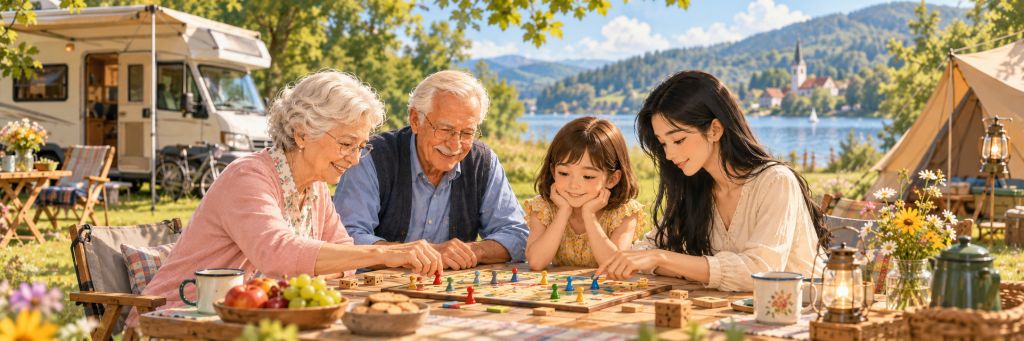
Last Saturday, Alicia’s former childminder, a licensed home-based childcare provider in Germany, and her husband drove us to the campsite where they now spend much of their time.
I call it a campsite, but it was quite different from what I used to imagine—a place where people pitch a tent for a night or two and then leave. This one has sixty or seventy permanent pitches. Many people leave their camper vans there long-term, put up an awning or tent beside them, and slowly turn that little patch of land into a second home.
There are flowers and grass, little tables and deck chairs. Some people grow a few vegetables, fix their fences, pull weeds, and water plants. It looks a little like the small garden plots many Germans rent, except that instead of a little garden house, the camper van and tent are at the center of everything.
They used to travel around in their camper van as well. During the pandemic, they even drove all the way to the Italian coast and stayed there for quite a while. But as they got older, they began to feel that traveling always came with too many unpredictable problems. The vehicle could break down. Something could go wrong on the road. Everything had to be arranged as they went.
So now they simply keep the camper van in one place and stay there whenever the weather is good.
Sitting there that day, watching them lie in the sun, drink coffee, and slowly tidy up the grass around their pitch, I suddenly felt very strongly that sense of ease I often notice in Europeans.
It is a kind of ease that is much harder to find in Chinese life.
When I used to visit China, I would sometimes meet friends who ran businesses. During a single meal, their phones would barely stop ringing. One customer, another order, supplies coming in here, shipments going out there—the whole person seemed to be running at high speed all the time. Even when they were physically sitting at the table, their minds never really stopped.
In Germany, by contrast, especially in summer, people really do take holidays. If you email certain companies in July or August, you may simply get no reply, or an automatic message saying the person is on holiday. In many industries, the pace noticeably slows during the holiday season. Some places almost seem to pause altogether.
I used to find that kind of ease almost unbelievable.
But after living in Germany for many years, I gradually realized that it does not appear out of nowhere. Behind it is a whole set of shared social rules that people more or less take for granted.
People know when it is time to work and when it is time to rest. They know that if someone is on holiday, you cannot simply expect an immediate reply. They know how people are supposed to behave in public spaces, how a game is played, and that certain things are simply done according to agreed rules.
That day we had brought several games with us. One of them was Mensch ärgere dich nicht, a classic German board game similar to Ludo.
As we sat around the table playing, I was struck by how deeply that generation of Germans seemed to have internalized the idea of rules.
Whose turn is it? How are you allowed to move? When can a piece enter the board? When can it not?
Everyone took these things seriously.
Not in an unpleasantly strict way. It was more a very natural, matter-of-fact precision. For them, the rules simply belonged to the game. If you had chosen to sit down and play, then you played according to the rules.
I joked at the time that they really were very typical Germans.
They are both in their seventies, and they have some qualities I often associate with an older generation of Germans. They may not be especially warm or expressive, but they have a strong sense of order. Rules matter to them, as do boundaries and respect between people.
It made me think about the years when Alicia was little and they cared for her.
From the time she was a little over one until she was three and a half, this woman was her childminder. Looking back now, I still feel very lucky.
At the time, finding a good childminder was not easy. Many looked after five children at once, and places were limited. We visited others too, but they would usually tell us to go home and wait while they decided whether our child would fit into the group. Then we simply never heard from them again.
She was different.
I happened to see her post online and sent her an email. Her husband called me quite quickly. He explained that she was busy looking after the children during the day, so he mainly handled the administrative side. The first thing he asked was whether we minded that they had a small dog at home. If not, we could arrange a time to meet.
Later we went to their house, and she even showed me the paper she had written during her professional training as a childminder.
She had originally studied mechanical engineering. Later, because she had several children of her own, she changed careers and became a childminder. Their home was not very large, and she did not want to rent another space, so she only cared for two children.
Perhaps because there were only two, she could look after them very carefully and patiently. She cooked their meals herself as well.
More importantly, she cared a great deal about rules.
What time the children ate. When they slept. When they went outside. How they behaved with other children. How they spoke to people, how they waited, how they respected others.
All these things may sound small, but in her home they were never left entirely to chance.
She was not someone who controlled children by shouting at them. But she gave them clear boundaries. What was allowed, what was not, and why something was not allowed—the children slowly learned all of this through a stable daily routine.
The older I get, the more important I think this kind of early education really is.
Many people assume that when children are very young, the main thing is simply to make sure they eat well, sleep well, and stay safe.
But at that age, children are learning much more than language and daily habits. They are also learning an entire set of rules for living together with other people.
Later that day, we talked about what is happening in schools.
There are now many children from different countries and cultural backgrounds in German schools. Diversity itself is of course not the problem. It is perfectly normal for people to move into a society bringing different languages, foods, religions, and family customs.
The problem begins when people live in the same country without developing a shared understanding of the rules that govern public life.
Then schools—and eventually society itself—become harder and harder to run.
Alicia has told me that some children in her school still talk loudly during lessons and even during tests. Sometimes the teachers do not seem to have many options. They may even give children noise-reducing earmuffs so they can block out the surrounding sound and concentrate.
The first time I heard that, I could hardly believe it.
There are only around twenty children in a class. If children need to wear ear protection during a test just to escape the noise around them, then the problem is no longer simply that one child is misbehaving. The order of the classroom itself has already been affected.
Her former childminder said that many children today really do lack basic education—not academic education, but the basic things involved in living with other people.
How do you behave in a public space?
How do you follow common rules?
How does a child learn to respect other people and understand that their own behavior affects those around them?
That stayed with me.
Germany, in many areas of life, does not primarily run on personal relationships. It runs on rules and trust.
Waste separation.
Quiet hours.
Queuing.
Public transport.
Order in the classroom.
Boundaries between neighbors.
Public services that assume people will follow the procedures.
These things seem completely ordinary. But together they form the underlying order of everyday life in Germany.
Waste separation is a good example.
The German recycling system works because most people more or less agree to sort their rubbish. Plastic, paper, glass, organic waste, residual waste—everything goes where it is supposed to go.
The system does not work because somebody stands beside every bin checking what people throw away. It works because residents collectively follow the rules.
If more and more people in an apartment building begin throwing things wherever they like, the consequences do not fall on one person alone. Everyone ends up dealing with them. The bins become contaminated, the property management sends warnings, costs may rise, and relationships between neighbors deteriorate.
That is the most fragile part of a rule-based society.
When it works efficiently, it is because people are willing to follow shared rules.
When it begins to fail, it is often because more and more people start thinking: no one is watching anyway; being a little careless does not matter.
The problem is not that someone keeps their own cultural habits.
People can speak their own language, eat their own food, celebrate their own holidays, and practice their own religion. None of that is a problem.
The real issue is that public life requires shared rules.
You can keep your own culture, but public rules cannot become optional.
You can have your own habits at home, but when your child goes to school, they need to learn how a classroom works.
You can come from any background, but when it comes to waste separation, public quiet, boundaries between neighbors, and traffic rules, there still has to be a common baseline.
Otherwise, a society that once functioned cheaply because people trusted one another begins to become expensive.
In the past, you did not need someone watching everywhere because people were expected to follow the rules.
But if more and more areas of life eventually require reminders, supervision, fines, complaints, and extra administration just to function, then the cost of running society rises.
Parcel delivery works the same way.
If people can generally trust that parcels will be delivered properly, recipients do not have to worry about every package. But once parcels are routinely left with neighbors without a note, signatures become unclear, and people have to go from door to door searching for their deliveries, writing emails and requesting an official trace, the cost of lost trust has already risen.
Deutsche Bahn delays are another example.
If trains are usually on time, people can plan their lives around the timetable. But if delays become normal, everyone has to allow more extra time, avoid tight connections, and trust plans less.
On the surface, that looks like a transportation problem.
In reality, it also becomes a cost of everyday life.
One of the most valuable things a society has is not simply money, technology, or pages of laws and regulations.
It is whether ordinary people can still trust that the rules of everyday life are functioning.
Can children go to school and expect a reasonably quiet classroom?
Can older people take time off and actually relax?
When a parcel is delivered, is responsibility clear?
Will people sort their rubbish without someone checking?
If something goes wrong in a public service, will anyone actually take responsibility?
None of these things sounds grand.
Yet they determine the texture of everyday life in a country.
Sitting at that campsite, watching Alicia’s former childminder and her husband, I suddenly understood a little better why the sense of rules I see in that older generation of Germans feels so noticeable today.
They are not perfect people, and I am not suggesting that Germany in the past had no problems.
But their generation seems to carry a deeply learned social habit: rules are not something to negotiate every time, nor something you follow only when someone is watching.
Rules are a condition for living together.
That can look old-fashioned. Sometimes it can even feel inflexible.
But the things that allow a country to remain quiet, orderly, and functional over long periods are often exactly these rather unromantic habits.
The challenge now is that as society becomes more diverse and population movement becomes more complex, shared rules have to be taught again, reaffirmed, and actively maintained. Otherwise, they slowly loosen.
And perhaps the most troubling part is what happens afterward:
people get used to it.
The classroom is noisy, so children are given earmuffs.
Parcel delivery becomes unclear, so people search the whole building themselves.
Trains are late, so everyone simply assumes in advance that the train will be late.
Rubbish is thrown into the wrong bins, so the property management sends another reminder.
Every time, it is a small thing.
Every time, there is some temporary solution.
But little by little, the way of life that once depended on shared rules begins to be rewritten.
That is why I increasingly feel that what a rule-based country should fear most is not foreign culture itself, nor the fact that society becomes more diverse.
It is the slow erosion of shared rules.
If a society welcomes diversity but stops insisting on common rules, diversity eventually becomes everyone simply living by their own standards.
If a society talks only about tolerance but becomes afraid to demand basic order, tolerance eventually becomes a situation in which no one is responsible.
If a society is so afraid of conflict that it no longer dares to say where the boundaries of public life lie, the people most affected are often those who were already trying to follow the rules.
This is not an argument against immigration, nor is it nostalgia for some completely closed version of the old Germany.
Germany clearly needs new people, new workers, and new cultures. A society cannot remain frozen in the past forever.
But integration has never been only a matter of language. Nor is it simply a question of obtaining a residence permit, finding a job, or sending your children to school.
Real integration also means understanding and respecting the public rules of the society you live in.
It means children learning at school not to disrupt everyone around them.
It means families understanding that public space is not their living room.
It means everyone recognizing that if they benefit from the convenience of a system, they also carry some responsibility for maintaining it.
When a rule-based society begins to lose its shared rules, it does not collapse overnight.
It simply becomes more troublesome.
More expensive.
Less efficient.
More exhausting for ordinary people.
And the first thing that changes is often not the system itself, but people’s expectations.
At first, you assume other people will follow the rules.
Then you start wondering whether they will.
Eventually, you simply assume that many things will not work as they should.
That is what I find most unsettling.
A society’s real order does not live only in its laws or on notices posted on walls.
It lives in the everyday habits of most of the people who share that society.
When those habits are still there, rules feel as natural as air.
When those habits slowly disappear, the air begins to thin.
And by the time people finally feel that it is becoming hard to breathe, the problem is no longer one particular rule.
Too much of the basic trust that makes shared life possible has already been used up.
This essay is also available in other languages:
Chinese version: 一个靠规则运转的国家,最怕共同规则慢慢失效
German version: Was ein Land, das von Regeln lebt, am meisten fürchten muss: dass gemeinsame Regeln langsam ihre Wirkung verlieren


Leave a comment