By Jane Sonnenschein · May 21, 2026
Today, as I came across a trending topic on the eve of the fifth anniversary of the death of Yuan Longping, the Chinese agricultural scientist best known for his pioneering work on hybrid rice, I assumed it would be another memorial piece filled with grand words about a “peerless national hero.”
But what really made me stop was not any of those grand words.
It was one very small gesture.
Deng Ze, now nearly ninety, went to the cemetery to pay respects to her husband. Someone beside her tried to support her as she walked, but she refused.
She moved very slowly, yet she still wanted to walk, step by step, to Yuan Longping’s grave on her own.
At that moment, I suddenly thought: some forms of love look like walking side by side when you are young. In old age, they become one person moving very slowly, but still wanting to make the journey to you herself.
Yuan Longping died in Changsha on May 22, 2021, so strictly speaking, the fifth anniversary of his death is tomorrow. What appeared in the trending topics today was more like an early moment of remembrance on the eve of that anniversary.
But this time, what I thought about was not only love.
I thought about a bag of rice.
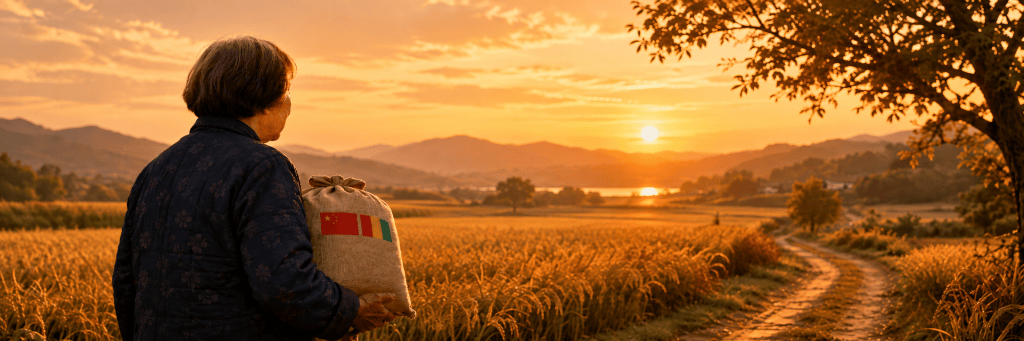
Not long ago, Yuan Longping’s wife, Deng Ze, received an unusual gift: a five-kilogram bag of hybrid rice grown in Guinea, a country in West Africa.
On the front of the sack were the flags of China and Guinea, with four large Chinese characters beneath them: Yuan Rice.
It was not an ordinary commemorative gift. The prime minister of Guinea had asked Fang Zhihui, one of Yuan Longping’s students, to bring it back to China and personally deliver it to Deng Ze. According to a report by People’s Daily, the French inscription on the back of the sack described it as “a perfect symbol of China–Guinea cooperation.”
When I reached that part, something in me suddenly ached.
Because in that moment, it no longer felt like just a bag of rice.
It felt more like a letter sent back from somewhere far away.
Yuan Longping has been gone for five years, but the dream he planted all those years ago is still growing on the other side of the world.
Today, when we talk about having enough to eat, it feels almost too ordinary to mention.
So ordinary that when a child eats too slowly, we hurry them along.
So ordinary that when rice is left in a bowl, we frown.
So ordinary that many young people might say: it’s just a bowl of rice. What is so remarkable about that?
But for people who have truly experienced hunger, having enough to eat has never been a light or ordinary thing.
I was born in the 1980s. To be honest, I never lived through a time when there genuinely was not enough food.
My family may not have been well-off when I was young, but things were never so desperate that we had to dig up tree roots, eat grass or Guānyīn tǔ,¹ or wait without knowing whether there would be anything at all to eat.
Strangely enough, my strongest image of hunger came many years later, from a video.
At the time, I wanted to teach my daughter not to waste food, so I found a video online showing children suffering from hunger in Africa.
One child in the video was so thin that he seemed to be little more than skin and bones. He was truly hungry. But his mother had no food to give him, so she put stones in a pot and boiled them, pretending that she was cooking, telling him to wait a little longer.
That was not cooking.
That was a mother, in desperation, using the last bit of imagination she had left to postpone her child’s hunger.
I have never forgotten that image.
In Chinese, we have the expressions wàng méi zhǐ kě² and huà bǐng chōng jī.³ But when something like that is no longer an idiom and actually happens to a hungry child, it becomes one of the cruelest realities imaginable.
I have experienced hunger myself.
When I was dieting, for example, I once chose to fast for four or five days. That kind of hunger was unpleasant too. My stomach felt empty, my body weak, as though all my strength had been drained away.
But that kind of hunger is nothing like real famine.
Because I knew that the moment I chose to, I could eat.
There was food in the fridge. Food in the supermarket. Bakeries on the street. Rice, flour, oil and other staples in the kitchen.
My hunger was a choice.
For many people, hunger means having no choice at all.
They are not refusing to eat. There is simply nothing to eat.
When hunger becomes severe enough, people eat roots, grass, even earth. They put things into their mouths even though they know perfectly well those things were never meant to be food.
Someone who has never lived through that may never really be able to imagine how hungry a person has to become before they can swallow such things.
For a long time, I did not really understand my parents’ generation and their habit of saving everything.
My parents were born in the 1950s.
The world they grew up in is not actually that far away in time, yet to children today, the life they lived can feel like another world entirely.
My father once told me that when they were children, even during Chinese New Year, there were not enough complete sets of decent clothes for all the brothers and sisters in the family.
Whoever had to go out was the one who got to wear the one relatively presentable outfit.
He also told me that when he was young, there was no money for proper shoes. Walking outside on rainy days was difficult in ways that are hard for people today to imagine.
And then there were the sweet potatoes.
Back then, there were not roads, tunnels and cars everywhere as there are now. Much of Zhejiang is hilly, and if someone wanted to take sweet potatoes to a market somewhere else, they had to carry them over mountains and walk a very long way.
Whenever my father told me things like this, I was often shocked.
To me, mountains are scenery, roads are transportation, and sweet potatoes are food.
But for his generation, a mountain was something life required you to cross. A road was hardship you walked one step at a time. And a sweet potato was sometimes not a matter of what you felt like eating, but a little bit of hope that might help you survive.
That is also why I used to find my mother’s thriftiness so difficult to understand.
She would have a perfectly good orange and refuse to eat it. Then, once half of it had gone bad, she still could not bear to throw it away. She would cut off the spoiled part and eat whatever remained.
There would be an old cleaning cloth at home that had already fallen apart into strips. I would think: this really has to go. A cloth costs almost nothing now. Why use it until it reaches this state?
But if I threw it away, she would become very angry.
When I was younger, I sometimes wondered whether this kind of behavior was almost pathological.
Later, I slowly began to understand.
Some kinds of frugality are not simply habits.
Some are memories left in the body after a person has been hungry, poor, and afraid.
Those memories do not automatically disappear just because life becomes better.
They remain in the hand that cuts the good half from a rotten orange, in the old cloth someone cannot bear to throw away, behind the repeated words “don’t waste it,” and inside all the stories parents tell their children again and again about the past.
People of my generation often think our parents save too much, deny themselves too much, and do not know how to enjoy life.
But it is not that they fail to see how much better things have become.
They simply know too well how bad things once were.
And that is why Yuan Longping’s greatness cannot be understood through the word “scientist” alone.
Of course, he was a scientist.
His work involved highly specific and extremely difficult agricultural research.
Rice is primarily a self-pollinating plant. Put simply, most of the time, pollination happens within the same tiny flower.
So producing hybrid rice on a large scale is not as simple as planting two varieties next to each other.
The real difficulty lies in finding or developing a male-sterile parent plant—one that cannot pollinate itself but can still receive pollen from another rice plant.
Only then can the strengths of two different varieties be combined in the first generation of hybrid seeds, producing stronger yields and vigor.
That sounds technical.
But translated into human life, it means more grain, more bowls filled with rice, and more children who do not have to go to sleep hungry.
Of course, the fact that people in China eventually gained reliable access to enough food cannot be attributed to one person or one technology.
It also depended on changes in agricultural policy, improvements in production conditions, the broader development of the country, and the work of countless farmers and agricultural researchers.
But Yuan Longping and hybrid rice were undeniably an extremely important part of that story.
The meaning of his work was not simply that one field could produce a certain number of extra kilograms of grain.
He placed an extraordinarily simple—and extraordinarily great—hope at the center of his life’s work:
that more people could eat enough.
It is such a simple wish.
So simple that today it may not even sound grand enough.
But to someone who has known real hunger, there may be no greater ideal.
A child does not have to fall asleep hungry.
A mother does not have to boil stones to comfort her child.
A family does not have to cross mountains for a few mouthfuls of food.
A whole people no longer have to live with the fear of whether there will be enough to eat hanging over their heads.
Is that not great enough?
And that is why the bag of “Yuan Rice” from Guinea moved me so much when it was placed in Deng Ze’s hands.
It was not simply a bag of rice.
It was an answer from a distant piece of land.
Yuan Longping once hoped that hybrid rice would go out into the world, so that people in more countries and more regions might have a chance to leave hunger behind.
Five years later, rice grown on African soil was carefully packed into a sack, carried thousands of miles, and placed in his wife’s hands.
In that moment, it felt almost as if the world itself were answering him:
You can rest easy. The dream you planted is still growing.
That is also why I found Deng Ze’s refusal to be helped as she walked toward the grave so moving.
She was not only walking toward her husband’s grave.
She was walking toward a whole life they had lived together.
No one can devote an entire lifetime to rice fields through willpower alone.
For Yuan Longping to spend so many years traveling between experimental fields, there had to be a family behind him carrying part of the burden, a wife taking responsibility for things he could not, and parents who understood the work he had chosen.
Deng Ze took care of the family and the elderly, holding up all those ordinary but heavy parts of daily life.
And near the end of his own life, Yuan Longping’s father reportedly understood that his son was at a crucial stage in his breeding work and did not want to call him home lightly.
A truly great undertaking often has one person’s name written on its surface.
But behind that name, there is usually a group of quieter people standing in the background.
Their names may never appear on medals. They may never make the headlines. They may never be praised again and again.
But they were part of that road too.
So when I saw Deng Ze walking, one slow step at a time, toward her husband’s grave, it did not feel like an ordinary scene of remembrance.
It was an elderly woman walking toward the person she had once chosen when she was young.
And it was also an era walking toward the man who had once helped protect the rice bowls of so many people.
Today, we have more clothes than we can wear and often more food than we can finish.
We declutter our wardrobes. We go on diets because we have eaten too much. We become annoyed when our children leave food on their plates.
And precisely because of that, perhaps we need to remember even more clearly:
Having enough to eat has never been something humanity could simply take for granted.
For our parents’ generation, it was once a luxury.
For children in many poor parts of the world, it is still a longing.
And it was the question Yuan Longping spent his whole life trying to answer.
He has been gone for five years.
But the rice is still growing. The smell of cooked rice is still rising from kitchens. And on distant land, new hope is still taking root.
Perhaps this is what true greatness looks like:
A person may no longer be here to see every harvest.
But what he once planted is still feeding the world.
1. Guānyīn tǔ (观音土) — Literally “Guanyin earth,” a type of fine clay that desperate people were known to eat during periods of severe famine in China. It contains little or no nutritional value and can be dangerous to consume. In Chinese historical memory, references to eating Guanyin tu evoke extreme hunger and the point at which ordinary food has completely disappeared.
2. Wàng méi zhǐ kě (望梅止渴) — Literally, “looking at plums to quench thirst.” The idiom comes from an old Chinese story in which thirsty soldiers were encouraged by imagining sour plums, causing their mouths to water. Today it refers to comforting oneself with imagination when the real thing one needs is unavailable.
3. Huà bǐng chōng jī (画饼充饥) — Literally, “drawing a cake to satisfy hunger.” It describes trying to satisfy a real need with something imaginary or empty. In this essay, both idioms become especially painful because they are placed beside the literal reality of a hungry child being asked to wait for food that does not exist.
This essay is also available in other languages:
Chinese version: 五年后,一袋从非洲来的大米,替世界回答了袁隆平先生
German version: Fünf Jahre später gab ein Sack Reis aus Afrika Yuan Longping die Antwort der Welt


Leave a comment