By Jane Sonnenschein · June 7, 2026
Today is the first day of the Gāokǎo.¹
At first, I had not particularly planned to write about it. After living outside China for so many years, the Gaokao has begun to feel like something very far away from me. Of course, it is still there. Years ago it took place in July; now, every June, it arrives on schedule, tightening the nerves of countless families and stirring up all over again people’s memories of youth, anxiety, expectation, and fate.
But for me personally, the examination room and those days of waiting for results had long since disappeared behind a great distance of time.
Then today, while scrolling through WeChat Moments—the social feed inside WeChat—I saw a post from a woman who used to live near us. She was wishing her son good luck in the Gaokao.
I suddenly stopped.
She is only two years older than I am, yet her child is already eighteen and standing at the entrance to the Gaokao.
For a moment, it was not simply a feeling of “time passes so quickly.” I suddenly remembered the old neighborhood where we grew up, the kind of apartment buildings we lived in, with neighbors’ doors almost touching. In summer, people would sit outside in the corridor to cool off, and whatever happened in one family was usually known by the people next door.
Life was very different then. Today, people often close their doors and live their own lives. Back then, neighborhood life was much more open. Everyone had some idea of how the children in each family were growing up.
In my mother’s memory, this woman had always been the kind of child who grew up quietly and steadily beside her parents. Her school grades were not especially strong. At least, she was never the kind of student who could simply charge ahead through academic subjects. But her mother had thought of another path for her quite early.
She was tall and pretty, and later went into an arts track, studying something like dance or music as part of her route into university. She attended a teacher-training university and eventually became a teacher.
Looking back now, it was actually a very steady path. There was no great wealth or dramatic success, but she had a job, a family, children, and parents close by to help. Her life moved forward in a fairly conventional way, but also a relatively smooth one.
When I was young, I did not understand any of this very deeply. At the time, I only knew who had good grades and who did not, who got into which school, and who eventually studied art.
Only many years later did I begin to see that some parents were making choices much earlier than I had realized. They did not wait until their child had repeatedly failed on the academic path before panicking and asking what to do. While the child was still young, they had already begun to see, at least roughly, what she might be suited to and what she might not be.
There was another girl my age who lived across from us. Her grades were not particularly good either. Later, during high school, her parents had her study painting, and she also followed an arts route. If I remember correctly, she eventually became a teacher too.
When I was younger, I would have understood this very simply: their academic grades were not good enough, so they went into art.
Now I see that it was not merely a question of “not being good at academic subjects.”
The deeper question was whether their parents could, at an important moment, help them find another road that was still possible to walk.
Of course, the arts route is not an easy path, and it is not suitable for everyone. But in the environment we grew up in, if a child genuinely struggled to compete academically but had certain physical strengths, interests, or ways of expressing herself, then whether her parents noticed those things early enough—and whether they helped her make another choice—could genuinely affect the direction of her life.
Some children may spend years being forced to fight their way down a road that simply does not suit them, experiencing failure again and again. If their parents can help them change direction at the right moment, their lives may not become extraordinary, but they may become much steadier.
Over the past few years, I have increasingly understood how important a parent’s perspective can be.
It is not simply about whether parents have money, or whether they are willing to spend money on their children. It is also about whether they can see the child who is actually in front of them, whether they can let go of their own fixed idea of what counts as a “good path,” whether they understand that there is more than one road through life, and whether they can support a child through a certain stretch of the journey before that child is old enough to make long-term decisions alone.
Some time ago, I also heard a Vietnamese mother talk about her daughter.
Her daughter had grown up hearing Vietnamese at home. After starting kindergarten, for reasons the mother herself was not entirely sure about, her German never became particularly strong. Secondary school was difficult for her as well. Later, the mother said, her daughter went on to study art. Once she began studying something she genuinely liked, life became much easier for her.
That stayed with me.
Because not every child is suited to the same school system. Not every child is able to sit still for long periods, memorize material, and move steadily upward along the same standardized route.
Education matters. I have never believed otherwise.
On the contrary, the books a person has read, the education they have received, and the worlds that education has opened to them can shape for many years how they understand life, make choices, and judge both themselves and other people.
But believing education matters does not mean believing that every child must squeeze onto the same road.
And it certainly does not mean that a child who is not suited to traditional academic competition has no future.
Today I also came across a story about a father who worked as a security guard at the south gate of a university. He worked hard to support his child through college, only for that child to struggle after graduation—trying different jobs, running a street stall, and going through one unsuccessful attempt after another.
Eventually, the child returned to the same university and became a security guard at the north gate.
Father and son became colleagues.
The story is moving not because it proves that “education is useless,” but because it reminds us that we no longer live in an era when getting into university automatically guarantees a stable upward path.
Many families will of course still push their children toward that road with everything they have.
For ordinary families, education is still one of the clearest, fairest, and most believable paths available. Especially for rural families or families with very few resources, parents may farm, work exhausting jobs, and save every possible cent to send their child away to study. What they are thinking is often very simple:
You need to study your way out. I don’t want you to suffer the way we did.
There is nothing foolish about that hope. In fact, it can be heartbreaking.
But reality has also become more complicated.
A degree may not match the labor market. Academic credentials may no longer be as scarce as they once were. City life is expensive, competition for jobs is intense, and technology and platforms keep reshaping entire kinds of work.
A child can graduate from university and still struggle to find a respectable job. A family can exhaust itself supporting a child’s education and still have no guarantee that the child will permanently move into another social class.
The problem is not that education has become useless.
The problem is that the words “get into university” are no longer enough to describe everything a young person will face afterward.
And that makes a parent’s perspective even more important.
A parent with perspective is not simply someone who tells a child, “You must come first in your class.” Nor is it someone who gives up the moment the child’s grades are poor.
It is someone who watches the child earlier and more carefully.
Is this child suited to an academic route, or would she thrive more through hands-on work?
Is she especially strong with language, or does she have good spatial awareness?
Can she sit and concentrate for long periods, or does she express herself better through movement, images, music, or making things with her hands?
Will she need a stable and predictable path in adulthood, or might she be better suited to something more creative?
These questions can sound very ordinary.
But many children’s lives are slowly changed precisely through judgments this concrete.
When I think about that woman from my childhood now, I do not envy her because her grades were only average and yet she ended up with a stable life.
What I see instead is another kind of family support.
Her parents may never have spoken about grand educational philosophies, but at important moments, they helped her choose a path. Later, when she married, had a child, and worked, her parents were still there beside her.
I remember hearing that after she had her baby, her mother sometimes slept on the floor at her home so that whenever the baby woke during the night, she could immediately get up to help.
That affected me deeply at the time, because I knew my own mother would never have been able to do that.
My expectations of my mother have actually always been quite low. Most of the time, I have never expected her to carry much of my burden. I only wished that she would say fewer things that hurt me, so that when I was already exhausted, I would not have to absorb another small wound on top of everything else.
But when I saw another mother supporting her daughter that way, I still could not help thinking:
So this is what it looks like when someone’s life is steadily held by their parents.
This is not a complaint, nor am I trying to blame every difficulty in my own life on the family I grew up in.
At this age, I understand more and more clearly that a person’s life is shaped by many things. Personality, historical moment, choices, luck, relationships, marriage, and financial circumstances all become tangled together.
But I also cannot deny that the emotional environment, judgment, and support parents provide during a child’s early years can deeply influence how steadily that child is able to walk later in life.
When I was young, my grades were quite good. Among the children in our neighborhood, I was even the kind of child adults pointed to when comparing their own children with someone else’s.
But having good grades does not automatically give a child a sense of security.
And it does not mean someone is helping her understand the road ahead.
It took me many years to realize that some children have average grades but parents who are able to help them find a suitable path, while other children perform very well academically but use enormous amounts of energy simply surviving a chaotic family environment.
Life is not measured by a report card alone.
It also depends on whether there is stable support behind you, whether someone catches you when you fall, and whether, when you have to make a choice, there is someone beside you who can help you see a little farther.
Today, as Alicia and I were walking together, we also talked about going back to China.
She asked me about the times we went there when she was small. She still remembers feeding cats and hamsters at my younger female relative’s home, remembers going to Hainan, and remembers being not quite three years old on a coach bus, helping an older girl fasten her seat belt before fastening her own.
As she talked, I had complicated feelings.
If we had not gone through those years of being deceived, legal disputes, and our lives being thrown into disorder, we probably would have returned to China at least once every two years. Alicia had already been there twice before she turned three, but somehow, seven years have now passed since her last visit.
Time really does move frighteningly fast.
The child of that woman from my old neighborhood is already sitting the Gaokao, while my own daughter has quietly grown older too.
She now sometimes asks me questions I do not expect.
Today she asked me:
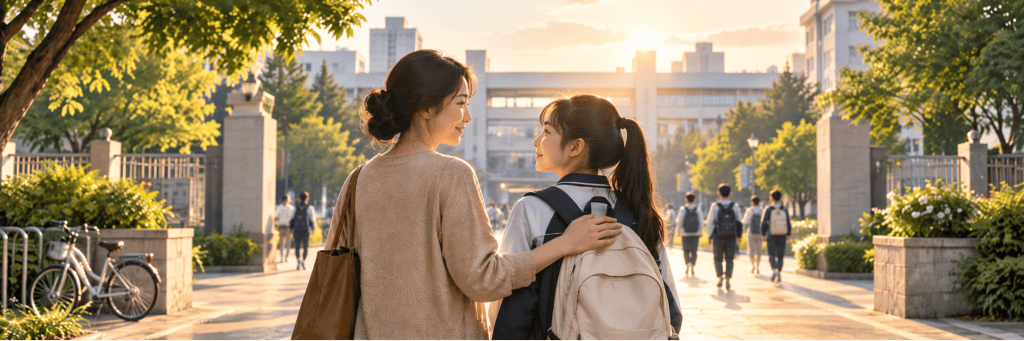
“Mom, is it true that if a mother walks farther, her daughter’s road will also go farther?”
I paused.
I had never heard the sentence before, and I had no idea where she had picked it up.
She asked again, and slowly I began to think that, yes, there was something true in it.
Only the “road” does not necessarily mean the physical road beneath our feet.
It can also mean the books we have read, the people we have met, the things we have experienced, the hardships we have endured, and the ability to stand up again after life knocks us down.
For a mother to have “gone far” does not simply mean she has traveled to many places.
It means that her world has grown wider. She knows that life does not have only one possible form. And because she knows that, she also knows her child should not be trapped on one narrow path.
I explained to Alicia that there is a Chinese saying: “Read ten thousand volumes and travel ten thousand miles.”
Reading many books is also a way of traveling far.
Books bring other people’s experiences, the complexity of the world, and different possibilities for a human life into our own field of vision.
If a mother has traveled farther, read more, and seen more of the world, then when her daughter eventually has to make choices, the mother may be able to help her see a little more.
Not to decide her life for her, but to let her know that life is not one narrow corridor.
The more I thought about Alicia’s sentence afterward, the more I realized that what moved me was not simply how beautiful it sounded.
It described something very deep between parents and children.
A parent with foresight is not someone who arranges an entire life for a child.
It is someone who tries, as much as possible, to give that child a slightly higher place from which to begin looking at the world.
The world looks very different from the ground than it does from the top of a tall building.
From the ground, you may see only the road directly in front of you, the wall blocking it, and the few people standing nearby.
But if you can stand a little higher, you begin to see that there are other roads farther away, places where the road turns, and possibilities you could not see before.
The roads parents have walked, the books they have read, the difficulties they have lived through, and the parts of the world they have seen eventually become a little bit of height beneath their child’s feet.
They cannot determine the child’s fate.
They cannot protect her from every hardship.
But they may allow her, when she has to choose, to see more than one narrow road.
Alicia listened and said she understood.
She said what I meant was that when a mother reads a lot of books and understands more things, her daughter is affected by that too—and that she also needs to read if she wants to understand more.
I thought she had understood it very well.
Perhaps that is what I most wanted to write down today.
The Gaokao matters, of course.
For many young people, it is a major turning point in life. For many families, it is the concentrated result of years of effort.
But the Gaokao has never been a single exam standing by itself.
Long before a child reaches that examination room, there have already been years of family environment, parental judgment, educational choices, emotional support, and accumulated resources behind her.
Some children slowly arrive at the examination room along a path their parents helped plan.
Some make it there while struggling through chaos and pressure.
Others discover halfway along the road that this may not be the road that truly suits them at all.
That is why, when I look at the Gaokao now, I no longer see only scores or who got into which university.
I think much more about how a child arrived at this point, step by step.
Did the parents see what she was good at?
Did they allow her not to be the child who fits the standard answer?
When she could no longer move forward, did they help her find another way?
While she was still young, did they look a little farther ahead on her behalf?
A parent’s perspective cannot save a child from every hardship. Life is not that simple.
No matter how hard a mother tries, she cannot shield her child from every storm.
But a parent’s perspective really can affect whether the first thing a child sees is a wall—or several doors.
Some doors are invisible to children when they are young. An adult has to help them see those doors first.
Some roads are too difficult for a child to walk alone. A parent may need to help her through the hardest part.
And some distant possibilities may become imaginable only because the mother herself once struggled to walk far enough for her daughter to know that those places existed.
Today is the first day of the Gaokao.
Countless students are sitting in examination rooms writing down their answers, while countless parents wait outside.
But it suddenly occurred to me that the answers a child eventually gives to life are never written only during these few days.
That process began much earlier.
It began with how parents looked at their child.
With how a family supported that child.
With the first moment she was allowed to see that another possibility might exist.
If a mother walks farther, her daughter’s road can reach farther too.
It sounds like such a light sentence, but the more I thought about it today, the more weight it seemed to carry.
Because the roads a mother has walked really do become part of the ground beneath her child’s feet.
Not so that the child can repeat her mother’s life, but so that she can stand where her mother once stood—and see a little farther than the generation before her.
1. Gāokǎo (高考) — China’s National College Entrance Examination, usually taken at the end of senior high school. It is the main route into undergraduate higher education for most students and carries enormous academic, social, and emotional weight for many Chinese families. Because university admission has historically been closely tied to educational mobility and future opportunities, the Gaokao is often experienced not simply as an exam, but as a major family and life event.
This essay is also available in other languages:
Chinese version: 高考这一天,我突然明白:父母的眼界,会变成孩子脚下的路
German version: Am Tag des Gaokao wurde mir plötzlich klar: Der Horizont der Eltern wird zum Weg unter den Füßen ihrer Kinder


Leave a comment