By Jane Sonnenschein · First draft: April 18, 2026 · Revised: September 4, 2026
After living in Germany for all these years, I have become increasingly aware that many differences between China and the West go far beyond everyday habits or ideas about family. Even the way people imagine the relationship between gods and human beings can be very different.
Over time, I began to realize that one reason I have never truly been able to believe in the Christian idea of the “Lord” is that I cannot accept the relationship between “Lord” and “servant.” But there is an even deeper reason:
The “gods” I grew up understanding and the “Lord” people here speak of are simply not the same kind of thing.
In the instinctive understanding of many Chinese people, a god is not first and foremost a distant being high above you, demanding obedience, service, and the surrender of yourself.
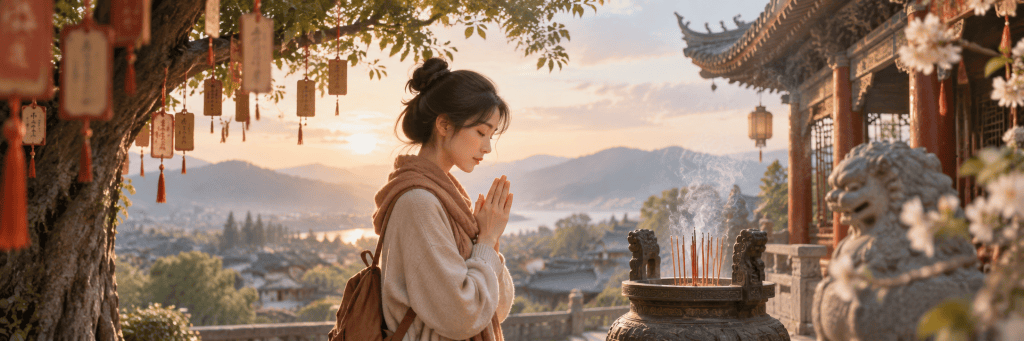
Chinese people certainly respect gods. They fear them too, and they worship them.
But the relationship between people and gods is often not one of master and servant. It is much more practical, much closer to ordinary human life.
If you want peace and safety, you pray for peace.
If you want prosperity, you pray to the God of Wealth.
If you hope for a child, you may pray to Songzi Niangniang¹.
If you are going out to sea, you may worship Mazu².
If you want peace and stability at home, you may make offerings to Zaowangye³.
And if you have suffered an injustice, been wronged, or seen something you simply cannot accept, you may even place your faith in the kind of justice represented by deities such as Chenghuang⁴ or Guandi⁵.
In other words, in the traditional Chinese imagination, the distance between gods and human beings has never been quite so absolute.
A god is not necessarily the one supreme authority before whom you must remain on your knees for your entire life. Often, a god feels more like a hand that a human being reaches upward in the face of suffering, desire, anxiety, fear, and hope.
That hand is not always an expression of submission.
Very often, it is a request for an answer.
The more I thought about this, the more I felt that Chinese gods, in some sense, are gods who respond to the human world.
Of course, I am not saying that Chinese people do not revere gods.
Quite the opposite. Chinese culture places great importance on awe and reverence.
But that reverence is often different from the kind that says, “I must surrender myself completely to you.” It is more like this: I know you are there. I also know that many things in this world are beyond human control. So I come to worship you, ask something of you, and show you respect. But that does not mean I define myself as anyone’s slave.
To me, that difference is enormous.
I thought about this for a long time and gradually realized that this feeling is closely connected to the cultural foundations we grew up with.
Chinese thought has never rested on a single, unified doctrine.
Buddhism, Daoism, Confucianism, together with much older ideas about yin and yang, fate, karmic consequence, good fortune and misfortune, have been mixing with one another for thousands of years.
That is why Chinese people rarely approach life by saying strictly:
“I belong to this particular religious system, so this is the only framework through which I can understand the world.”
More often, different ideas exist together.
When something difficult happens, people may say it is fate.
When they do something wrong, they may think about cause and consequence.
When they become too attached to something, they may remind themselves to let go.
When something has reached its end, they may tell themselves to follow the natural course of things.
When someone goes too far, people may say that everything requires a sense of measure and balance.
And beneath all of this, many people still carry a simple belief somewhere inside them: what people do is seen by Heaven.
It would not be accurate to say that all these ideas come from Buddhism.
It would not be accurate to say they all come from Daoism either, nor that Confucianism alone taught them.
But over time, they have all blended into Chinese daily life and become a very natural Chinese way of understanding how life works.
And perhaps that is also why the relationship between Chinese people and their gods has always remained so close to the human world.
People do not worship gods only because they are thinking about what happens after death, nor only because they want their souls to be saved.
More often, they are thinking about the life directly in front of them: they hope their family will be safe, their business will go well, their children will stay healthy, their journeys will be smooth, and disaster will stay away. When they suffer, they want someone to hear them. When they have been wronged, they want somewhere to take that grievance. Even if life is hard, they hope there will still be some path left open to them.
These wishes are extremely practical.
And extremely human.
That is why so many Chinese deities attract generations of worshippers. It is not because those gods demand unconditional submission, but because people believe they are ling⁶—that they respond, that prayers to them may work, that they can help.
This idea of a god “helping people” is not some elevated theological concept.
It can even feel somewhat worldly, somewhat transactional.
And yet that is exactly what feels so Chinese to me.
Because Chinese gods have never been entirely separated from everyday life.
They are close to the kitchen stove. Close to the sea wind. Close to sickness and pain. Close to children, marriage, the household, the harvest, and money.
Put simply, Chinese gods do not always remain far away in heaven.
Very often, they live among the smoke and warmth of ordinary human life.
Perhaps that is why the Chinese imagination of gods also carries such a strong sense of response.
You do not necessarily worship because you need to prove that you are loyal enough, obedient enough, or worthy enough to be someone’s servant.
You worship because you are suffering, because you are afraid, because you are asking, because you are hoping.
You take your difficulties, your wishes, and your fate with you and go looking for some kind of opening.
That is very different from the language I later heard in church.
There, I heard words such as “Lord,” “obedience,” “service,” “belonging to,” and “servant.”
But within the Chinese cultural language I grew up with, the words that feel more familiar are “protection,” “blessing,” “accumulating virtue,” “cause and consequence,” “fate,” “the will of Heaven,” “following the course of things,” and “response.”
Even the vocabulary is different.
In one kind of relationship, God feels more like authority.
In the other, a god feels more like a presence that can be moved by human suffering.
I am not saying that the second is somehow more advanced. Nor am I saying Chinese forms of belief are free of practical self-interest. The Chinese world of gods and spirits can certainly be very worldly. Sometimes it is precisely because it is so worldly, so entangled with ordinary life, that people may regard it as somehow less “pure.”
But increasingly, I think that this very worldliness is what makes it so close to the deeper structure of the Chinese way of thinking.
We are not a people who are always trying to hand ourselves over completely and wait for someone else to save us once and for all.
We are more like people who, in the middle of suffering, can believe in fate while refusing to surrender entirely to it.
We worship. We ask. We believe. We show reverence.
But at the same time, we still want to struggle a little more ourselves, carry the weight a little longer, and move forward another small step.
That is why the Chinese myths that move me most have never been stories about human beings completely submitting to the gods.
Quite the opposite.
Whether it is Jingwei filling the sea, Kuafu chasing the sun, Yu the Great controlling the floods, or Houyi shooting down the suns, what is most powerful in these stories is not how mighty the gods are.
It is that human beings, confronted by Heaven, Earth, and fate itself, somehow refuse to retreat completely.
Perhaps that is why I have always found Chinese gods easier to accept.
Not because I am somehow more “traditional” than anyone else, but because this relationship between gods and human beings feels closer to something deep inside me:
A god may stand high above us, but not so high that human beings disappear beneath them.
A god may inspire awe, but should not require people to lose their backbone.
In the end, the divine presence I can accept more easily is not a “Lord” standing high above, waiting for people to submit.
It is a god who remains entangled with human suffering, desire, fate, and ordinary life—and who, in some sense, responds to the human world.
Because such gods feel more like Chinese gods.
And that kind of relationship also feels more like the way Chinese people have learned to live with the world.
There is a deep current in Chinese culture that ultimately does not flow toward conquest and domination, but back down into the ordinary world of daily life.
Keep living. Hold the family together. Take care of what is in front of you. Earn the money that needs to be earned. Carry the responsibilities that need to be carried.
That feels much closer to the underlying spirit of Chinese life.
And so I increasingly feel that one important reason Chinese civilization has managed to continue all the way to the present may be that it has always preserved an extraordinary ability to keep itself going.
It does not survive through empty declarations, nor by giving up easily, nor by exhausting itself entirely through the conquest of what lies outside. It is more willing to spend its strength slowly holding together its own life, order, and reality, one piece at a time.
Notes
1. Sòngzǐ Niángniang(送子娘娘)
A traditional Chinese fertility deity associated with granting children to families who hope to conceive. Worship of Songzi Niangniang appears in different local traditions and is closely connected with ordinary family hopes rather than a single unified religious doctrine.
2. Māzǔ(妈祖)
A Chinese sea goddess traditionally worshipped by sailors, fishermen, merchants, and coastal communities, especially in southeastern China and Taiwan. People pray to Mazu for protection at sea and safe journeys. Her worship is a clear example of how Chinese deities often become closely connected to particular risks and needs in everyday life.
3. Zàowángyé(灶王爷)
The Kitchen God, a traditional household deity connected with the family hearth and domestic life. In folk belief, he watches over the household and its conduct, making him one of the clearest examples of a Chinese deity whose presence is imagined not in a distant sacred realm, but inside the home itself.
4. Chénghuáng(城隍)
Literally the “City God.” Traditionally understood as a divine guardian of a city or locality, Chenghuang was also associated with justice, moral judgment, and protection of the local community. Different cities could have their own Chenghuang temples and traditions.
5. Guāndì(关帝)
The deified form of the historical general Guan Yu, who later became widely worshipped as a symbol of loyalty, righteousness, courage, and justice. His importance extends across folk religion, Daoist traditions, Buddhist contexts, and popular culture.
6. líng(灵)
In this context, ling is difficult to translate with a single English word. When people say a deity or temple is ling, they usually mean that prayers are believed to receive a response, that the deity is spiritually effective, or that worship there has a reputation for “working.” The word carries a practical sense of responsiveness and efficacy that is very common in Chinese folk religious life.
This essay is also available in other languages:
Chinese version:为什么中国人的神,更像是在回应人间
German version: Warum chinesische Götter eher auf die menschliche Welt zu antworten scheinen


Leave a Reply