By Jane Sonnenschein · April 8, 2026
Today, when I saw the news that Chen Lihua had passed away, my first reaction was: “Tang Seng’s wife is gone.”¹
That is, after all, how many people in China remember her: as the wife of Chi Chongrui, one of the actors best known for playing Tang Seng in the classic television adaptation of Journey to the West. But after clicking on the news and reading more about her life, a very different thought came into my mind:
She really belonged to an era when, if you fought hard enough to survive, you sometimes truly could change your fate.
According to public records, Chen Lihua was born in Beijing in 1941. Her family was poor, and she left high school before graduating. She later began investing in real estate in Hong Kong and founded Fu Wah International Group in 1988. She went on to build a large property business and became known for her collection of zitan, or Chinese red sandalwood, eventually establishing a museum devoted to it.
In 2016, she topped the Hurun list of China’s wealthiest women with an estimated fortune of 50.5 billion yuan. She married Chi Chongrui in 1990, and their marriage remained in the public eye for decades. Chen died in Beijing on April 5, 2026, at the age of 85.
Looking at a life like hers, many people’s first reaction is to see a legend: a female billionaire, immense wealth, a woman who rose from poverty and completely changed her destiny.
But in recent years, I have increasingly felt that the word “legend” is almost too light.
What moves me about her is not simply how much money she eventually had. To me, she represents the survival logic of an entire generation of Chinese people: people who had known real poverty, and because of that were more willing to take risks, endure hardship, and believe that if they were brave enough to keep pushing, fate might eventually be rewritten.
She came from poverty, left school early to make a living, and eventually reached an extraordinary level of wealth. Personal ability and courage were obviously part of that story, but so was the window of opportunity created by the era she lived through.
Today, when I had a video call with my mother, she happened to mention two of my younger cousins again.
The younger one was quite wild when he was young. He did badly at school and even spent time in prison after getting into a violent fight. By the usual standards, he looked like someone who was unlikely to have much of a future. And yet, in recent years, he and his older brother have been running a mold-manufacturing factory together, and even during an economic downturn, their business has continued to grow.
My uncle’s family used to be extremely poor. When they had their second son, the family was heavily punished under China’s family-planning policy at the time.² They were fined so severely that even their pigs were taken away. Later came debt, business losses, a stroke, and years of financial difficulty. Yet after struggling through all of that, the family has somehow managed to rebuild its life.
I know another family that was also desperately poor. They wanted another son so badly that they gave away a daughter who had been born to them.
Seen from today’s perspective, that was clearly a wound created by its time, and an extraordinarily cruel one.
Later, however, the family made money in the jade business and completely transformed its financial situation. Their lives became much more comfortable than those of many people around them. What is striking is that when they eventually tried to reconnect with the daughter they had given away, she did not want to return to them, because the adoptive parents who raised her had treated her so well.
Why did all these people suddenly come back into my mind today?
Because I increasingly feel that many of the anxieties and confusions of my generation can be traced back to the previous generation’s belief in one thing: effort.
Why did they believe so deeply in enduring hardship? Why were they so convinced that relentless effort would pay off? Why did they believe that whether through exams, education, business, or sheer hard work, there would always be some path upward?
It was not because they were ignorant, and it was not because they loved feeding people empty motivational slogans.
It was because they had actually seen it happen.
They had seen people change their lives by starting businesses. They had seen people escape rural poverty through education. They themselves, or people around them, had genuinely taken advantage of the enormous changes happening in China and slowly transformed their lives.
For a long period after China began its Reform and Opening Up,³ there really were opportunities for many ordinary people to move upward. Those opportunities were never equally distributed and certainly were not fair, but they existed.
That meant ideas such as “hardship can change your fate” and “if you work hard enough, you will eventually get somewhere” were not merely slogans.
They were the lived experience of an entire generation.
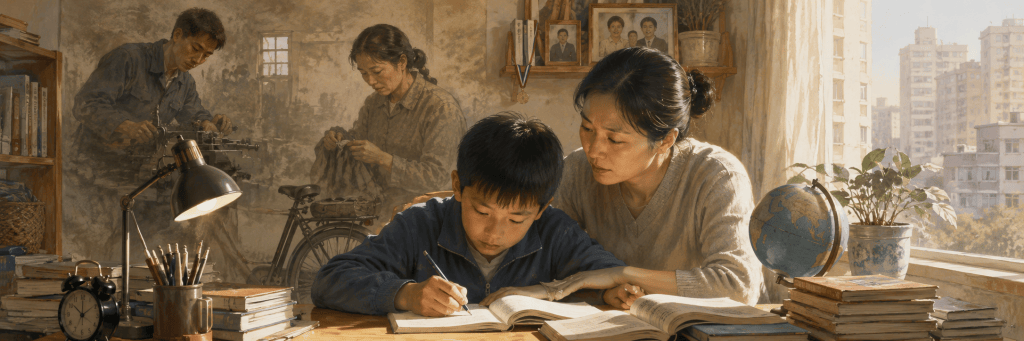
And that is exactly why I have become more able to understand why so many Chinese parents today push their children so intensely.
They did not simply wake up one day and decide to become competitive parents. Nor are they naturally obsessed with controlling their children.
Many parents cling so tightly to ideas like “you cannot lose at the starting line,” “you have to work harder,” “you have to compete,” “you have to keep doing more exercises,” and “you have to endure,” because in the world they grew up in, there really was a visible relationship between effort and outcome.
If you endured a little more, worked a little harder, and caught one more opportunity, your life genuinely could become different.
They benefited from that logic themselves, or at least watched it work for people around them.
So naturally, they assume that the same logic still works today.
But that is exactly where the problem begins.
The world has already changed.
That does not mean effort no longer matters. It means that the map the previous generation relied on is slowly becoming less reliable.
Social mobility has become harder, competition has become more intense, and technology and AI are rapidly rewriting the rules in many industries. The old certainty that “if you are willing to fight hard enough, you can definitely turn your life around” is becoming much harder to hold on to.
Many of the survival rules the previous generation believed in still contain some truth, but only part of the old formula continues to work. The rest has quietly fallen away.
The problem is that many parents have not fully realized this yet.
And so we get a very common mismatch: old experience is still shaping people’s decisions, while the new reality has already changed. One generation really did build a life by following that path; the next generation may follow exactly the same path and still never arrive at the same destination.
That is one reason today’s neijuan⁴ feels so exhausting.
It is not simply competition, anxiety, or parents blindly following everyone else. Beneath it lies the path dependence of an entire generation. They trust the road that brought them here so deeply that it is difficult for them to accept that the same road may no longer be the most effective one today.
A couple of days ago, I watched a video by a Chinese content creator living in Germany. He had decided to leave Germany and return to China with his child. Many people in the comments warned him that once he went back, he would not be able to stand the intense competition surrounding children and education in China.
But one thing he said stayed with me.
He said that sooner or later, we have to learn to accept three things: that we ourselves are ordinary people, that our parents are ordinary people, and that our children are ordinary people too.
I had mixed feelings when I heard that.
Because what many parents may truly need is not to push harder or compete more fiercely, but to become more clear-headed.
Clear-headed enough to understand what kind of person their child actually is; what suits that child and what does not; which efforts are still meaningful, and which ones are simply the result of seeing everyone else running and being too afraid to stop.
In the end, perhaps the greatest role of a parent was never to force a child into one standard mold. It may be to shield them from some of the pressures they do not need, and help them gradually see which direction is actually theirs.
And this brings me back to Chen Lihua.
What her generation achieved deserves admiration. But what moves me most about her life is not simply the fact that she went from poverty to becoming one of China’s wealthiest women.
Her life makes something else much clearer to me: there are eras in which fighting desperately really can change your fate. And then there are eras in which what becomes scarce is something different — the ability to first understand the age you are living in, and only then decide how you want to live.
Perhaps what we need to learn today is not simply how to repeat the hardships endured by the previous generation.
The world we live in is changing too quickly for that.
Technology, new tools, and high-tech industries have transformed life at such speed that the changes of just the past ten or fifteen years can sometimes feel greater than what once took several decades, or even longer.
In a world like this, if parents instinctively continue to treat “work harder,” “compete more,” and “endure more” as the only possible answers, that may no longer be enough.
Instead of blindly pushing children onto an increasingly crowded track, perhaps something else matters more: helping them gradually build a clear understanding of themselves, the ability to adapt to change, and the judgment to know who they are, what they are good at, and where they should go even as tools and technologies keep changing.
In the end, perhaps what parents today truly need to give their children is not simply:
“You need to work harder.”
But rather:
“You need to see more clearly.”
To understand yourself clearly. To understand the age you live in clearly. And to find the path that truly fits you.
W. B. Yeats is often credited with the line: “Education is not the filling of a pail, but the lighting of a fire.”
Perhaps instead of pouring all of the previous generation’s formulas for success into our children, what matters more is helping them light that fire within themselves.
So that in an increasingly complicated and rapidly changing world, they do not only know how to compete, take exams, and keep running after everyone else, but gradually develop judgment, a sense of direction, and the clarity not to be carried away by the crowd.
Because the previous generation crossed the river that belonged to them.
And today’s children will ultimately have to learn how to cross their own bridge.
Notes
1. Tang Seng (唐僧)
Tang Seng is the Buddhist monk at the center of the classic Chinese novel Journey to the West (Xiyouji, 西游记), one of the best-known works of Chinese literature. The story was adapted into an enormously popular Chinese television series in the 1980s, which became part of the shared cultural memory of several generations. Chi Chongrui, Chen Lihua’s husband, was one of the actors who played Tang Seng in that adaptation. This is why many Chinese people immediately associate Chen Lihua with “Tang Seng’s wife,” even though she was also a highly successful businesswoman in her own right.
2. Jìhuà shēngyù zhèngcè (计划生育政策) — China’s family-planning policy
For several decades, China imposed strict limits on the number of children many families were allowed to have. The rules varied over time and by region, but in many places families who had an unauthorized additional child could face substantial fines and other penalties. In rural areas, where household assets might include livestock, enforcement could be extremely harsh. The reference in the essay to pigs being taken away reflects this broader historical context.
3. Gǎigé kāifàng (改革开放) — Reform and Opening Up
This refers to the broad period of economic reform that began in China in the late 1970s. Market-oriented reforms, private enterprise, foreign investment, rapid industrialization, and urbanization created new opportunities for many ordinary people, although those opportunities were never equally distributed. For the generation discussed in this essay, the period helped reinforce a powerful belief that hard work, entrepreneurship, education, and risk-taking could fundamentally change a family’s future.
4. Nèijuǎn (内卷)
Literally translated as “involution,” neijuan has become a widely used term in contemporary Chinese to describe an exhausting form of competition in which people keep investing more time, effort, and resources simply because everyone else is doing the same, while the overall rewards do not necessarily increase. In education, it often describes parents and children competing through extra tutoring, more homework, more activities, and ever-higher expectations because no one feels able to step out of the race.
This essay is also available in other languages:
Chinese version: 为什么今天的中国家长这么卷?陈丽华这一代,其实早就给出了答案
German version: Warum sind chinesische Eltern heute so extrem auf Leistung und Konkurrenz fixiert? Chen Lihuas Generation hat die Antwort längst gegeben


Leave a Reply