By Jane Sonnenschein · April 26, 2026
Today I came across an interesting post on Xiaohongshu (a Chinese lifestyle and social media platform often compared to a mix of Instagram and Pinterest).
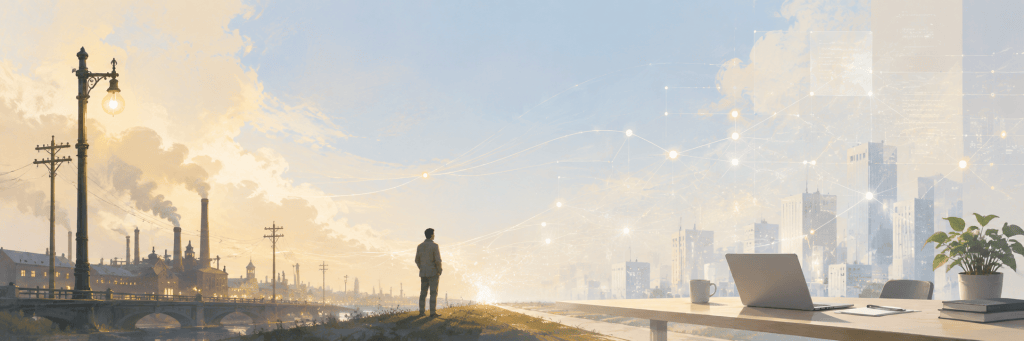
The author said that the AI era we are living through now is a lot like the period around 1890, when electricity was just beginning to enter everyday life.
At first, that comparison sounded a little exaggerated.
One is artificial intelligence, the other electricity. One is happening today, the other happened more than a century ago. But the more I thought about it, the more fitting the comparison seemed.
Because what truly changes the world is often not the moment a new technology is invented. The real transformation begins when that technology gradually becomes part of the entire system of production, reorganizing existing jobs, companies, cities, and ways of life.
When electric lights first appeared, people may simply have thought: now we no longer need oil lamps.
But what ultimately changed the world was not a single light bulb. It was the power grid, factories, assembly lines, nighttime production, modern cities, and an entirely new way of organizing industry.
AI is beginning to look similar.
Many people still think of it mainly as a tool: something that can write a piece of copy, generate an image, translate an article, or organize some information.
But that is not the part that is truly unsettling.
The real change will come when AI is no longer helping you with one individual task, but is built into the entire workflow.
When that happens, the first people to feel uneasy may not be manual workers. It may be the people sitting in office cubicles—the middle layer of the workforce who once believed their professional skills gave them a secure position.
I have a friend who studied media technology and has spent years working in advertising. His income is fairly good. He lives alone in Germany, has no family responsibilities, and does not pay particularly high rent. On the surface, it is the kind of stable job many people would envy.
But a few years ago, he started wondering whether he should quit and retrain as a nurse.
At first, I did not really understand it.
From an ordinary person’s point of view, he already had a good job. He had been doing it for years, the income was stable, and the work was not especially exhausting. Why suddenly switch to something so physically demanding?
Looking back now, I understand his anxiety much better.
What he is afraid of is not waking up one morning and hearing from his company, “You don’t need to come in anymore. AI has completely replaced you.”
What makes him uneasy is the growing sense that the kind of industry he works in will gradually be reshaped by AI.
And that kind of change does not happen all at once.
At first, AI may simply help you write some advertising copy, come up with a few headlines, organize a proposal, generate several images, or do some basic analysis.
It looks like nothing more than a productivity boost.
But once the tools become more capable and more and more steps are connected, the situation starts to change.
An advertising agency might once have needed different people for copywriting, visual design, video, data, SEO, ad placement, and client presentations. Each person had a small area of expertise, almost like one station on an industrial assembly line.
As AI develops, those divisions of labor may begin to collapse into one another.
One person who understands the business, has good aesthetic judgment, and knows how to evaluate results may be able to use a set of AI tools to do work that once required several people working together.
People may not disappear entirely. But fewer of them may be needed, and the abilities companies value will change.
That is the part that is truly unsettling.
What AI is best at is not laying bricks, carrying plates, or turning and washing elderly people. At least for now, what it is especially good at is processing information.
And a large part of office work is, at its core, information processing.
Finding information, organizing it, identifying key points, writing first drafts, revising headlines, creating proposals, translating, formatting, making PowerPoint presentations, generating images, analyzing basic data, producing reports.
In the past, people had to do all these things step by step because the human brain and human hands were the tools of production.
Now AI can do many of these things extraordinarily fast.
A person reading a document, no matter how quickly, still needs time. Even if you are an exceptionally fast reader, you cannot scan an entire set of materials in a few seconds and immediately extract the main points, structure, and logical problems.
AI can.
That does not mean AI never makes mistakes, or that it necessarily has better judgment than people. Of course it makes mistakes, and people still need to check its work.
But when it comes to large numbers of standardized information-processing tasks, its advantages in speed and cost are simply too great to ignore.
That means some of the people most at risk in the future may be those who have made their living through standardized forms of knowledge work.
They went to school, received training, joined companies, and learned the skills required for a particular role. But if those skills themselves can be broken down, reproduced, and automated by AI, then the sense of security attached to that role will gradually weaken.
This is one reason so many people are becoming anxious.
We used to think of manual labor as hard, low-status, and unstable. But looking at things now, some jobs that require a person to be physically present, dealing with real people in real situations, may actually be harder to replace in the short term.
Nursing is one example.
Nursing is difficult. It is physically exhausting and emotionally demanding, and I have no intention of romanticizing it.
But it has one important characteristic: it is not simply information processing.
You are dealing with a real person, a real body, real emotions, and real unexpected situations. An elderly person may suddenly seem unwell. A patient may react in an unusual way. A child may start crying. A family may have complicated communication problems.
These are not things that can easily be handed over entirely to AI.
So my friend’s idea of retraining as a nurse is not unreasonable at all.
He may never have put it in words like, “AI is going to restructure knowledge-work workflows.” But perhaps he sensed the direction of change before he could fully explain it: sitting in an office doing content, advertising, or media technology may look comfortable and respectable, but it may not be as secure in the future as it once seemed.
And I suspect this kind of anxiety will become increasingly common.
Much of the education our generation received was designed to turn people into specialized professionals who could carry out particular tasks.
You can write.
You can make PowerPoint presentations.
You can work with spreadsheets.
You can do basic design.
You can optimize website content.
You can create advertising materials.
You can write emails and reports and produce summaries.
All of these skills were useful in the industrial age and the internet age.
But the real question of the AI age is this: if machines can take over a large share of these execution-level tasks, what is left for people?
It is not an easy question.
The people who remain valuable in the future may no longer be those who simply know how to complete a particular step. They may be the ones who understand how the entire process should be designed, what a good result looks like, where the risks are, when AI is talking nonsense, and what the real purpose of a task actually is.
In other words, people may have to move gradually from being executors to becoming judges, integrators, workflow designers, and the ones who take responsibility for the final result.
But that transition will not be easy.
Not every person who is good at executing tasks can naturally become someone who designs the whole process. Many people’s professional experience consists largely of becoming skilled at completing certain steps.
Once AI takes over those steps, they may suddenly discover that the professional abilities they once believed were secure are being priced very differently.
That is one of the harshest things about the AI era.
The question is no longer simply:
“Do you know how to use AI?”
The real question is:
When AI can perform most of the execution-level tasks you once depended on for your livelihood, can you move up one level?
Can you ask good questions?
Can you judge whether an answer is good?
Can you spot gaps in the logic?
Can you connect different tools into a working system?
Can you take responsibility for the final result?
If not, you may be in a vulnerable position.
This is why I increasingly think that the first people to really feel the impact of AI on the workplace may not be those at the very bottom, but those in the middle who once believed that knowledge and professional skills had given them a stable place.
That is also why the idea that “people sitting in cubicles will be the first to feel uneasy” resonates with so many people.
Because many of them have already sensed it.
They still go to work every day. Their salaries are still being paid. Their companies have not collapsed, and their jobs have not disappeared.
But somewhere inside, they already know that the direction of the wind has changed.
In the past, a person could learn one professional skill and rely on it for many years.
Now that cycle is getting shorter and shorter.
Industries used to change slowly, and jobs changed slowly with them.
Now tools can change within a few months, and the way work is done can be rewritten within a year.
That makes it very difficult for people to feel secure.
Of course, I do not believe this means human beings will become less valuable.
Quite the opposite. The more powerful AI becomes, the more important genuinely human judgment, experience, aesthetic sense, responsibility, and the ability to understand complex situations will become.
But only if people do not remain stuck at the level of “I know how to complete this one step.”
If all you can do is write an ordinary piece of copy, AI can do that too.
If all you can do is organize information, AI can do it faster.
If all you can do is make a basic PowerPoint presentation, AI can do that as well.
If your job is simply moving information from one format into another, that kind of work will sooner or later be compressed.
What is much harder to replace is knowing why a piece of copy needs to be written in the first place, who it is for, what business goal sits behind it, where you must not exaggerate, where the language still needs to feel human, what a platform is likely to reward, and what might damage the long-term value of a brand.
That is where the human role lies.
So perhaps what we really need to learn in the AI age is not simply “how to get AI to write a sentence for me.”
It is how to build AI into our own workflows without giving up our own judgment.
That may be something many of us will have to learn.
Not how to compete with AI over who can work faster,
but how to stand above the tools, use them well, and redefine where we ourselves belong in the process.
Otherwise, the respectable-looking office jobs may be among the first to feel the chill.
Because the first thing AI is transforming is not human physical labor.
It is information work.
And over the past few decades, a great many people have built their place in the middle of society precisely by doing information-based work.
That is what makes this wave of change worth paying attention to.
This essay is also available in other languages:
Chinese version: 我们现在,可能正活在 AI 版的 1890 年
German version: Vielleicht leben wir gerade im KI-Pendant zum Jahr 1890


Leave a Reply