By Jane Sonnenschein · August 16, 2026
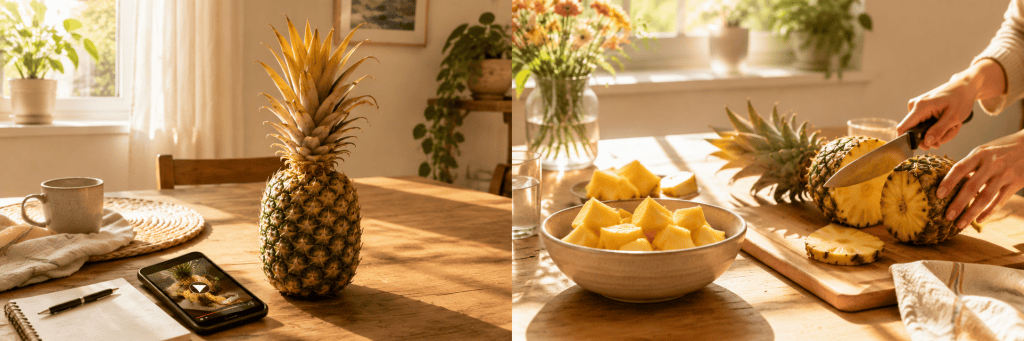
For the past few days, there had been a pineapple sitting on our dining table.
When we first brought it home from the supermarket, its leaves were still green and it looked fresh. Then, day by day, the tips of the leaves began to turn yellow. After a while, little flies started circling around it. We cook and eat at that table every day, so it wasn’t that I had forgotten about the pineapple. Quite the opposite. I saw it every single day, and almost every time I looked at it, the same thought came into my head: Shouldn’t I cut that pineapple today?
But I kept not doing it.
This wasn’t the first pineapple we had bought.
The last time, I didn’t really know how to prepare it either. When I was little in China, the pineapples I saw sold on the street had usually already been peeled beautifully. After the skin was removed, the dark “eyes” were carefully cut out one by one, leaving neat spiral grooves while preserving as much fruit as possible.
Maybe because that was the kind of pineapple I had grown up seeing, I always felt that a pineapple wasn’t something you could simply attack with an ordinary kitchen knife. Surely it required some special tool or technique.
Last time, I couldn’t be bothered to look it up myself, so I asked Chris to search online for how to cut one. He later told me that there seemed to be a special pineapple tool that could remove the eyes without cutting away too much flesh, and that you could buy one on Amazon.
My immediate reaction was: buying a special tool just for one pineapple sounds like a lot of trouble.
So we didn’t buy the tool.
And we didn’t cut the pineapple.
It sat on the dining table day after day. Eventually, when I finally thought, Maybe I really should deal with this today, I picked it up and found mold growing on the bottom.
At that point, there was nothing left to think about.
The whole pineapple went into the trash.
So when my daughter wanted another pineapple at the supermarket this time, I was actually reluctant to buy it at first. I still remembered exactly what had happened to the last one.
But she wanted to eat pineapple, so we bought it anyway.
And then something very familiar started happening all over again.
The new pineapple went onto the dining table. I saw it every day. Every day I thought I should deal with it, and every day I somehow felt, I really don’t feel like doing this today.
I remembered seeing a video not long ago of someone cutting a pineapple without any special tools. The method had looked clever and simple, and it didn’t seem to waste much of the fruit. At the time I remember thinking, Oh, so that’s how you can cut a pineapple.
The problem was that now, when I actually needed that video, I had absolutely no idea where I had seen it.
Was it on TikTok? Somewhere else?
I only remembered that I had liked the method. I couldn’t remember what the person had actually done.
So that became yet another obstacle: I needed to find that video again.
It sounds like such a tiny thing. But once the task entered my head, it turned into a whole process.
First I had to find a tutorial, preferably the exact one I had seen before. If I couldn’t find it, then I would have to compare different methods. I didn’t want to cut away too much fruit. Would an ordinary knife even work? Did I actually need some special tool after all?
So every time I looked at the pineapple, the whole thing felt slightly troublesome.
My daughter was much more impatient than I was.
A few days ago, she had already started asking me, “Mom, when are you going to cut the pineapple?”
I told her I would look up a tutorial.
The next day, she asked again.
I still hadn’t looked.
Yesterday I was tired and had very little energy. She reminded me again, and I said I really didn’t feel like doing anything that day. I would do it tomorrow.
Then today she finally asked me again:
“Are you actually going to cut this pineapple today? If you don’t, it’s going to go bad again.”
I looked over at the pineapple on the table.
The leaves that had once been green were now obviously turning yellow. Little flies had started appearing around it. From the outside, it still looked solid and sturdy, covered in spikes, like a fruit that was rather difficult to deal with.
But I knew what had happened to the last one. Day after day it had looked “still okay,” until suddenly it wasn’t edible anymore.
This time, I really couldn’t put it off much longer.
After dinner, I told my daughter, “Give me a little while. I’ll have a look.”
I opened Bilibili (a Chinese video platform often loosely compared to YouTube) and searched for “how to peel a pineapple.”
I watched several of the first videos that came up.
I didn’t like any of them.
Their method seemed almost brutally simple: cut off both ends, stand the pineapple upright, then take a knife and slice the skin away from top to bottom. Because the knife also had to remove the dark eyes, every cut took a fair amount of pineapple flesh with it.
Some of the videos even had titles like “Cut a pineapple in one minute.”
As I watched, I kept thinking: That is a lot of pineapple you’re cutting away. If you do it like that, how much is even going to be left?
It looked nothing like the pineapples I remembered seeing on the street as a child. Those vendors would peel away the skin and then carefully deal with each eye, leaving behind a very complete, beautifully cut pineapple.
These videos were certainly fast. But to me, they looked like: chop, chop, chop — skin and fruit coming off together.
I still didn’t really want to accept that method.
I was even thinking, Where on earth is that clever video I saw before? Why can’t I find it?
By this point, the whole situation was getting slightly ridiculous.
The pineapple was close to going bad. I had already found a perfectly usable method. And yet I still didn’t want to begin because the method wasn’t “good enough.”
Eventually, I finished washing the dishes and looked at the pineapple again.
No.
I couldn’t keep doing this.
If I didn’t cut it now, it really was going to rot again.
I went and got one of those thick oven gloves because the pineapple was prickly and I didn’t want it digging into my hand. Then I took out our big kitchen knife and, following the method I had just watched, cut off both ends.
I had always imagined that pineapple skin looked so hard and thick that an ordinary knife might barely get through it.
But when I actually made the first cut, I paused for a second.
It wasn’t nearly as difficult as I had imagined.
The knife went straight through.
I tried using a vegetable peeler at first, but that really didn’t work. So I gave up on that, went back to the big knife, stood the pineapple upright, and sliced the skin off from top to bottom, just as I had seen in the videos.
Slice, slice, slice.
It was done very quickly.
Of course, I did lose more flesh than with the careful method I remembered from childhood. I also knew that with a special tool, or if I were willing to spend more time removing each eye one by one, I could have saved more fruit.
But the entire process took maybe two or three minutes.
I removed the harder core in the middle, cut the pineapple into pieces, and that was it.
I stood there looking at the pineapple I had just cut and suddenly had a strange feeling.
This was something I had put off in my head for days. Every day I had seen it and thought about it. Every time I thought about it, I had felt that it was “a bit of a hassle.”
And when I finally did it, it took only a few minutes.
What was even more interesting was that the pineapple had remained uncut for days, but that didn’t mean it hadn’t been taking up any of my time.
It was there every day.
Every time I saw it, I had to think about it again: Should I cut it today? I still haven’t found the tutorial. Where was that method I saw before? Will an ordinary knife work? Do I need a special tool? Am I going to waste too much fruit?
Every time my daughter reminded me, I thought about it again.
So the real price I paid for that pineapple wasn’t just the final three minutes.
Before I ever picked up the knife, I had already been paying a small psychological cost for days.
And suddenly I realized that I do this with many things in my life.
Before I start something, I often make it seem much harder in my head than it really is.
Job hunting, for example.
For a long time, whenever I thought about looking for work again, I immediately thought about everything at once: I would have to redo my résumé. My work history over the years was long and messy. How should I write a German résumé? What if I applied to German companies and got rejected? What about interviews? What would people think of a career history that had been so broken up over the years?
Before I had even submitted a single application, “applying for a job” had already turned into an enormous project in my head.
My website was the same.
I put that off for months.
I kept thinking I should find the right time to start. I even wanted to choose a “good day.”
But strangely enough, whenever that day actually arrived, I would decide that I wasn’t in the right state of mind. Or there were other things to do. Or I still wasn’t prepared enough.
So the good day would pass, and the website still wouldn’t exist.
Then July 1 came, and I suddenly realized that half the year was already gone.
If I didn’t start that day, when exactly was I planning to start?
That moment felt a little like looking at the pineapple leaves turning yellow.
The situation suddenly changed from “I can still do this later” to “if I don’t do it now, it really is going to go bad.”
So I started.
Looking back, of course building an independent website was far more complicated than cutting a pineapple. But once I actually began, it wasn’t nearly as frightening as I had imagined.
With many things, you only discover the next step after you have taken the first one. You cannot solve every possible problem before you begin.
I once bought a printer because I wanted to print some things myself. I bought the printer, the ink, and various tools. I spent quite a bit of time preparing everything.
Then my first attempt didn’t work.
So I stopped.
I didn’t continue, and I didn’t return the things I had bought either.
These situations all look different: a pineapple, a website, job hunting, a printer.
But now I increasingly feel that the same pattern sits underneath them.
Before I start something, I tend to imagine it in its most complete, ideal, and complicated form.
A pineapple cannot simply be “cut open so we can eat it.” Ideally, it should look like the ones I remember from street vendors in my childhood, beautifully prepared while preserving as much flesh as possible.
A website cannot simply be “something I build first.” My mind immediately jumps ahead to how I will organize the categories, how I will make it trilingual, how I will choose images, and how I will promote it.
Even a résumé struggles to remain “just a first draft,” because the moment I think about it, I also think about submitting applications, being rejected, interviews, and whatever job might come afterward.
Before I have taken the first step, I have already walked through the next few dozen steps in my head.
Of course the whole thing feels heavy.
The most absurd part is that the first pineapple had already taught me this lesson in an almost embarrassingly concrete way.
Because I didn’t want to use a method that would waste too much of the fruit, I ended up wasting the entire pineapple.
I wanted to preserve more.
In the end, I preserved nothing.
The second pineapple almost followed the same path.
The only difference was that this time, when I could not find the “perfect method,” I finally accepted a method that was less elegant — one I actually disliked a little.
It wasted some of the fruit.
But at least the pineapple got cut.
Afterward, following what I remembered from childhood, I soaked the pineapple in salt water for a while.
My daughter took one bite and immediately became unhappy.
“Why is this pineapple so salty?”
I had to explain that when I was growing up, we used to soak pineapple in salt water, and I had always believed it helped keep your mouth from feeling so rough and irritated afterward.
She still wasn’t convinced.
I even asked her father to explain it to her again.
Eventually I simply took the pineapple back to the sink, rinsed it with fresh water, and gave it to her again.
She still thought it tasted a little strange.
At that point, I couldn’t help finding the whole thing funny.
I had put this pineapple off for days. I had finally worked up the courage to deal with it. And instead of hearing anything like, “Mom, you did such a great job,” what I got was a child looking deeply unimpressed with my pineapple-processing skills.
But somehow that made the whole thing feel more real.
Real life rarely gives us perfectly neat endings.
Finally starting something you have procrastinated on does not mean you will do it beautifully.
Finally building a website does not mean people will immediately come and read it.
Finally sending out a résumé does not mean you won’t be rejected.
Finally trying to make something does not mean the result will turn out well.
But all of those things are still different from never starting at all.
I used to feel that I needed to find a better method before I began.
Now I increasingly think that what we often need is not a perfect method, but simply a method that allows the thing to happen.
I still don’t think that one-minute pineapple method is particularly elegant. If I start buying pineapples regularly in the future, maybe I’ll look into better ways to cut them while wasting less fruit.
But that is the next problem.
The most important thing today was simply this:
Don’t let this pineapple rot again.
Some other things in life are like that too.
Build the website first. Improve it later.
Get the résumé into shape first. Polish it later.
Send the first application. Then see what happens.
Let something move from “I keep thinking I should do this” to “I have done it once.”
Because with many things, the hardest part may not be the complicated process we imagine at all.
It may simply be picking up the knife and making the first cut.
That pineapple sat on our dining table for days, covered in spikes, looking hard and troublesome.
But once I finally cut into it, I realized:
It was never as difficult to deal with as I had imagined.
This essay is also available in other languages:
Chinese version: 我拖了好几天没有切一个菠萝,最后却只用了三分钟
German version: Ich habe tagelang aufgeschoben, eine Ananas zu schneiden – am Ende brauchte ich dafür nur drei Minuten


Leave a Reply