By Jane Sonnenschein · March 20, 2026
Today Chris started talking to me about the situation in the Middle East again.
The gist of what he said was that several Middle Eastern countries had now joined together to warn Iran: if Iran continued attacking and shelling them, they would unite and take action against Iran.
As he was talking, my first reaction was not shock. I almost wanted to laugh.
I casually replied, “If those countries want to be slaves themselves, then let them.”
It was not because I thought the situation was unimportant. Quite the opposite. I know what the Strait of Hormuz means for global energy supplies, and I know that this latest round of conflict has pushed both Gulf energy infrastructure and global oil and gas prices into a very dangerous place. Israel first attacked Iran’s South Pars gas field and processing facilities, after which Iran expanded its retaliation to energy facilities in Qatar, Saudi Arabia, the UAE, Kuwait, Bahrain, and other Gulf states. Germany and the United States have also been accelerating arms sales and defense support to these Gulf countries.
What I found absurd was something else. From my perspective, the United States and Israel were the ones who struck first. They were the ones who pushed Iran step by step into a corner, to the point where so many important Iranian figures were assassinated. And yet in the end, the story somehow became this: Iran is now attacking other countries. Iran is now the side that needs to be collectively warned and fought back against.
The moment I heard that argument, I knew Chris and I were once again thinking on completely different planes.
What he was considering was actually a very typical kind of logic on paper.
In his view, these Middle Eastern countries control resources the whole world depends on, such as oil and natural gas. So in theory, if they truly united, the United States would be in serious trouble. He even put it in an exaggerated way, saying that if they all stopped cooperating, America “might be finished the next day.”
But the more I thought about it afterward, the more I felt that our real disagreement went deeper than that.
Behind his way of looking at the situation was also a very typical Western filter of universal values. In his eyes, Iran’s political system itself is backward. So even though Iran is being attacked by the United States and Israel this time, part of him seems to feel that perhaps this is not entirely a bad thing, as though these attacks could somehow be “helping” Iran by bringing these countries a certain kind of so-called democracy and freedom.
He never said that explicitly. But the way he interpreted the conflict already made that perspective clear.
And this is exactly why I so often find it difficult to keep talking to him about these things.
Because what I see is never simply an abstract question of whether a political system is “advanced” or “backward,” nor is it merely a calculation of how many resources a country possesses. What I see is a very concrete reality: many of Iran’s actions today are, at their core, resistance to external aggression.
To me, that is not difficult to understand. It reminds me of China’s resistance against the Japanese invasion during the Second World War. Someone else invades first and pushes you to the edge of national destruction, and only then, when there is almost no other choice left, do you unite and fight back.
Yet that is precisely where the absurdity begins. Once that resistance happens, the narrative is quickly reversed. Suddenly Iran is described as the one starting fires everywhere, attacking everyone around it, as though it were the real force destroying order rather than those who first pushed the situation to this point.
There is a reason Chinese people are particularly sensitive to this kind of narrative.
We grow up learning this history, and we know very well what it means for a nation to be pushed to the edge of survival. Many Chinese people connect Iran’s current situation with what China once experienced precisely because that historical memory runs so deep. We know what it means to be invaded first, to be driven into a desperate situation, and to be forced to resist when almost every other path has been closed.
That is why, in the instincts of many Chinese people, the question of right and wrong can sometimes feel unusually clear.
To me, this entire way of interpreting the situation already feels absurd.
Following Chris’s logic, I could not help wondering: could these countries really unite in practice? Do they truly have the independence, the political will, and the room to bear the consequences?
I am not saying these countries have no resources.
I am saying that resources are not the same thing as independence, and independence is not the same thing as being willing to resist.
When people talk about international relations, they often make countries far too human-like in their imagination, as though states behave just like individuals: you hit me, so I hit back; you pressure me, so I turn against you; you bully me, so I refuse to accept it.
But reality does not work like that at all.
Of course many countries fail to resist because they are “afraid.” But the “fear” I am talking about is not childish cowardice or some emotional feeling of being scared.
It is a whole set of very concrete calculations.
If I turn against you, will my security umbrella disappear? Will my weapons supplies be cut off? Will my trade and financial access be restricted? Will my domestic government become unstable? Will my infrastructure be bombed tomorrow? Will my political leadership pay a real price?
That is not childishness.
That is reality.
So when I say that these countries are often “afraid of the United States,” I am not talking about psychological fear at all. I am talking about being structurally constrained by another power.
Recent events make this quite clear.
After these Gulf countries were attacked by Iran, their actual response was not to “collectively break away from the American system.” If anything, they moved further in the opposite direction, seeking more defense support within the existing security framework. Germany recently loosened restrictions on arms sales to Gulf countries, while the United States also approved new arms sales to countries including the UAE.
What does that tell us?
It tells us that even if these countries control enormous oil resources, that does not mean they actually have the ability to leave a US-led security system.
At least in reality, their more common reaction is not to overturn the table, but to keep sheltering underneath it.
That is why I have always felt that these Middle Eastern countries have never really formed a unified bloc capable of acting together.
In that sense, it is not so different from the European Union.
On the surface, everyone appears to be part of an alliance. But when key interests have to be redistributed and real costs have to be shared, every country still thinks about itself first.
Why do so many alliances and communities eventually fall apart?
It is not always because the outside force is too powerful. Very often, it is because the people inside never truly developed a sense that “we are one.”
The same basic logic can appear on every scale, from a few sellers undercutting one another in a price war to alliances between countries.
Everyone would benefit more from standing together. Everyone would suffer less if they formed a genuine community of shared interests. And yet in the end, they still undermine one another, distrust one another, and make their own private calculations.
From the outside, it looks as though someone else defeated them.
From the inside, very often they had already begun falling apart on their own.
The Middle East is even more complicated.
Historically, these countries have never really formed a stable, unified community capable of sharing consequences together. Their religious sects, political systems, interests, external dependencies, and security needs are all different.
On top of that, many of these states are already deeply embedded in a US-led military and security system. It is easy enough for them to sound tough. But actually joining together and overturning the table is another matter entirely.
So when Chris said, “If these countries united, America would be finished the next day,” my reaction was not, “How can you be so awful?”
It was more like: you are imagining real-world politics in far too linear a way.
You are talking about theoretical capability. I am talking about actual structures.
You see oil, money, and geographic position.
I see weapons, security, finance, and political stability, all of which are deeply tied to the American system.
You ask: why don’t they resist?
I think about why, in reality, they usually do not dare to—and often cannot.
Over time, I have realized that many of our arguments are not really about having different information. We simply have different ways of looking at the same problem.
Some people are used to looking at surface events, single points of logic, and short-term outcomes.
I tend to take a few more steps backward and look at the relationships of dependency underneath, the structures of power, historical inertia, and the real costs involved.
That does not mean I am wiser than anyone else.
I simply find it harder and harder to accept the kind of reasoning that says, “If something is theoretically possible, then it should also happen in reality.”
Reality is not a strategy game played on paper.
In the real world, what many countries obey first is not reason, but power.
That is why, after Chris had only said a few sentences today, I no longer wanted to continue the conversation.
It was not because I had nothing to say, nor because I genuinely did not care about the subject. I simply recognized the direction of the conversation immediately and knew that if we kept going, we would most likely end up talking past each other.
He would probably think my use of the word “afraid” was too simplistic.
But hearing that criticism would only make another kind of simplification stand out even more clearly to me: the belief that states would never choose submission simply because the real cost of resistance is too high.
Yet this is one of the most common realities in international politics.
There was a line in a recent AI-generated video from CCTV, China’s national broadcaster, that I particularly liked:
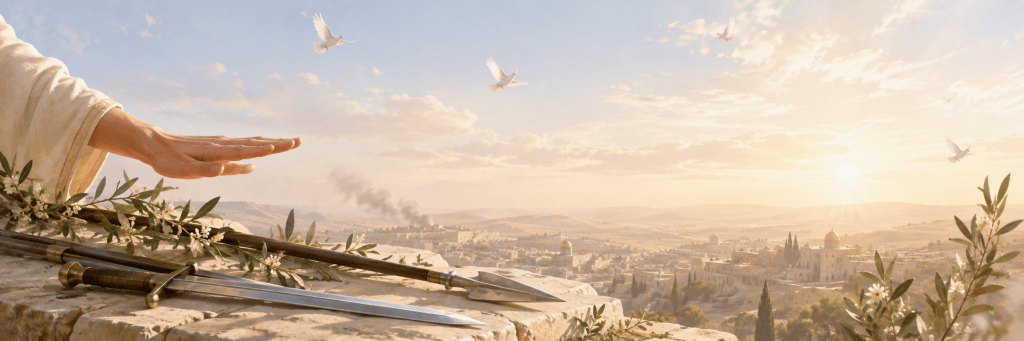
“The highest expression of wǔ does not lie in taking up the spear, but in bringing the spear to a stop.”[1]
It is only a few words, yet it captures something very deep in the philosophy contained within the Chinese character wǔ.
Wǔ is not simply about fighting. It is not about hitting harder and continuing until the bitter end. At its highest level, wǔ means bringing weapons to a stop. It means preventing a situation from continuing to spiral out of control.
I think this is also very close to an instinct many Chinese people have when looking at international affairs.
We do not necessarily look only at who appears stronger right now, who is more ruthless, or who is shouting most loudly about war.
Nor do we find it easy to stop at calculations on paper—who has more resources, or what one side could supposedly achieve if only everyone united.
We are more inclined to look a few steps further: at the structures underneath, at interests and dependencies, at who is shaping the narrative, and at who appears to be “maintaining order” while actually pushing the situation, step by step, toward losing control.
That is also why many things that sound perfectly natural within Western narratives can feel deeply contradictory to Chinese instincts.
Someone else strikes first, pushes another side into a corner, and drives the situation closer and closer to the point of no return.
But once the other side finally begins to resist, the outside narrative quickly reverses. Now you are said to be setting fires everywhere. You are said to be attacking everyone. Suddenly the real danger is presented as the side fighting back rather than the side that launched the aggression in the first place.
Why are Chinese people so sensitive to this kind of narrative?
I think a large part of the reason is that we have grown up with this feeling in our history.
We know too well what it looks like when a nation is pushed to the edge of destruction. We know what it means to be invaded first, and what it means to have no path left except resistance.
That is why, very often, the basic question of right and wrong can feel particularly clear in the instincts of Chinese people.
Perhaps that is also why I increasingly feel that the way we look at the world really is different in some respects.
We are not only looking at the battle happening in front of us, or asking who attacked whom today.
We are also looking at where this entire game will eventually lead everyone.
Wǔ at its highest level does not lie in the spear. It lies in stopping the spear.
Real strength is not about making the fighting bigger and bigger.
It is about understanding who is creating the conflict, who has been forced to take up arms, and, even more importantly, understanding that the true end of any conflict should never be only victory or defeat.
It should be an end to the fighting.
[1] Zhǐ gē wéi wǔ(止戈为武): This traditional Chinese expression is closely connected to an ancient interpretation of the character wǔ(武), commonly associated with martial force, military strength, or martial arts. In Chinese cultural thought, the phrase is often understood to mean that the highest purpose of martial strength is not endless fighting, but the ability to stop violence and restore peace. The expression plays on the components traditionally associated with the written character 武—zhǐ(止, “to stop”)and gē(戈, an ancient pole weapon)—and turns “martial strength” into a moral idea: true power ultimately proves itself by bringing weapons to rest rather than by using them without limit.
This essay is also available in other languages:
Chinese version:“止戈为武”,才是武学的最高境界。可惜,老祖宗的智慧,90%的外国人都理解不了


Leave a Reply