By Jane Sonnenschein · May 20, 2026
Today is May 20—520 (in Chinese internet culture, the numbers sound similar to wǒ ài nǐ, “I love you”).
My daughter, of course, has no idea that the date carries this meaning. Otherwise, she would probably have started preparing a gift long ago.
On Mother’s Day, she gave me a present.
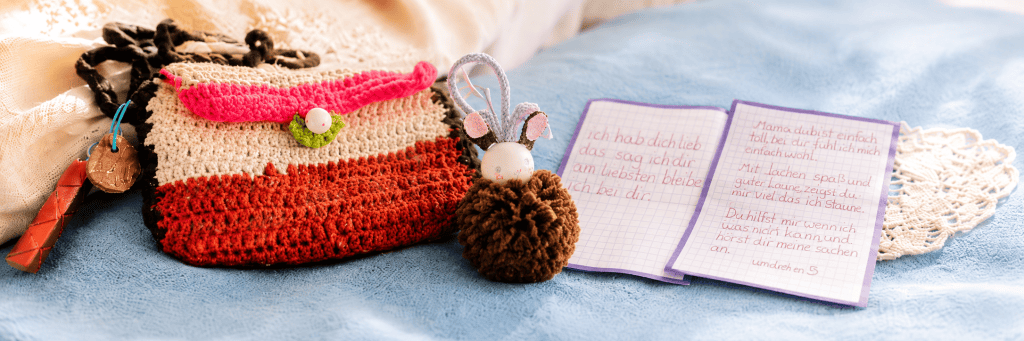
It was not something she had bought in a shop. She had prepared it herself, little by little: a small bunny charm and a handwritten note.
She later told me that she had started working on them about two weeks earlier. The bunny charm was made especially for the little pouch she had made for me before. I usually use that pouch for documents, keys and other small things. Some of the charms, wooden decorations and carefully sanded little pieces attached to it were also made by her, one by one, with her own hands.
To be honest, I was moved when I received them on Mother’s Day. But over the years, I may have grown somewhat used to the care she puts into expressing her love.
And yet today, when I looked at the note again, it suddenly touched me very deeply.
Perhaps a date like 520 naturally makes people think more about love. Or perhaps some feelings do not fully reach us at the moment we receive them. Only when we return to them a few days later do they begin to flow more deeply into the heart.
On the note, she had written carefully, one word at a time:
“Mama du bist einfach toll, bei dir fühl ich mich einfach wohl.
Mit Lachen, Spaß und guter Laune, zeigst du mir viel, das ich staune.
Du hilfst mir wenn ich Was nicht kann, und hörst dir meine Sachen an.
ich hab dich lieb das sag ich dir, am liebsten bleibe ich bei dir.”
Roughly translated, it means:
Mum, you are simply wonderful. I feel safe and happy when I am with you.
With laughter, fun and good spirits, you show me so many things that amaze me.
You help me when there is something I cannot do, and you listen to the things I want to tell you.
I love you, and I want you to know that. My favourite place is by your side.
I understand every one of those German words. But when I saw them joined together like this and translated them once more into the language I know most intimately, I suddenly felt something very deep.
It was a strange and beautiful feeling.
It was not the abstract kind of knowing that says, “I know she loves me.” It was more as though I could reach into the spaces between those words and touch something warm and real. Something seemed to flow gently into my heart.
Later, I thought that perhaps this is part of the power of language. Hearing a sentence in everyday life, seeing it written down with your own eyes, and then understanding it again through the language closest to your heart can create completely different feelings.
But it was not only the note itself that moved me.
More and more, I feel that my daughter possesses something I deeply lacked as a child.
From a very young age, she has had a natural ability to express love.
Whenever she visits someone, she wants to bring something. Sometimes it is a drawing, sometimes a handmade gift, and sometimes a small present she has saved up to buy herself. No adult needs to remind her, and I never taught her that she should behave this way. She simply seems to feel that when you visit someone, go to their home or celebrate a special occasion, you should prepare a small gesture of affection.
She also cares deeply about the rituals of special days. She starts preparing early for Mother’s Day, Father’s Day, birthdays and even Valentine’s Day.
People used to joke, “Your mum is so lucky. She gets presents all the time.”
I spent a long time wondering why she is like this while I am not.
As a child, I had a strange misunderstanding. Instinctively, I felt that giving someone a present meant placing yourself in a lower position. It seemed like a form of pleasing people, or something you did when you wanted something from them.
Looking back now, I understand that this came from a deep sense of emotional scarcity. It was not a healthy way of thinking.
No one may have taught me this explicitly, but somehow it still grew inside me.
Perhaps I did not receive the right guidance as a child. Or perhaps people with low self-esteem sometimes develop a twisted kind of pride in certain areas. They do not want to give, express affection or make the first kind gesture, as though holding back were the only way to protect their fragile sense of dignity.
For many years, I was not very good at these things.
Bringing something small when visiting another person’s home is simply basic courtesy. Expressing affection between friends and family on special occasions is also perfectly natural. I understand all of this now.
But understanding something and knowing how to do it naturally are not the same.
Some things, if they were never written into your body during childhood, remain difficult even after you understand them as an adult. You still forget. They still feel unnatural. It is like a basic instinct for living: when you never developed it, something really does feel missing.
My daughter is different.
Expressing her feelings comes naturally to her.
Giving comes naturally to her.
She naturally lets people know: I like you. I think about you. I want to make you happy.
I often feel that she has grown up in an environment filled with love, and that is why love moves through her so freely. She does not have to wonder whether giving something will make her look weak or inferior. She simply knows that when you like someone, you show it; when you feel grateful, you give something back; and when you love someone, you let them know.
I am already in my forties, and I am still learning these things little by little.
I am not someone who easily says the word “love.” Perhaps because of the family I grew up in, I rarely say “I love you,” and many tender words are difficult for me to speak aloud.
But she is different.
She naturally says, “Mum, I love you.” She wraps her arms around me and does not want to let me leave. Every evening, she pulls me into a conversation. Sometimes it feels as though she is the one teaching me what it means to express love and how to send the feelings inside us out into the world.
That is why what moved me about this Mother’s Day gift was not simply that she had given me a charm and written me a note.
It was the sudden realisation that a child who grows up surrounded by love can truly turn love into something that flows naturally.
She does not mistake giving for trying to please someone. She does not see emotional expression as putting herself beneath another person. Nor does she find it difficult to say, “I love you.”
She simply turns the affection and gratitude inside her into one small, warm thing after another.
And for the first time, I understood something very clearly:
Perhaps the meaning of being a mother is not only about what you give your child.
Very often, your child is also using their own way of loving you to fill in, little by little, the things that were once missing inside you.
The final sentence she wrote to me on Mother’s Day was:
“Am liebsten bleibe ich bei dir.”
“My favourite place is by your side.”
And what I thought in my heart was:
Thank you for coming into my life.
Thank you for showing me, in such a simple, direct and tender way, what it means to be loved and what it means to express love.
So often, I am not the one teaching you.
You, too, are quietly raising me all over again.
This essay is also available in other languages:
Chinese version: 母亲节过去10天后,我却在520这天,被女儿写的那张纸条看哭了
German version: Zehn Tage nach dem Muttertag brachte mich ausgerechnet am 20. Mai der Zettel meiner Tochter zum Weinen


Leave a Reply