By Jane Sonnenschein · June 1, 2026
Today is June 1, Children’s Day.
In Germany, schools do not celebrate it with the same excitement and ceremony that you often see in China. But children still care about the day. My daughter had known for a while that this was supposed to be a special day for children.
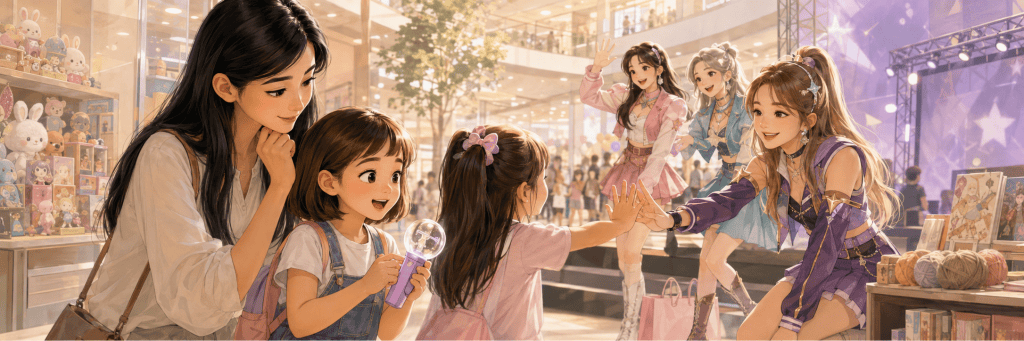
Paunsdorf Center happened to be holding a K-pop-themed event. Several young women dressed as game characters would be there, and children could queue up to high-five them and take photos.
I thought that since it was Children’s Day, I might as well take her to have a look.
By the time we arrived, the place was already crowded. The queue was long, and my daughter was naturally excited. She had also brought along a little girl from our neighbourhood. The two of them stared at the stage and at the brightly dressed performers, their eyes shining.
Standing beside them, the adults could not quite understand the excitement. These were not the real game characters, and they were not major celebrities either. Why were so many people willing to wait in such a long line?
But children do not see it that way.
For them, it was Children’s Day. There was a stage, music, people dressed like familiar characters, and a crowd of other children waiting together. Put all of that together, and it was already enough to make the day feel special.
Because the queue was so long, we decided to visit the toy shop first and come back later.
That was where the trouble began.
These days, it is very hard to take a child into a toy shop and leave empty-handed.
Everything is displayed so temptingly: stuffed animals, surprise balls, blind boxes, building sets, keychains and tiny figures. None of them looks especially expensive on its own. Some cost ten or twenty euros, while others are only eight or nine.
The problem is that we already have plenty of similar things at home.
We have stuffed animals. We have bought blind boxes before. We have building sets, too. All kinds of little toys have come home with us, been played with for a few days, and then disappeared into some forgotten corner.
My daughter knows this as well. You can remind her that she has already received Children’s Day presents, that Grandma bought her roller skates, that I bought her a building set, and that there are already more than enough toys at home. She understands what you are saying. She is not completely unreasonable.
But understanding does not mean she stops wanting something in that moment.
Standing in front of shelves full of colourful packaging and products promising a “surprise,” she still thinks, I really like this one.
That is what modern consumer culture does so well.
It does not make children feel that they truly need something. It simply keeps making them feel that they would still like to own one more thing.
Blind boxes are a particularly clear example. What they really sell is not the toy itself, but the anticipation before the box is opened. The child is not simply buying a small plastic figure. She is buying the feeling that she might get the one she really wants.
Once the box is open, however, the excitement often lasts only a little while. She plays with it briefly, puts it aside, and forgets about it a few days later.
From a parent’s point of view, the money can feel strangely wasted.
It is not that you cannot afford one toy. But when one purchase follows another, you begin to notice how easily money disappears. It is rarely one large expense. Instead, it is a steady stream of small purchases along the way. None of them seems alarming on its own, but together they can make you feel uneasy.
Later, my daughter said she wanted to look around Müller.
There, she found a book about knitting and yarn crafts. The book cost more than eighteen euros, while the yarn beside it was surprisingly cheap—just over one euro per ball.
The contrast struck me. In Germany, materials are sometimes quite affordable, but books are genuinely expensive. By the time we bought the craft book and several balls of yarn, the total came to more than twenty-six euros.
To be honest, I hesitated.
Before leaving home, we had agreed that we would not buy things unnecessarily. She had already received her Children’s Day presents.
But my daughter genuinely loves making things. She is not simply asking for everything she sees. Her interest in crafts is real.
A few days earlier, she had injured her leg. The pain was high up in her thigh, and sitting was uncomfortable. Yet when she was working on her building set, she stayed there for three or four hours and kept going until she had finished it.
I realised that she is just like the adults in our family. When she is doing something she genuinely wants to do, she can sit there for hours and forget both tiredness and pain. But as soon as she is asked to read or write, something starts hurting. Her leg aches, then her head hurts, and soon she feels too tired to continue.
So in the end, I bought the book and the yarn.
I knew they offered more value than a blind box that would be opened and soon forgotten. At least this was something she truly wanted to spend time on. She could learn to follow the pictures, work with her hands and complete something of her own. Even though it cost more, it did not feel entirely wasteful.
Still, the experience reminded me how difficult it has become to take a child out without spending any money at all.
You think you are only going to see an event. Then the children get hungry and need something to eat. McDonald’s is too crowded, so you go to Subway instead. Two half-size sandwiches and two cookies for the girls, and more than fifteen euros is gone.
Then you visit the toy shop and see the blind boxes.
Then you go to Müller and find a craft book and some yarn.
By the end of the day, you realise that you have not bought anything particularly large, yet the money has still disappeared little by little.
This is one of the ways modern life can make you feel powerless.
Parents are not unwilling to make their children happy, and it is not that every small expense feels unbearable. What is exhausting is that children’s happiness is increasingly placed inside a consumer setting.
The shopping centre, the toy shop, the fast-food restaurant, the Children’s Day event, the blind boxes and the craft materials all appear one after another. Each purchase seems to come with a reasonable explanation.
It is so cute.
The child really likes it.
It is a special day.
It is not that expensive.
She can learn something from it.
We will eat it and then move on.
Taken one by one, every reason makes sense. But by the end of the day, the adult suddenly realises that taking a child out is no longer simply about spending time together. It has become a constant series of decisions about money.
Should I buy it or not?
Should I make an exception this time?
Is this one worth the money?
Will my child be disappointed?
Am I being too stingy?
Do we already have too many things at home?
The decisions themselves are exhausting.
I used to think that the expensive parts of raising a child were the major things: school costs, extracurricular activities, clothes and electronics. Increasingly, though, I feel that much of the real expense is hidden inside everyday life.
A fast-food meal, a cookie, a blind box, a book, a few balls of yarn, a shopping-centre event. None of these things is enough to cause a crisis. But they happen so often that modern society can begin to feel like a voice constantly telling children: You could still have a little more.
Of course children find it difficult to resist.
Adults are not necessarily much better. Short videos work in a similar way. Before opening the app, you may not feel a strong desire to watch anything. But once you start, one video follows another, and it becomes difficult to stop.
Shopping is much the same. When you do not enter the shopping centre and do not see the products, you may not want anything at all. But once the products are in front of you, the desire is awakened.
That is why I do not think my daughter is greedy.
Much of the time, she is simply standing in a place carefully designed to make her want things. The colours, the packaging, the music, the event and the festive atmosphere are all telling her the same thing: today is special, so you should have something special too.
A parent’s job is to understand the child’s disappointment while still holding a boundary for her.
I increasingly feel that what we need to teach children is not simply, “Don’t buy things unnecessarily.” They need time to understand something more complicated:
Liking something does not mean you must own it.
Not buying something today does not make the day any less happy.
Some things are only attractive in the moment and may be forgotten a few days later.
Some purchases give you nothing more than the brief excitement of opening the package.
Other things may cost a little more, but if they help you learn, make something or develop a real skill, they may be worth far more than another toy.
This experience was also a reminder for me.
Modern consumer culture does not wear people down by making them spend one enormous amount of money. Instead, it breaks everyday life into countless small opportunities to spend.
Each opportunity seems harmless. Every decision feels minor. Yet they keep appearing, repeatedly testing your judgement, your boundaries and your emotional patience.
When I took my daughter out today, all I wanted was to give her a Children’s Day that felt a little special.
In the end, we never made it through the queue for the event, and we did not buy a toy. We ate at Subway and bought a craft book and some yarn instead. It was not exactly a perfect success, but it was not a failure either.
My daughter was still happy.
She saw a lively event, walked around the toy shop, ate something she liked and came home with materials for a craft she genuinely wanted to learn. From her point of view, it was probably a perfectly good Children’s Day.
For me, the strongest feeling I took away from the day was this: when you take a child out, the most expensive thing is not necessarily one particular toy. It is all the small, carefully designed purchases that appear along the way.
And what parents are resisting is not simply a child saying, “I want that.”
It is the voice of the entire consumer age, constantly placing something new in front of the child:
Look, this one is nice too.
It is not very expensive.
Today is a special day.
Go on. Buy one.
This essay is also available in other languages:
Chinese version: 现在带孩子出门,最贵的不是玩具,是一路上的“顺手消费”
German version: Wenn man mit Kindern unterwegs ist, sind nicht die Spielsachen am teuersten, sondern all die kleinen Käufe nebenbei


Leave a Reply