—Some Thoughts on Reading, Focus, and Individual Differences
By Jane Sonnenschein · January 8, 2026 · Revised July 23, 2026
A few days ago, I saw a sentence on Facebook that made me pause.
“Mom, I’m good at reading, but reading isn’t fun at all.”
It was such an honest thing for a child to say. It was also the kind of sentence many parents may have heard without knowing how to respond.
We often assume that if a child learns to read early and reads well, she will naturally enjoy books and feel happy when she reads. But that isn’t always true.
My daughter’s situation may be a little unusual because she has grown up with three languages. German is the language she hears in the world around her, while English and Chinese mainly come from home. But if we look at how much time we’ve put into each language, we’ve probably spent the most time on Chinese.
By the age of seven and a half, she could already recognize more than two thousand Chinese characters. For quite a long time after that, I asked her to read in Chinese for half an hour every day. She also spent about twenty minutes a day using an English reading app.
Looking back, I can see that reading had started to feel like a task to her. She didn’t dislike words, and it wasn’t that she couldn’t read. But she often tried to bargain with me and asked if she could read a little less that day. The things she was being asked to read simply didn’t interest her very much.
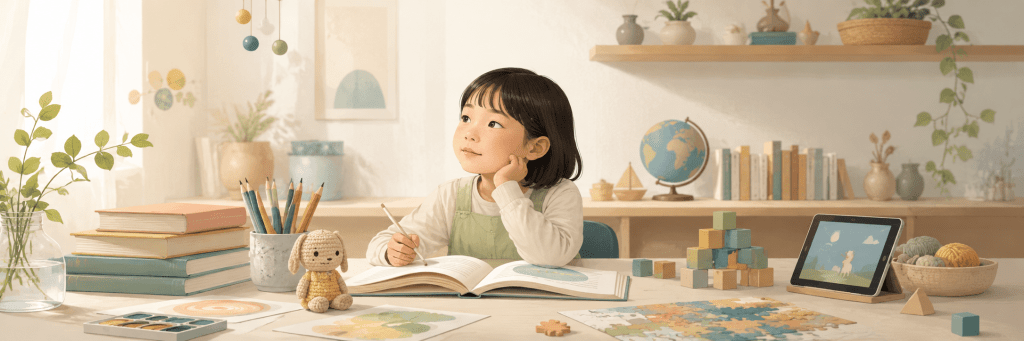
Over time, I realized that the things she truly enjoyed were not “reading” in itself, but drawing, making things, building with LEGO, and doing puzzles. She could sit quietly with those activities for a very long time, without anyone needing to remind her or keep her going.
Reading was different. If I chose the book, watched her while she read, timed her, or told her exactly what she had to finish, she would quickly become resistant.
But when she chose the book herself, everything changed.
Some time ago, she picked up Alice’s Adventures in Wonderland on her own. During those days, she became noticeably quieter. She was so absorbed in the story that my husband even asked me, “What’s going on with her lately?”
She wasn’t reading because she had been given a task or because someone had told her to sit there for a certain amount of time. The story had simply pulled her in, and her concentration came naturally.
That was when I began to understand that perhaps the real question was never whether a child loved reading. Perhaps she just hadn’t found something she truly wanted to read yet.
There was something else about her that I used to misunderstand.
When she is drawing, making things, or helping me tidy up, she often plays Chinese videos from Bilibili or YouTube in the background. Sometimes she listens to people talking about games such as Minecraft. Sometimes she listens to craft tutorials.
At first, I assumed that having a video playing while she was doing something else must be distracting. Many parents believe that a child can only work properly when everything is quiet and she is giving the task her full attention. Music, voices, or videos are easily seen as signs that she isn’t concentrating.
I went through something similar when I was young. There were no online video platforms then. We listened to cassette tapes.
I liked to play music while doing homework or memorizing things for school. To me, it was simply background sound. It didn’t pull my thoughts away. In fact, it helped me calm down and focus on what I was doing.
My mother couldn’t understand that. In her eyes, I was supposed to be studying, but instead I was sitting there listening to music. That meant I couldn’t possibly be taking my schoolwork seriously.
Once, she even ruined some cassette tapes I had borrowed from classmates because she believed they were stopping me from studying properly.
As I grew older, I realized that people’s minds don’t all work in the same way.
I have a friend who loves music, but he can’t listen to it while studying. If he plays music while doing homework or trying to memorize something, his thoughts follow the music and he loses his focus completely. For him, music really is a distraction.
I’m the opposite. Music doesn’t take my attention away. It helps me settle down, and I often find it easier to concentrate with music than without it.
That is why we can’t judge this kind of thing by one rule. Listening to music doesn’t help every child learn, but seeing a child listen to something while working doesn’t automatically mean she isn’t paying attention.
My daughter seems to be more like me in this way. She often tells me, “I’m not watching it. I’m listening.”
Once, she was helping me pack some things while a Chinese gaming video played in the background. I asked her, “Are you really listening? What did he just say?”
She immediately told me what she had just heard, almost word for word.
That was when I realized that the sound wasn’t necessarily disturbing her. It may even have created a familiar atmosphere that helped her settle into what she was doing.
While her hands were busy, she was also taking in Chinese words, sentence patterns, and expressions. Recently, she has started using Chinese idioms naturally when she talks to me. She didn’t learn them by sitting at a desk and memorizing them. They slowly became part of her language because she had heard them again and again.
A few days ago, she came home after staying with her grandmother and showed me two small things she had crocheted. One of them looked like an old woman wearing a hat. It had a head, a body, clothes, eyes, and a mouth. It really did look like a little person.
I was surprised by how well she had made it. I asked if someone had taught her.
She said no. There was no one at her grandmother’s home who knew how to make it. She had simply thought about how it might work and figured it out herself.
I once learned a little crochet too, but I never made anything more complicated than a scarf. I know that making a three-dimensional figure out of yarn isn’t as simple as it looks.
She had watched crochet videos before and learned by observing how other people did it. This time, she took what she had seen, worked it out in her own way, and created something new.
It made me realize again that she wasn’t simply sitting in front of videos and wasting time. She was watching, listening, and learning in a way that suited her.
Of course, this doesn’t mean that every child should listen to music or videos while studying. It also doesn’t mean that background sound will always help a child focus.
Some children are easily distracted by sound. Others need a familiar voice or a little background noise before they can settle down.
Parents need to look at the child in front of them. Is she still following what she hears? Is she doing the task well? Is the sound helping her concentrate, or is it pulling her away?
Reading is much the same.
We often use very narrow standards to decide whether someone is a “good reader.” How many books did they finish this year? Did they take notes? Can they explain what they read? Did they write a book review afterwards?
But people don’t all read in the same way.
Some people finish every page of a book and write careful notes, yet nothing in the book really changes the way they live or think.
Others may not finish the book at all. Perhaps they only read a few pages or remember a few sentences. But those sentences speak to something they have experienced. They stay in the person’s mind, become part of their thinking, and later come out again in their own words.
From the outside, that second kind of reading may look careless or incomplete. People may say that the reader only skimmed the book or didn’t really understand it.
But perhaps the real question is not how many pages someone has read. Perhaps it is whether anything from those pages truly stayed with them.
Children are no different.
Some children love sitting quietly with a book. Others find their way into language through stories, sounds, images, or a subject they already care about.
Some children become calmer when they read before bed. Others become more excited the longer they read.
My daughter now reads a little in German before going to sleep. She usually chooses the books herself at the library.
For her, reading at night helps her calm down. We used to lie in bed and talk. Very often, we would end up laughing so much that our minds became more and more awake. Sometimes that made it harder for her to fall asleep.
Now that she reads before bed, she settles down more easily.
But a friend of mine has a child who is completely different. The girl grew up with her grandmother in China and was used to going to bed quite late.
She had only recently arrived in Germany, and her German wasn’t good enough for her to read German books comfortably. I suggested that my friend let her read something in Chinese before bed.
My friend said, “That would never work. If she starts reading a Chinese book she likes, she gets more and more excited. Then she can’t sleep at all.”
The same habit can calm one child and excite another.
This is why I’ve come to believe that very few methods work for every child in exactly the same way. Whether we are talking about music, videos, reading, or learning, what matters is not whether the method looks serious enough to an adult.
What matters is whether it works for this particular child.
Over time, I also became less controlling about my daughter’s reading.
I stopped standing beside her and watching her read. I stopped insisting that she use one particular reading app.
We have many Chinese books that were sent to us from China. Now she chooses what she wants to read. She can also decide when to read and how much.
Some days she reads more, and some days she reads less. But I can feel that once reading stopped being something that was constantly watched and measured, her relationship with words became much more relaxed.
When I think again about that sentence—“I’m good at reading, but reading doesn’t make me happy”—I understand it better now.
Perhaps it doesn’t mean there is anything wrong with the child.
Being good at something doesn’t mean you will enjoy it. Learning quickly doesn’t mean you will love the process.
There is also more than one way into reading. A child may find it through books, but she may also find it through stories, sounds, videos, or something she already loves.
This is especially true in multilingual families. Every child has her own way of meeting a language, taking it in, and making it part of her life. Her path will not always fit the standard model adults have in mind.
The method adults believe is the most correct or efficient may not be the one that works best for the child.
I now prefer to believe that when reading becomes something a child can choose, and when she feels a real connection with what she is reading, her relationship with words will slowly grow in its own time.
It doesn’t always need someone standing behind her and pushing.
This essay is also available in other languages:
Chinese version: 我孩子很会读书,但读书并不让她快乐
German version: Mein Kind kann sehr gut lesen, aber Lesen macht ihm keinen Spaß


Leave a Reply