By Jane Sonnenschein · July 18, 2026
“Concentrate a superior force to destroy the enemy forces one by one.” — Mao Zedong¹
Yesterday, I watched a creator on Bilibili, a Chinese video platform, use strategic ideas from Mao Xuan² to explain procrastination and habit change. One idea stayed with me long after the video ended: when the enemy is strong and we are weak, the most foolish response is not to step back temporarily. It is to recognise that the balance of forces is against us and still insist on confronting the stronger side with our weakest resources, as though a head-on collision were the only way to prove our courage.
In Concentrate a Superior Force to Destroy the Enemy Forces One by One, Chairman Mao explains that when enemy forces are advancing from several directions, already limited troops should not be distributed evenly across every front. Such an arrangement may appear comprehensive, but in reality it can leave every position too weak to achieve anything decisive. A more effective strategy is to concentrate superior forces at one relatively favourable point, defeat one section of the enemy first, and then decide what to do next according to the new situation, rather than attempting to win every battle simultaneously.
This was originally a principle of military strategy, yet when I brought it back into ordinary life, I suddenly realised that many of us make precisely the opposite mistake whenever we try to change ourselves. Even though we are already fighting from a weaker position, we launch attacks on every front at once.
On an evening when we feel particularly disappointed in ourselves, we may suddenly decide that tomorrow will mark the beginning of a completely new life. We will go to bed early and rise early, stop looking at our phones, control what we eat, begin exercising, read every day, improve our productivity, overcome procrastination, regulate our emotions, and revive every plan we have previously abandoned. We produce an overcrowded list and imagine that, if our determination is strong enough, willpower alone will enable us to suppress every desire, habit and impulse within a single day.
The problem is that the “troops” available to us are limited from the beginning. Attention, energy and self-control change according to sleep, physical condition, stress and emotion, while the things that offer immediate pleasure and relief continue to provide instant rewards. A single movement of the finger produces another short video; something sweet brings satisfaction the moment it reaches the mouth; lying on the sofa and doing nothing is naturally easier than beginning a difficult task whose rewards lie far in the future. The tired version of us, the emotionally depleted version and the well-rested version do not possess exactly the same capacity for self-control, and a habit formed over many years does not suddenly lose its power simply because we have written a new schedule.
If old habits, immediate rewards, physical exhaustion and the surrounding environment are all standing on the other side, while we rely on a temporary burst of determination to control our diet, exercise every day, give up our phones and establish an entirely new sleeping routine, then failure has already been built into the battle plan. It is not that we have made no effort. We have simply scattered our limited forces across too many fronts while demanding victory on every one of them.
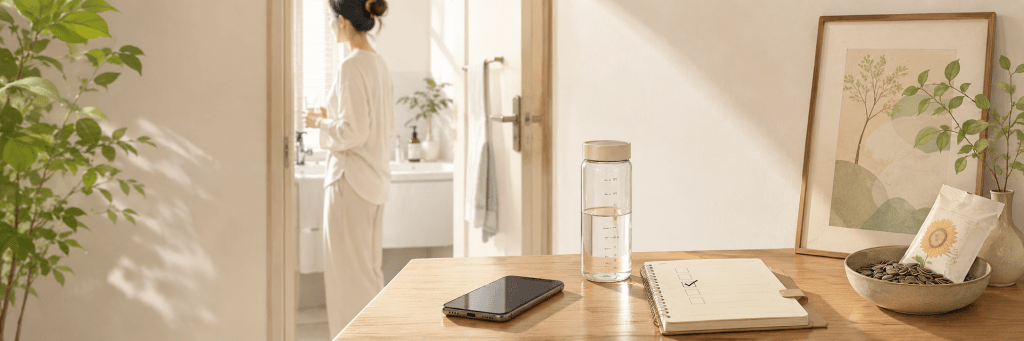
I used to love eating sunflower seeds, and once I started, I found it extremely difficult to stop. Eating them was satisfying, of course, but afterwards my mouth would become sore and my throat would hurt. I understood the consequences perfectly well, yet the next time I saw a bowl of sunflower seeds, I would still reach for them almost automatically. Eventually, instead of placing them in front of me every day and trying to prove that I possessed enough willpower to eat only a small handful, I adopted the simplest possible strategy: I stopped buying them.
At first, I sometimes felt that this did not count as genuine self-discipline. I had not defeated the temptation; I had merely avoided it. Yet experience showed that when there were no sunflower seeds at home, I did not spend my days thinking about them or struggling with an unbearable desire to eat them. Several years later, I visited a friend’s office and saw that she had a large supply there. I told myself that I had not eaten any for such a long time and that a few could do no harm. But once I began, I still ate far more than I had intended and found it almost impossible to stop at the point I had originally chosen.
That experience taught me that some enemies do not disappear simply because we have not encountered them for several years. When they are absent, we merely no longer have to mobilise our self-control against them every day. If I already know that beginning is what makes stopping so difficult, then refusing to bring sunflower seeds home is not a shameful escape. It is a deliberate decision to acknowledge the true balance of forces and choose a more favourable battlefield. If I cannot yet rely on myself to remain restrained every time they are placed in front of me, why should I keep them within reach and turn every day into another test of my character?
Not taking my phone into the bathroom may also look like a very small change, but I was not finally able to sustain it merely because I recognised how powerful the phone’s attraction was, nor because I had suddenly become more disciplined. The change lasted because, for the first time, I moved beyond the visible behaviour and began to understand what was actually happening beneath it.
Taking my phone into the bathroom had been part of my routine for well over a decade. My digestive system has never been particularly active, and constipation has often meant that I needed to wait before anything happened. With the phone in my hand, one video led to another, and after reading a post I would open the comments, so what was initially meant to be a short wait gradually became half an hour or even longer. The longer I remained seated, the more I felt that I was not yet finished; the less finished I felt, the more reluctant I became to stand up. Physical discomfort and the phone’s immediate rewards began to reinforce each other, creating a self-perpetuating cycle.
Yet describing the problem simply as phone addiction would still miss part of the truth. For many parents who have spent years caring for a child, the bathroom is one of the few places in the home where the door can be closed and nobody has to be answered immediately. My daughter Alicia is already nine, but from the time she was born she has almost always been beside me and has rarely spent any real time away from me. Household responsibilities, her needs and my husband’s health have often meant that many things ultimately still fall to me. Sometimes I took my phone into the bathroom not only because I wanted to consume its content, but because behind that closed door I could briefly retreat into silence, arrange nothing and attend to nobody else’s needs or emotions.
Without recognising this layer, simply ordering myself never to use my phone in the bathroom would have been difficult to sustain. The phone was not only offering instant stimulation; it was also satisfying a genuine need to withdraw from family responsibilities for a few moments. At the same time, however, my body was warning me in a much more direct way that this method of finding rest was beginning to carry consequences I could no longer ignore.
I previously underwent surgery for an anal polyp, and the pain involved is difficult to understand unless one has personally experienced it. During the past year, an irregular routine, chronic late nights and long hours at the computer, combined with the changes I have felt in my body since passing forty, have made constipation more noticeable again. I also began to sense that the earlier problem might be returning. At that point, I realised that this was no longer merely a matter of wasting time or lacking self-control. A genuine health alarm had begun to sound. If I continued taking the phone inside and repeatedly sitting there for long periods, I might eventually face another operation and a period of suffering I had no wish to relive. I could no longer dismiss the behaviour as an insignificant habit while allowing my body to bear its consequences.
Once I moved beyond the surface appearance of “liking to scroll on my phone” and saw the prolonged sitting, constipation, physical risk and need for a moment of solitude underneath it, the issue acquired an entirely different weight. I was no longer vaguely telling myself that the habit was bad. I understood why I genuinely needed to change it. Yet recognising the seriousness of the problem did not automatically erase a routine that had existed for more than ten years. I also knew that if I carried the phone inside and then expected myself to stop at the right moment, I would probably still lose that struggle.
Since the temptation was stronger than the self-control available to me in that setting, I stopped carrying it onto the battlefield and asking myself to confront it directly. My solution was simple: I would not take my phone into the bathroom. I began using a marked water bottle to remind myself to drink more throughout the day, paid greater attention to my diet, and used gentle abdominal massage to support my digestion. When I felt the need to go, I went in, finished and came out, rather than turning the bathroom into a place where I remained for an extended period. Instead of waiting until I was already sitting there and then mobilising my willpower to put the phone down, I prevented the unnecessary battle from beginning.
Looking back, I realised that this experience closely reflected the movement “from the surface to the deeper level” described in On Practice³. We often speak of looking beyond appearances to grasp the essence of a problem, but the value of doing so does not lie in arriving at an explanation that merely sounds more profound. Only when we understand how a problem is structured can we create a plan that has a genuine chance of working.
On the surface, the problem seemed to be that I used my phone in the bathroom. At a deeper level, slow digestion encouraged me to remain seated, the phone’s instant feedback made remaining there easier, and years of being surrounded by childcare and domestic responsibilities had turned the bathroom into a place where I could temporarily close the door and find some peace. Only when my previous experience of surgery and the renewed warning signals from my body showed me that this cycle had reached a health boundary did my goal change. I was no longer trying to take my phone inside and restrict myself to five minutes. I needed to dismantle, at its source, a behavioural chain that had been operating for more than a decade.
This is what it means for understanding the essence of a problem to influence the battle plan. I have maintained this change for nearly two months, not because I have finally conquered every desire, but because I first worked out what the real problem was and then admitted that, under the old conditions, I was unlikely to win. The warning from my body made the seriousness of the situation visible, while leaving the phone outside, reducing prolonged sitting and adjusting my hydration and bathroom habits became practical strategies I could actually carry out with the strength available to me.
Many of our plans repeatedly fail not because we lack determination, but because we never move beyond what is visible. We see ourselves scrolling, eating sweets, procrastinating or giving up exercise, so we immediately issue another command. What we often fail to ask is what need the behaviour is meeting, why it keeps returning, where its most serious consequences lie, and which part of the problem needs to be addressed first. Without this understanding, even an extremely detailed plan may simply direct our limited forces towards the wrong battlefield.
The same principle applies to the number of changes we try to make at once. If the most important issue for someone at a particular stage is their diet, it may be better to concentrate first on reducing sweets, changing shopping habits and arranging regular meals. If some energy remains, exercise can certainly be included, but there is no need to demand high-intensity training every day while also going to bed before eleven, reading a fixed number of pages and restarting every unfinished work project. Once every intention becomes a compulsory task, a disruption in any one area can cause the entire arrangement to collapse.
I used to be capable of following a new exercise routine or plan for three days on the strength of my initial enthusiasm. On the fourth day, my period might begin, I might feel physically unwell or emotionally low, or perhaps I had simply slept badly the previous night and did not want to exercise. The real problem was rarely that I had missed one session. It was that I immediately interpreted the interruption as failure and concluded that, once again, I had proved myself incapable of persistence. Because the sequence had been broken, the previous three days seemed to lose all value, and I became even less willing to begin again.
Looking back, I can see that I was demanding that the entire campaign proceed exactly according to its original schedule, as though any pause meant complete collapse. Yet in the same military directive, Chairman Mao also wrote that after an operation, forces could continue according to circumstances or “withdraw for rest and prepare for the next battle.” If an actual war requires rest and adjustment according to changing conditions, why should an ordinary person’s life not pause for a few days because of menstruation, illness, exhaustion or an unexpected event?
A pause is not surrender, and an interruption does not erase everything that came before it. Not exercising today means only that I did not exercise today. Needing rest for several days does not mean I cannot resume a week later. What prevents many plans from being restarted is not the pause itself, but the speed with which we declare the entire effort a failure once the pause has occurred.
Applying the principle of concentrating superior forces and defeating problems one by one does not mean treating our bodies and desires as literal enemies, nor does it mean managing everyday life as a military campaign. What it offers is a way of judging the situation. When the forces currently available to us are limited, we do not need to declare war on every problem simultaneously. When a particular temptation is still stronger than our ability to resist it, we can alter the environment rather than confronting it every day. We can choose the issue most worth addressing at this stage and concentrate our time, attention and action there, then turn to the next matter after a new way of living has gradually become more stable. Interruptions caused by illness, menstruation, exhaustion or unexpected events can be treated as necessary periods of rest rather than proof that the entire campaign has failed.
I increasingly believe that self-discipline is not truly measured by whether a person can fight ten enemies at once whenever every temptation appears. It lies in knowing what matters most at this particular moment, which temptations should temporarily be avoided, which difficulties genuinely need to be confronted, and when it is reasonable to stop and recover. We do not need to win the whole war in a single day. We need only choose the right battle in front of us and concentrate our strength on fighting it well. Even when rest becomes necessary, we do not have to rush to declare defeat, because after resting, we can still begin again.
Notes
1. Máo Zédōng (毛泽东): Mao Zedong (1893–1976) was a Chinese communist revolutionary and the principal leader of the Chinese Communist Party during the establishment of the People’s Republic of China in 1949. He remained Chairman of the Chinese Communist Party until his death. In Chinese, Máo Zhǔxí (毛主席), literally “Chairman Mao,” is a familiar and respectful form of address still widely recognised in discussions of his life, writings and political thought.
2. Máo Xuǎn (毛选): This is the common shortened Chinese name for Máo Zédōng Xuǎnjí (毛泽东选集), translated as Selected Works of Mao Tse-tung in the older official English editions and now more commonly rendered as Selected Works of Mao Zedong. The multi-volume collection brings together Mao’s political, military and philosophical writings. Jízhōng Yōushì Bīnglì, Gègè Jiānmiè Dírén (集中优势兵力,各个歼灭敌人), officially translated as Concentrate a Superior Force to Destroy the Enemy Forces One by One, was a military directive dated September 16, 1946, and appears in Volume IV.
3. Shíjiàn Lùn (实践论): Translated as On Practice: On the Relation Between Knowledge and Practice, Between Knowing and Doing, this philosophical essay was written in July 1937. It discusses how knowledge develops through practice: people begin with direct, perceptual experience, move towards a deeper rational understanding of a problem and then return that understanding to practice through plans and action. In this essay, the movement from surface impressions towards the inner relationships and essence of a problem is not merely intellectual; it is meant to guide more effective action.
This essay is also available in other languages:
Chinese version: 当欲望比自制力更强时,不要再逼自己硬碰硬
German version: Wenn das Verlangen stärker ist als die Selbstkontrolle, kämpfe nicht länger frontal dagegen an

 Jane Sonnenschein | A Chinese Way of Seeing
Leave a comment