By Jane Sonnenschein · Drafted on May 5, 2026 · Revised on July 15, 2026
“Education is not the filling of a pail, but the lighting of a fire.” — William Butler Yeats
Very few things happen all at once. This is true of language, growth, and memory alike. What determines whether something remains with us is usually not one period of intense effort, but whether it has a stable place in our everyday lives.
A couple of years ago, while scrolling through WeChat Moments, I came across a post from a mother I knew from a Chinese-German family.
She wrote, with some frustration, that her child was becoming increasingly unwilling to speak Chinese. Although her child clearly understood everything she said, the response almost always came in German whenever she spoke Chinese. That day, she had spent two hours studying Chinese together with the child, only to end the session feeling that she simply could not get the child interested.
I was not particularly surprised when I read her post.
We had known each other for many years, from a time when several Chinese-German families regularly met and brought their young children along. She had always cared about Chinese and hoped that her child would grow up speaking it well, but in everyday life she generally chose to speak German with the child.
Part of the reason was that she worried the child would not understand Chinese when they were very young. She also wanted the three members of the family to use a language everyone could understand, so that her husband would not feel excluded from their conversations.
From her position at the time, this was an entirely understandable choice. Many intercultural families face the same dilemma and make similar decisions.
Later, she took her child to China for more than six months and enrolled them in a local primary school, hoping that full immersion would help rebuild their Chinese. I never found out exactly what happened afterward, because we eventually lost touch, but the story stayed with me.
When our children were still young, I met another family that left an equally strong impression on me.
The mother was Chinese, while her German husband had studied Sinology at university and could speak a fair amount of Chinese himself. On paper, their family seemed to have an advantage that most Chinese-German families did not have. The father understood Chinese, the mother was a native speaker, and both parents knew the language mattered. At the time, I assumed that their child would naturally speak Chinese well.
What surprised me was that whenever the children played together, their child quickly switched to German, while speaking Chinese seemed hesitant and laborious.
For a long time, I could not understand why.
I had assumed that if both parents knew Chinese, the child would naturally acquire it too. Only later did I realise that these are two entirely different things.
Parents knowing a language does not mean that the language is truly alive within the family.
What matters is not how much Chinese the parents know, but whether Chinese has become a natural and indispensable part of daily family life.
I did not understand this clearly from the beginning either.
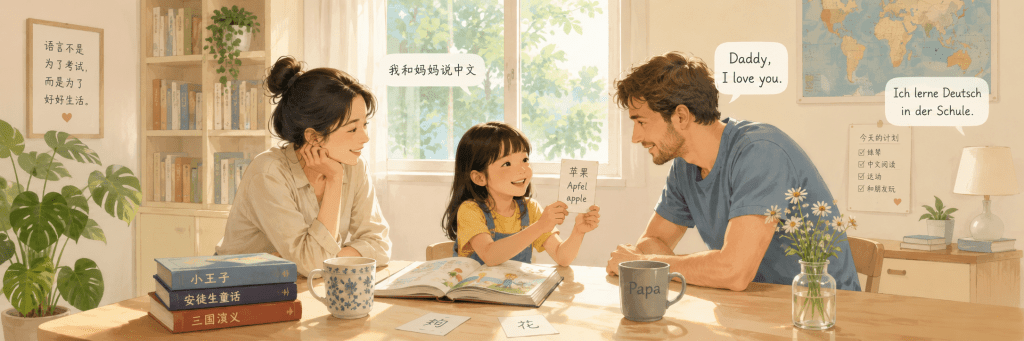
For years, I only had a vague sense that each person in a multilingual family should maintain a consistent language role. This has always been the structure in our home: my daughter, Mido, and I speak Chinese with each other; my husband, Chris, speaks English with her; and German is provided by school and the wider society around us.
Why this structure could remain stable over time, and what a minority language truly needs in order to survive, only became clearer to me after years of observing other families and reflecting on our own experience.
Some time ago, while writing, I was also reading about philosophy and psychology. I tried to bring the ideas of Kant, Nietzsche, Plato, Aristotle, Freud, Adler and others back into my own life and relationships, rather than leaving them as abstract theories.
While I was writing those essays, many of the concepts felt remarkably clear. I could understand the theories, connect them to my own experiences, and gradually turn those reflections into finished pieces.
Yet a little more than a month later, I suddenly noticed that some of the ideas I had once understood so clearly were already becoming blurred, simply because I had not continued using or revisiting them. Even thoughts I had examined carefully and written down began to fade when I stopped calling upon them.
Human memory is not like a computer hard drive, where a file remains safely stored as long as nobody deletes it.
What we keep in our minds can easily be displaced by new information if it is not repeatedly used, reconnected and reinforced. Ideas that once seemed perfectly clear can disappear like a ring of water on a tabletop, wiped away with one movement of a cloth. They can also resemble dandelion seeds carried by the wind: one moment they are right in front of us, and the next we no longer know where they have gone.
Over time, I began to see that language and memory follow remarkably similar patterns.
Many parents focus on how many Chinese characters their children recognise, how large their vocabulary has become, or how dramatically their Chinese improves during a particular stay in China. All of these things are valuable, but whether a minority language truly remains does not depend on how quickly the child progresses during one particular period. It depends on whether that ability continues to be used after the child returns to ordinary life.
The community language becomes stronger not because children deliberately practise it every day, but because it participates in nearly every important part of their lives.
They use it to follow lessons, read, write and complete homework. They also use it to build friendships, manage conflicts, express complicated emotions and, increasingly, to think. The more situations in which a language is used, and the more complex the ideas it is required to carry, the more readily the brain calls upon it and the more naturally it continues to develop alongside the child.
A minority language lives under very different conditions.
If Chinese appears only occasionally in family conversations, or is concentrated into weekend classes and short periods spent in China, but rarely carries real communication, reading or thought once the child returns home, then even a high level of ability will not preserve itself indefinitely.
A mother living in New Zealand once shared her experience in the comments under one of my articles.
She said that when her child was around ten, she deliberately took the child back to China for two years, hoping that complete immersion would bring their Chinese to a genuinely strong level.
The results during those two years were unmistakable. The child lived in Chinese, studied in Chinese at school and communicated with classmates in Chinese. Their listening, speaking, reading and writing improved enormously, perhaps even dramatically.
According to the assumption many parents share, once the child had reached that level, the language should have remained with them after returning overseas.
Yet when the family moved back to New Zealand, the child once again lived almost entirely in English. Schoolwork, reading, writing, thinking and most everyday interactions took place in English. After some time, the mother noticed that the Chinese the child had built up during those two years in China was gradually declining and had not remained as naturally as she had expected.
She wrote something in the comments that stayed with me.
She said that she had once believed sending her child back to China for a few years would solve the problem. Only later did she realise that the real question was not whether the child could learn Chinese, but whether Chinese could continue to live in the child’s daily life after they returned overseas.
When I read her comment, many of the things I had observed over the years suddenly seemed to connect.
The reason Chinese has remained strong in our family is not that I designed an especially sophisticated method, nor is it because Mido necessarily has more linguistic talent than other children.
It is because, from the time she was born, Chinese has been tied to the relationship between the two of us. For nine years, that relationship has not fundamentally changed for the sake of convenience, circumstance or concerns about whether she understood every word.
Even when the three of us are out together, I still speak Chinese naturally with Mido.
Sometimes I am only making an offhand complaint about how expensive something has become at the supermarket, or grumbling about some minor inconvenience. I have never asked her to translate for me, yet she will often immediately turn to her father and explain in English what I have just said, because she knows that Chris understands only a few words of Chinese.
When her translation is not quite accurate, I sometimes correct her with a laugh. She never translates her father’s English back into Chinese for me, because she knows perfectly well that I understand him.
Over time, she has naturally taken on the role of relaying my words to her father. I sometimes joke that she has become a human translation machine, or a little parrot repeating everything I say.
When I casually complain about some small part of daily life, she immediately translates that too, and I sometimes have to remind her that she does not need to reproduce every sentence word for word. Her father does not necessarily need to know every detail of what I have just muttered.
Chris used to feel that when the three of us were together, we should speak a language everyone could understand, because otherwise he could not follow what we were saying.
Over time, however, he became accustomed to the arrangement. We both understand that speaking Chinese between mother and daughter is not intended to exclude him. Chinese has simply become the most natural language of our relationship.
When necessary, he can understand what I mean through Mido’s explanation, but we do not therefore replace a mother-daughter language pattern that has developed over nine years with English.
This is why I have come to believe that what a minority language truly needs to preserve is not a certain amount of vocabulary, nor a sudden period of impressive progress. What it needs is a stable place within the family.
When a language remains connected to a particular person, a steady relationship and a form of life that happens every day, it continues to grow through repeated use and has a better chance of developing alongside the child.
But when it is valued today and replaced for convenience tomorrow, or strengthened intensively for a short period and then rarely used once the child returns to their usual environment, even a very high level of ability can fade like a memory that is no longer reinforced.
Many children do not suddenly become worse at Chinese. At some point, their Chinese simply stops growing within their everyday lives.
This understanding of a language’s place is not limited to Chinese-speaking families overseas. It applies to minority languages in multilingual families more generally.
For children growing up in European or North American language environments, however, Chinese differs considerably from English, German and other European languages in its writing system, sounds, vocabulary and patterns of expression. Children cannot easily transfer what they know from the community language into Chinese. Without sustained input and regular use, Chinese may therefore stop developing more easily than European languages that share more structural or lexical similarities with one another.
Yet whether a family hopes to preserve Chinese, Spanish, French or any other language, what determines whether it remains is still not how much the child manages to learn in a short period. What matters is whether that language has a clear, stable and continuing place in the child’s daily life and family relationships.
What families need to preserve is not merely the level of Chinese a child once reached. They need to preserve a place for the language, regardless of how the surrounding environment changes: someone who continues to speak it with the child, listen to the child through it, and allow it to remain part of how the child expresses who they are.
What remains with us is rarely one sudden burst of ability. It is what has been repeated so consistently, day after day, that it has quietly become part of life.
This essay is also available in other languages:
Chinese version: 很多孩子的中文,不是突然变差的,而是从某一天开始不再往前长了
German version: Viele Kinder werden nicht plötzlich schlechter in Chinesisch – ihre chinesische Sprache hört einfach irgendwann auf, weiterzuwachsen


Leave a Reply