By Jane Sonnenschein · January 14, 2026
Over the past couple of days, I came across a clip from the Chinese television drama Xiao Shede² while scrolling through Shipinhao¹.
The series is primarily about education, family life, and intergenerational anxiety. Yet I unexpectedly found myself drawn to a different subplot.
Not the children.
An adult marriage.
The drama features a couple who once seemed to have a very loving relationship.
From a young age, the wife had always been well cared for. She rarely needed to worry about the practical details of everyday life. Her husband had also become accustomed to saying, in effect, “I will take care of everything,” and he saw this as one way of expressing his love.
Then one day, he became seriously ill.
The relationship began to expose a question that is rarely discussed when life is going well:
When life is no longer easy, and a person must confront illness, physical decline, and survival itself, is love still enough?
In stories, we are used to believing that love comes before everything else. We believe that someone may be willing to give up everything for the person they love.
But once we step into reality, and staying alive becomes a question that must actually be answered, many people discover that love is not the only consideration.
At that moment, survival often comes first.
Being Loved Is Not the Same as Being Prepared for Life
Many people instinctively see “never having to do anything” as the highest form of happiness.
But in real life, if a person is spared from doing things for too long, that freedom can gradually turn into something else: an inability to function in the real world.
This does not mean that the person is unkind, insensitive, or incapable of love.
Quite the opposite. Many people in this position are highly empathetic. They know how to comfort others and provide emotional support.
It is simply that their way of loving has long remained within the emotional realm rather than extending into the realm of shared responsibility.
When life is peaceful, such a relationship can look almost perfect. It is the kind of gentle harmony in which one person is carefree and playful while the other watches with affection.
But once life enters a stage that demands long-term decisions, caregiving, practical action, and the carrying of heavy responsibilities, the underlying problem begins to reveal itself.
In the Face of Life and Death, Human Nature Is More Honest Than Love
One storyline in the drama provoked considerable controversy.
When the male character realized that his physical condition might determine how long he had left to live, he made an extreme and deeply unpopular choice.
Many viewers condemned him angrily in the comments:
“This is selfish.”
“This is a betrayal.”
“How could he do this to someone who had shared so many years of his life?”
But if we put our immediate emotions aside and look at the situation calmly, we may see that this is not really a romantic question.
It is a stark question of survival.
When a person is genuinely facing the possibility that they may or may not remain alive, they will often instinctively choose someone who is steadier, more decisive, and more capable of dealing with reality.
That response is neither noble nor despicable.
It is one of the most common ways human nature reveals itself under extreme pressure.
Literature may celebrate love that remains unwavering even unto death. In reality, however, most people choose first to stay alive.
The Greatest Danger in an Intimate Relationship Is Not a Lack of Love, but One-Sided Growth
The greatest risk is that only one person in the relationship continues to grow.
To me, a truly stable intimate relationship does not mean:
“I will protect you so completely that you never have to do anything.”
It means:
You may depend on me without losing your ability to stand on your own.
I may carry things for you, but I cannot live your life in your place.
This brings to mind the kind of relationship described by Shu Ting in Zhi Xiangshu³:
Not clinging to one another.
Not being sheltered from life.
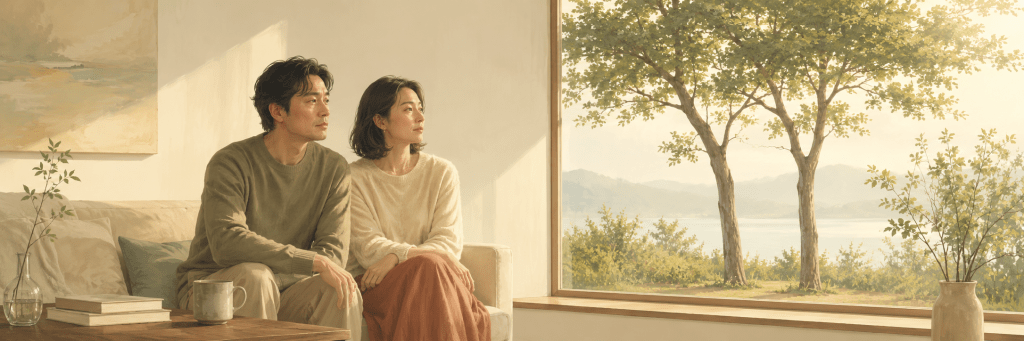
But two trees growing upward from their own soil, their roots connected and their branches facing one another.
This is not merely a poetic metaphor.
It is also a way of sharing the risks of reality.
No one can guarantee that they will never become ill, lose a job, fall down, or be shaken by changes in the world.
If only one person in a relationship keeps learning, adapting, taking responsibility, and caring for the other, while the other person remains permanently settled inside a comfort zone, the relationship may appear sweet on the surface.
In reality, it is quietly accumulating risk.
This Is Not Only About Marriage. It Is Also About Parenting
For this reason, the story also made me think about children.
Love is important in parenting. So is a sense of security.
But if love is expressed only through taking over, doing everything for the child, and preventing the child from experiencing any discomfort, then what the child may truly lack are some of the most important abilities they will need in the future:
The ability to act when facing difficulties.
The ability to tolerate and handle real-life problems.
The ability not to collapse when life becomes chaotic.
Responsible parenting does not mean ensuring that a child’s entire life remains smooth and free of difficulty.
It means allowing the child, within a range they can reasonably bear, to learn gradually how to face the parts of life that are not smooth.
That is why I am willing to be a somewhat “lazy” mother.
As long as my daughter is willing to try, I let her dress herself, brush her own teeth, eat independently, use the bathroom by herself, and pack her own luggage. She is usually very happy to do these things on her own.
This is not neglect.
Nor is it emotional coldness.
It means treating competence as part of love.
I know that I cannot remain beside her for the rest of her life.
Being able to do something and being willing to do it are two different matters. What matters is that the ability is there when she needs it.
Especially for a girl, I do not want her to place her entire fate in someone else’s hands.
For You, Here and Now
This is not meant as a criticism of any particular person, family, or choice.
Many relationship patterns develop not because someone has done something wrong, but because, for a long time, reality never forced those involved to change.
Yet the world is becoming increasingly unstable.
Health, economic security, relationships, and even the environment can no longer be treated as permanent constants.
In such a time, perhaps we need to reconsider one question:
Does loving someone mean placing her inside an ivory tower?
Or does it mean helping her become capable of surviving even if, one day, she loses the support she has always relied on?
This may not be the most romantic answer.
But it may be the answer that lasts longer.
Notes
- Shipinhao(视频号): Usually known in English as WeChat Channels, it is a video and content-sharing feature within WeChat. Users can discover and publish short videos, longer video content, and livestreams without leaving the WeChat ecosystem.
- Xiao Shede(小舍得): A 2021 Chinese family drama released internationally as A Love for Dilemma. The series follows several interconnected families and explores parenting, intergenerational relationships, academic competition, and the anxiety surrounding children’s education.
- Zhi Xiangshu(致橡树): Commonly translated as To the Oak or To an Oak, this is a well-known modern Chinese poem by Shu Ting(舒婷), a poet associated with the Misty Poets. Through the images of an oak tree and a kapok tree, the poem presents an ideal of love in which two people remain independent and equal while standing beside and supporting one another.
This essay is also available in other languages:
Chinese version: 如果必须在爱情和活着之间选择,你会选什么?
German version: Wenn du zwischen Liebe und dem Weiterleben wählen müsstest, wofür würdest du dich entscheiden?


Leave a Reply