
By Jane Sonnenschein · April 26, 2026
A few days ago, my daughter was tidying up her room and collected a large bag of messy things.
There was paper in it, plastic packaging, broken little toys, and all kinds of small items that were hard to classify. She originally wanted to clean everything up at once, but in the end she put everything into one bag.
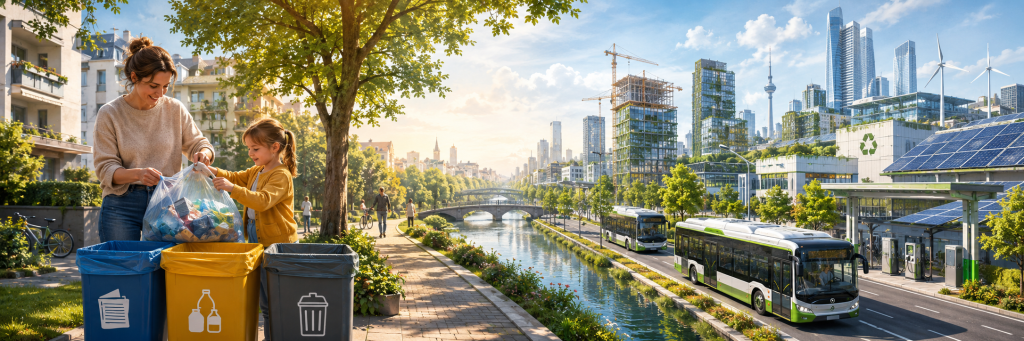
When I took it downstairs to throw it away, I stood in front of the garbage bins and hesitated for a moment.
If this had happened in my first years in Germany, I might have simply thrown the whole bag into the black bin for general waste. But after living in Germany for more than twenty years, I have become very used to the garbage-sorting system here. Paper goes into the paper bin. Plastic packaging goes into the yellow bin. Ordinary residual waste goes into the black bin.
So I stood there and sorted that bag of things again, piece by piece.
As I was sorting, I suddenly felt something very strongly. Germany’s garbage-sorting system is not just an environmental slogan. It has truly become part of everyday life in this country, and it has been maintained for many, many years.
You cannot say that Germans do not care about environmental protection.
On this matter, Germany has indeed been very serious. Children learn from a young age at school what kind of waste goes where, why waste should be separated, and why people should not throw trash around carelessly. If a person grows up in this environment, these rules slowly become habits.
This was also something that impressed me deeply when I first came to Germany.
At that time, Germany really gave me the impression of being clean, orderly, and well-maintained in public spaces. People had picnics in parks, but they would collect their trash and take it away or throw it into bins. Streets were not full of bottles, wrappers, and food packaging.
But in recent years, I have clearly felt that some things have changed.
There is a park near my home. It used to be very clean. Parks in German cities are usually very pleasant: tall trees, lawns, children’s playgrounds, places where people can walk, sunbathe, or have a picnic. But now, when I go there, I sometimes see a lot of trash on the ground: wrappers, bottles, leftover food, and even dirty traces that make people feel uncomfortable.
It is not only the park. At the bus stop downstairs, there is often trash on the ground too.
Once, my daughter and a neighbor’s child even took trash-picking tools and picked up litter downstairs. That scene made me feel a little emotional. In a country like Germany, which has long valued public order and environmental education, children should not have to pick up thrown-away trash so often right outside their own home.
So the problem is not that “garbage sorting in Germany has become difficult.”
Garbage sorting itself is not difficult. What has become more difficult is this: the cleanliness of public spaces is becoming harder and harder to maintain by relying on the old model of civic self-discipline.
Behind this lies a very important issue.
Germany’s environmental protection and public order in the past were built on a relatively stable social premise. Most people received similar education from childhood, followed similar rules, and developed more or less similar public habits.
In other words, this system does not work only because there are several garbage bins. It is supported by an entire structure of education and social consensus built from childhood onward.
But when the population structure of a society changes, and more and more people come from different cultural backgrounds, different family habits, and different experiences of public rules, the original default premise is no longer so stable.
This is not to say that immigrants are necessarily bad, nor is it to blame all problems on a certain group of people.
What I want to say is that every system has its own social soil. If a system originally relies on highly consistent civic habits, while the people in real life have become more and more diverse and complex, then the system has to face a new question:
It is no longer only about whether the rules are well written. It is about whether people in reality will still naturally carry out these rules in the same way as before.
Germany’s problem lies here.
Germany is very good at making rules, and it is also very good at keeping those rules running for decades. Garbage sorting is like this. Public order is like this. Many industrial processes are also like this.
This spirit was extremely powerful in the industrial age.
A screw should be installed where it is supposed to be installed. A process should be carried out exactly as it is written. A standard should be followed exactly as it is set. The trust people once had in German manufacturing was largely built on this sense of precision, stability, and order that does not change casually.
But this advantage can also become a kind of slowness when society changes very quickly.
I once heard a very typical example. Someone did a test and placed two phone booths side by side. One was marked “men,” and the other was marked “women.” When Germans saw the signs, they might very likely line up according to the labels: men using the men’s phone booth, women using the women’s phone booth. But Chinese people might think: A phone booth is not a toilet. If one is empty, just use it. Why crowd around one side and wait?
Of course, this example is a little exaggerated. But it does reveal a difference in thinking.
Germans are more likely to trust the rule itself.
Chinese people are more likely to adjust the rule according to the actual situation.
There is no absolute good or bad here. In the industrial age, this German way of rule-based thinking was extremely effective. But in an age when technology changes quickly, population structures change quickly, and social problems keep changing, too much faith in the original rule itself can bring new problems.
Waste management is actually a very good example.
Germany has turned environmental protection into a habit.
In recent years, China increasingly seems to have turned environmental protection into an engineering project.¹
When I was a child in China, there was no systematic garbage sorting. At that time, we also experienced power cuts and lit candles at home. Later, Chinese cities developed faster and faster. In summer, almost every household used air conditioning, and electricity consumption became enormous. But the power supply also kept expanding along with it.
In the past, Chinese people’s understanding of recycling did not begin with the idea of “environmental protection.” It began with the idea that “this thing can be sold for money.”
Cardboard boxes could not simply be thrown away, because someone would collect them. Plastic bottles, waste paper, and old metal could all be sold to small collectors. At that time, it was not necessarily called environmental protection. But in practical effect, many things were not simply discarded. They entered a recycling system.
Later, Shanghai also experimented with very strict garbage sorting. There were even people standing beside garbage bins, reminding and supervising residents about how to throw things away. This was very Chinese: first choose one city as a pilot, push it through with strong enforcement, and see whether the system can run.²
But what later became truly surprising in China was the speed of the technological path.
For example, waste-to-energy incineration.
In the past, people worried that burning waste would produce pollutants such as dioxins. This was a very real concern. But modern incineration technology is not simply “burning garbage.” It uses higher-temperature and more complete combustion, flue-gas purification, activated carbon adsorption, bag filters, and other systems to control pollutants such as dioxins within emission standards, while also using the heat generated by incineration to produce electricity.
So in some places, there has even been the phenomenon of “not enough garbage to burn,” or incineration plants competing for waste.
This sounds a little absurd. But behind it lies another kind of governance logic: if it is very difficult to require everyone at the front end to sort waste accurately and keep doing it for a long time, then the system should try to solve the problem at the back end through technology, infrastructure, and engineering capacity.
Germany’s logic is: everyone should do their part properly at the front end.
China’s logic increasingly seems to be: if the front end cannot do well enough, then the back-end system must become stronger.
These are two very different environmental paths.
Germany relies on civic discipline.
China relies on engineering iteration.
Both approaches have their strengths, and both have their costs.
The German way is civilized and long-term in spirit. It asks each person to develop habits from childhood, respect public rules, and take responsibility. If everyone in a society can do this, of course it is very good.
But the problem is that once the social structure changes, the sources of the population become more complex, and public habits are no longer so consistent, this system begins to struggle.
China’s way is more engineering-oriented, more realistic, and more focused on results. It does not necessarily expect everyone to first become an environmental role model. Instead, it asks: Is there a technological path that can deal with this problem more efficiently?
This makes me think of a larger question.
The real capacity of a country is not only whether it has good systems, nor only whether it has good ideals. It is whether, after reality changes, it can quickly adjust its solutions.
Germany’s past advantage was stable rules.
China’s current advantage is rapid iteration.
Germany is good at carrying out one set of rules over a long period of time.
China is good at discovering that an old method no longer works and then quickly trying a new engineering solution.
So the small issue of garbage sorting actually reflects something much larger.
It reflects not only environmental protection, but also the speed at which a country responds to change.
When a society is still relatively homogeneous, when its population structure is stable, and when civic habits are highly consistent, the German style of environmental protection is certainly effective. But when people in cities come from different backgrounds and the maintenance of public spaces becomes more complex, relying only on “everyone being self-disciplined” becomes less and less sufficient.
At that point, what truly tests a country is not only how detailed its rules are, but whether its system can change along with reality.
Many of China’s changes in recent years have grown precisely out of this engineering-oriented way of solving problems.
Garbage can be turned into electricity.
Waste materials can enter recycling systems.
Cities can remain clean through dense sanitation work and governance capacity.
When one method does not work, try another. First test it in cities, then see whether it can be expanded. If it fails, there is no need to stubbornly hold on to it. If it succeeds, it can be rolled out quickly.
Of course, this approach also has its own problems: costs, pressure from enforcement, local differences, and the risk of overbuilding. But at the very least, it shows one thing: China is not only shouting environmental slogans. It is constantly turning environmental protection into technology, infrastructure, and governance projects.
So I increasingly feel that environmental protection has never had only one standard answer.
Germany’s environmental protection turns rules into habits.
China’s environmental protection turns problems into engineering projects.
The former works very well in a highly rule-abiding society.
The latter may be more realistic in a country with a huge population, enormous cities, and extremely rapid change.
What is truly worth comparing is not which one is more superior.
It is this:
As the world changes faster and faster, which system has a stronger capacity to keep iterating?
That may be the most important question.
Notes on Chinese Context
¹ Gongcheng(工程) literally means “engineering” or “project.” In this essay, it carries a broader Chinese sense: not only technical engineering, but also a way of solving public problems through infrastructure, administrative coordination, large-scale implementation, and continuous iteration. When I say China turns environmental protection into gongcheng, I mean that environmental problems are increasingly handled through systems, facilities, technology, and governance capacity.
² Shidian(试点) means “pilot” or “pilot program.” It is a common method in Chinese governance: a policy or system is first tested in one city, region, or sector. If it works, it may be adjusted and then expanded more widely. This trial-and-rollout logic is one reason China can sometimes move very quickly from experiment to large-scale implementation.
This essay is also available in other languages:
Chinese version: 德国把环保做成习惯,中国把环保做成工程
German version: Deutschland macht Umweltschutz zur Gewohnheit, China macht ihn zum Ingenieurprojekt


Leave a Reply