By Jane Sonnenschein · June 9, 2026
John Dewey once said, “Education is not preparation for life; education is life itself.”
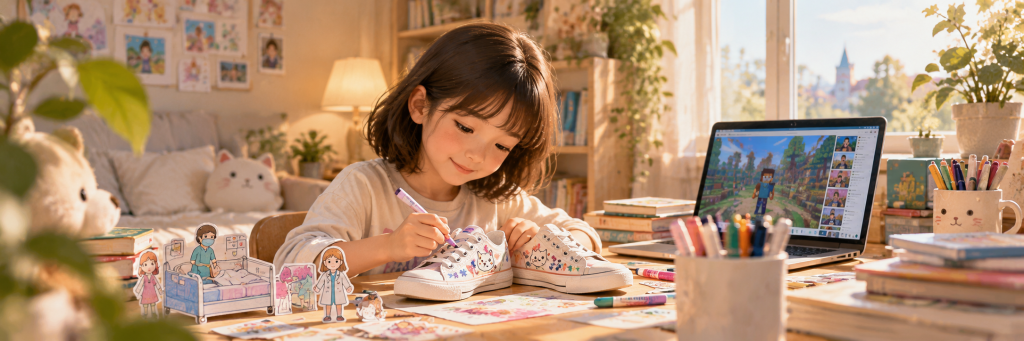
I used to find that idea a little abstract. Then I watched Alicia record gaming commentary in Chinese, chat with a girl her age in China, and use Chinese to talk about her crafts and the small worlds she creates. That was when I suddenly understood: a language truly comes alive not when a child sits down to finish an assignment, but when she wants to use it to play, express herself, and make friends.
When overseas Chinese parents talk about their children learning Chinese, the first things that often come to mind are recognizing characters, writing, pinyin, reading, and memorizing classical poems.
All of those things matter, of course.
Chinese is not an alphabetic language. If a child never develops literacy and does not read, the language can easily remain at the level of everyday spoken Chinese. As the child grows older, the range of things she can express may become increasingly limited.
But after spending the past few years learning Chinese with Alicia, I have come to feel that whether an overseas child can really continue with the language depends on more than how many characters she writes every day or how many poems she can recite. What matters just as much is whether Chinese has actually entered her own life.
If Chinese is simply the language her mother requires her to speak, it can easily become a task. If it is mostly the language her mother uses to lecture her, assign exercises, or remind her not to “forget her roots,” then it can also begin to carry a certain pressure.
But if Chinese helps her understand a craft video she loves, lets her post gaming commentary on Bilibili (B站, a Chinese video platform with a large youth and creator community, sometimes loosely compared with YouTube), or allows her to follow and chat with a girl her age in China and ask, “Can we be friends?”, then the language becomes something completely different.
It is no longer only her parents’ commitment.
It becomes her own tool.
Alicia used to have a small account on Bilibili where she posted gaming commentary videos she recorded herself.
They were not professional videos, of course. Most of the time she simply played a game, recorded the screen, and talked while she played. The voice, images, and background music all had the unmistakable feel of something made by a child.
What surprised me was that she had figured out almost all of it on her own.
She never came to ask me how to record the screen, nor did she need me to teach her step by step how to upload a video. Sometimes I only discovered afterward that she had already worked it all out.
I might tell her, “The background music is too loud. You could turn it down next time.” She would listen. Whether she actually changed it was another matter.
But the process itself already told me something important: she was not completing a learning task arranged by her parents. She was exploring a world she was interested in, in her own way.
What became even more interesting was that she later met a girl in China through the platform.
That girl also posted similar gaming videos. Once they followed each other, Alicia started chatting with her on her own.
She would tell the girl where she lived and explain that because of the time difference, by the time Alicia came home from school, the other girl might already be getting ready for bed. They would talk about when they might be able to chat the following week.
Alicia even asked her, “Can we be friends?”
Those words sound completely ordinary. But for a child growing up in Germany, they are not ordinary at all.
She was not writing a classroom essay called “My Friend.” She was not standing in front of her mother reciting a prepared passage in Chinese.
She genuinely wanted to build a relationship with another child.
When she wanted to say something, she found a way to say it. When she wanted to communicate, she began solving the problems of which characters to use and how to phrase a sentence on her own.
Her pinyin—the standard Romanization system for Mandarin—is actually not very strong, and her tones are even less reliable. When I ask her to keep a diary, she sometimes takes the easy way out by writing quite a lot in pinyin, and the spelling is not necessarily correct either.
But when she genuinely wants to talk to someone, she does not come running to me for every character and ask, “Mom, how do I write this?”
She finds a way.
Maybe she relies on suggestions from the Chinese input method. Maybe she recognizes roughly what a character should look like. Maybe she sees one and thinks, “That looks like the one I need.” Whatever the method, she keeps moving forward.
That really stayed with me.
Once learning becomes something a child needs for herself, it no longer depends entirely on an adult pushing from behind.
Ask a child to write a character for practice, and she may drag her feet. Ask her to memorize a passage, and she may find it boring. But when she wants to chat with someone her own age, post a video, or explain her own gaming world, she suddenly begins drawing on the language voluntarily.
That is the power of interest.
I used to worry that an overseas child’s Chinese might remain only at the level of “family Chinese.”
By that I mean Chinese that works for basic life at home: Mom says something, the child answers; they can talk about eating, getting dressed, sleeping, and homework; when grandparents call, the child can manage a few simple exchanges.
That kind of Chinese certainly has value.
But if the language never leaves the home, the world it can connect a child to remains very small. Chinese can start to feel like Mom’s language, part of a family obligation, rather than something the child can take out into the world and use for herself.
Alicia has begun to show me another possibility.
She watches craft videos in Chinese. She records gaming commentary in Chinese. She chats with children in China in Chinese, and she uses Chinese to tell stories about the things she makes.
For a while last year, she was especially interested in making paper dolls.
She drew the people herself, drew their clothes, hospital beds, surgical tools, bellies, babies, and things doctors might use. Then she colored everything, covered the pieces with clear tape, cut them out, and made a whole set of paper props she could play with.
One time she created a scene in which “a mother has a C-section.”
She placed the paper character on a hospital bed, dressed her in hospital clothes, designed the belly and the operation, and worked out what would happen to the baby after it was delivered.
And while acting it all out, she explained everything in Chinese.
Some of the vocabulary was surprisingly specialized. At least for a child growing up in Germany, these were not words that would naturally emerge from ordinary family conversations alone.
I found it fascinating.
She had watched many Chinese craft creators and absorbed not only their ways of speaking, but also a lot of the everyday vocabulary that children pick up through things they are genuinely interested in.
She was not sitting at a desk memorizing the words “hospital,” “doctor,” “operation,” and “baby.” She was using those words inside a world she had created herself.
That is very different from what we traditionally think of as “learning Chinese.”
But if the goal is for a language to enter a child’s real life, this may be more effective than simply memorizing vocabulary.
She was not speaking Chinese because she had an exercise to finish. She was speaking it because she wanted to explain her own little world.
Later, I also filmed some videos of her introducing her crafts and posted them online.
People in China commented that for a child growing up abroad, her Chinese was already very good.
I can hear it myself too: when Alicia speaks Chinese, she rarely switches constantly into German or English. Unless she genuinely does not know how to say something, she usually tries to complete the thought in Chinese.
That is not easy for a child growing up overseas.
Many children can speak Chinese, but once the topic becomes a little more complicated, they naturally switch into German or English because those are the languages they use at school and with their peers.
The fact that Alicia still tries to stay in Chinese when she is talking about crafts, games, and role-play tells me that the language is still very usable for her.
That is what I value most.
Of course, I am not saying this is enough.
Her character recognition and writing still need to improve gradually. Her pinyin needs work, and her reading cannot remain limited to videos and spoken language forever.
If a child’s Chinese depends only on short videos and chatting, the depth of her future expression will certainly be limited.
But I increasingly do not want to think of “learning Chinese” only as a textbook, a handwriting workbook, or a reading passage.
For an overseas child, Chinese first has to stay alive.
It has to become a language the child actually wants to use before it has any chance of going deeper.
If Chinese becomes heavy, boring, and filled with criticism from the very beginning, a child may start avoiding it more and more.
She may begin to feel that German is the language of school and friends, English is the language of games and the internet, while Chinese is the language in which Mom watches her write characters, makes her memorize things, and corrects her mistakes.
It is difficult for a child to feel close to a language like that.
So I have increasingly come to believe that the most important thing in overseas Chinese education is not to demand perfection from the beginning, but to help a child find an entrance she actually wants to walk through.
If a child loves cartoons, let Chinese cartoons be the entrance.
If she loves games, perhaps it can be Chinese gaming videos.
If she likes crafts, let her watch Chinese craft creators.
If she loves music, she can enter through children’s songs, pop songs, or music she encounters in short videos.
If she loves making friends, then within safe boundaries, let her talk with children her age who speak Chinese well.
None of these things look much like traditional “study.”
Yet they help build a feeling inside the child: Chinese is useful. Chinese can be fun. Chinese can open a door into a world.
That feeling can be far more powerful than parents repeatedly explaining why Chinese matters.
Often, children do understand their parents’ good intentions. But good intentions by themselves are not very effective motivation.
You can tell a child, “Chinese will be useful to you one day,” and she may feel nothing.
You can tell her, “Don’t forget your culture,” and it may feel too distant.
You can tell her, “Chinese is important,” and she might nod, then immediately go back to a German game or an English video.
But if she discovers that Chinese lets her understand an incredibly interesting craft video, follow and chat with a girl her age in China, upload her own gaming commentary, or hear someone tell her, “Your Chinese is really good,” then that motivation is not something her parents have poured into her.
She has experienced it for herself.
I think that is also why Alicia does not resist certain forms of Chinese input.
She is not the kind of child who obediently sits down every day and studies Chinese.
If I ask her to practice writing properly, she may try to get away with doing less. If I ask her to keep a diary, she may fill it with pinyin instead. If I make her memorize something, she may complain that it is boring.
But she is willing to watch Chinese craft videos. She is willing to explain her own creations in Chinese. She is willing to make commentary videos in Chinese and chat with Chinese-speaking children.
That tells me she is not rejecting Chinese.
She is rejecting a way of learning Chinese that has nothing to do with what she cares about.
That realization matters to me.
Parents often interpret a child’s resistance as “she doesn’t want to learn Chinese.”
But perhaps the child does not reject the language at all. Perhaps we simply gave her the wrong entrance.
We give her textbooks and assignments; she wants a world in which she can express herself.
We give her characters and pinyin; she wants friends and games.
We give her “You have to learn this”; she wants “I want to use this.”
The difference is enormous.
Of course, parents cannot simply follow every preference a child has.
If children only ever do what they already enjoy, it is difficult to build solid foundations.
But parents also cannot ignore a child’s interests completely and turn a language into something sustained only through willpower.
The better approach may be to build a bridge between the two.
Let Chinese enter an area the child already cares about, and then gradually extend more systematic learning from there.
If she likes posting gaming commentary, perhaps she can write her own Chinese title, even if it is not perfectly correct at first.
If she loves crafts, she can write a few Chinese labels for what she makes: character names, objects, parts of the story.
If she likes chatting with children in China, she can slowly learn to express time, place, feelings, and questions more accurately.
If she enjoys role-playing, she can record the dialogue and listen to it afterward, noticing what sounds good and where another expression might sound more natural.
In that way, Chinese is not pressed onto her from the outside.
It grows out of something she is already doing.
This has also made me rethink what we mean by a “language environment.”
People often say that children growing up overseas do not have a Chinese-language environment, which is why it is so difficult to maintain the language.
That is certainly true.
But an environment does not necessarily mean having a large group of Chinese-speaking children physically around you.
Today, a language environment can also be made up of videos, platforms, interest-based communities, interaction with peers, and the family’s own persistence.
A child can live in Germany and still watch Chinese craft creators, post gaming commentary in Chinese, follow and chat with a girl in China, and continue speaking Chinese with her mother at home.
Together, all of those things also form an environment.
It is incomplete and unstable, and parents still need to filter and guide what children encounter.
But it is far better than having nothing at all.
I used to think that Chinese learning had to look formal before it really counted as learning.
Now I almost think the opposite. For children growing up overseas, informal Chinese input may be one of the most important things keeping the language alive.
The internet jokes they hear, the crafts they watch, the expressions they pick up online, and those few exchanges with children their own age are all quietly telling them the same thing:
Chinese is not something distant.
It does not belong only to Mom.
Chinese can belong to them too.
That idea matters a great deal to me.
Because only when a language begins to feel like the child’s own does it become less likely to disappear.
Parents can keep providing Chinese input for years. They can explain its importance, buy countless textbooks, and insist on practice.
But whether a child eventually chooses to keep using the language depends, to a large extent, on whether that language has ever given her real joy, real relationships, and real room to express herself.
Alicia is still young, and there are plenty of unstable areas in her Chinese.
She recognizes characters she cannot write. Her pinyin is not solid. Her reading still needs to develop slowly.
But when I see her use Chinese to record videos, make friends, and explain the world of her crafts, I suddenly feel that even though this path is slow, it has not been wasted.
She is no longer only fulfilling her mother’s expectations.
She has begun using Chinese to do things that belong to her.
For me, that may be one of the most reassuring signs in raising an overseas child with Chinese.
If a language exists only in the parents’ mouths, it will eventually grow weaker.
But when it enters a child’s interests, friendships, games, creativity, and self-expression, it gains the possibility of continuing to grow.
So now I no longer ask only how many characters Alicia wrote today, or watch only for another pinyin mistake.
I am more interested in something else.
Does she choose to use Chinese in her real life?
Does she express her own thoughts in Chinese?
Does she laugh in Chinese?
Does she treat Chinese as a tool she can simply pick up and use?
For a child growing up overseas, those may be more precious signs than another completed worksheet.
Chinese is no longer only homework.
It is no longer only her mother’s persistence.
It is beginning to become one of the ways she connects with the world.
And perhaps that is where a language truly begins to stay.


Leave a Reply