By Jane Sonnenschein · March 13, 2026
During Chinese New Year this year, a friend sent me an article.
The title was something along the lines of: “After Meeting My Child’s Future In-Laws During the Spring Festival, I Finally Saw One Reality Clearly.”
He said the article was interesting and asked what I thought.
I laughed and told him it was funny timing, because I had just seen another article with an almost identical title. So I sent mine back to him. When I clicked through and read more carefully, I realized that although the openings were similar, the two pieces eventually went in completely different directions.
He casually said, “This topic is getting a lot of attention. You could repost something about it, or write your own piece.”
At that moment, I suddenly realized that I had actually been thinking about caili¹ for many years. I had simply never found the right moment to sit down and talk about it more systematically.
Chinese New Year seemed like that moment.
The story itself was simple.
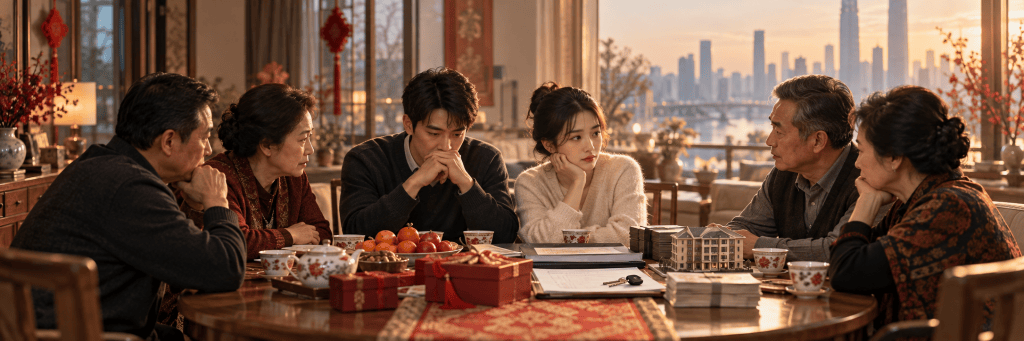
The parents had worked and saved for years, cutting back wherever they could, until they had managed to put together three million RMB. They had also prepared a home for their child’s marriage in their hometown. For many ordinary families, that amount would represent almost half a lifetime of savings.
Their child worked in one of China’s top-tier cities and was preparing to marry. The money was meant either as a down payment on a home or as caili.
The woman’s family, meanwhile, was well-off. They already had property and a car in the city, along with local resources and an established life there.
So when the two families met during Chinese New Year, someone raised a very practical question:
When they eventually have a child, whose surname will the child take?
The question itself was not particularly complicated.
But behind it was a much larger structural anxiety:
“We have given everything we have to our child, but our child’s life may not ultimately revolve around us.”
After living in Germany for many years, I gradually noticed that many families here are not used to putting aside enormous sums of money for the future. Credit, installment payments and financing are normal parts of everyday life.
That is not because people do not care about money.
It is because the system itself absorbs part of the risk.
When pensions, healthcare and education come with clearer forms of social protection, families do not have to use “all their savings” to defend themselves against uncertainty.
But when most risks are carried by the family, caili becomes magnified far beyond the money itself.
It stops being only money.
It becomes a symbol of security, bargaining power and even emotional investment.
Perhaps what is really worth discussing is not the several million RMB itself.
The more important question is why, in Chinese society today, caili has been pushed into such a central position.
It can even become a condition for whether a marriage is able to begin at all.
In many real-life cases, a couple can talk about love. They can plan a future and imagine a life together. But as soon as the conversation reaches caili, everything suddenly stops.
The issue is no longer whether married life will look respectable.
It becomes:
Can the couple enter the marriage at all?
Once a traditional custom repeatedly becomes a public issue and even enters policy and legal discussions, it is no longer simply a private family matter.
Why Does Caili Seem Like Something That Happens Only in China?
People often ask why something like caili seems so uniquely Chinese.
In Europe or North America, the idea that parents would spend years saving several million RMB simply to provide the starting capital for their child’s marriage can be very difficult to understand. Converted into euros, three million RMB is already an enormous amount for many ordinary Western families.
But if we look back at history, we can see that the logic of today’s caili is not the same as the traditional pinli².
Traditional marriage placed great importance on families being well matched in status, background and resources. Marriage was, in essence, a union between two families that already possessed assets and occupied roughly comparable social positions.
Pinli and dowry often flowed in both directions. They symbolized an alliance between families and a matching of social status rather than a one-way transfer of resources.
A model in which one side simply pays money in order to “sever” a woman’s ties with her family of origin is closer to the historical logic of concubinage or a transactional marriage than to the mainstream system of formal marriage.
In other words, under the traditional structure, marriage did not depend on one family exhausting everything it had in order to make a single “bet.”
It was more like the integration of two families whose resources were already relatively established.
Today, the situation is almost the opposite.
Against a background of rapid urbanization, intense educational competition and anxiety over social mobility, many young people have not yet achieved real financial independence when marriage is already placed in front of them.
Housing has become a ticket into urban life. Risks around old age and healthcare are still heavily carried by families. The transfer of resources from one generation to the next is often treated as something natural and expected.
As a result, caili is no longer merely a symbolic gesture.
It becomes a concentrated transfer of resources.
It carries an advance payment against future uncertainty, a form of protection against the risks of marriage, and perhaps the largest guarantee a family can offer when facing structural insecurity.
When marriage shifts from being a union between two families that have already accumulated resources to a process in which two not-yet-fully-independent individuals are trying to build a new household, caili inevitably moves to the front of the stage.
It is no longer simply ritual.
It becomes an advance payment for security, a tool for transferring risk, and an invisible filter of social class.
Even if the government abolished caili through legislation, I do not think it would truly disappear.
It would simply return in another, less visible form.
Much like the earlier crackdown on private tutoring. The form can be restricted, but the anxiety remains.
The Higher the Cost of Marriage, the More Fragile It May Become
If caili is becoming a threshold for marriage, then another, less visible consequence follows:
A high-cost marriage may actually be more fragile.
In some regions, especially rural areas where population movement is limited and the marriage market is badly imbalanced, the cost of marrying has already moved far beyond what an ordinary family can reasonably afford.
Hundreds of thousands of RMB in caili, together with expectations of a home and a car, can mean wiping out a parent’s lifetime savings—or beginning the marriage in debt.
The marriage starts under a heavy financial burden.
The problem is that accumulating costs does not automatically create a stronger emotional bond.
Quite the opposite.
When a marriage is built on an enormous financial investment, everyone’s expectations tend to rise with it. The more money invested, the higher the expectations. The heavier the debt, the greater the pressure.
Family members begin “protecting” the marriage not out of warmth, but out of risk awareness. Conflict becomes frightening because separation has become too expensive.
A marriage that begins with a very high investment can therefore have surprisingly little room for flexibility.
Every disagreement may be interpreted as a threat to everything that has already been put into the relationship.
Gradually, the relationship between people begins to shift from emotional interaction toward cost calculation.
When marriage increasingly resembles a high-value transaction, its stability can actually weaken.
The logic of a transaction is based on exchange and return.
The logic of an intimate relationship requires flexibility and tolerance.
When those two logics no longer align, conflict is almost inevitable.
Under economic pressure, this tension becomes even clearer.
Some young men begin recalculating the risk. If marriage means exhausting everything they have, taking on long-term debt, and receiving something highly uncertain in return, then delaying marriage or even opting out of it is no longer necessarily just an emotional form of tang ping³.
It can also be a rational response to a game whose risks and costs feel deeply unequal.
This is not simply moral decline.
It is behavioral adjustment under structural pressure.
Are Women Really Becoming More “Materialistic”?
I do not think so.
One common complaint in discussions about marriage is that women today have become increasingly “realistic” or materialistic.
Caili is about money. Marital conflict is often about money too. The husband’s parents do not provide enough support. A postpartum care nanny is too expensive. A postpartum recovery center is unaffordable. The mortgage is too heavy.
So many conflicts seem to circle back to money that it becomes easy to reach a simple conclusion:
Love has been replaced by money.
But if we look one layer deeper, things are not that simple.
In the way many Chinese women grow up thinking about life, marriage has long been presented as one of the most important projects of adulthood.
To “marry well” means security. It means protection. It can even mean upward social mobility.
Risks are supposed to be shared by a partner and, on some subconscious level, may still be expected to fall more heavily on the “stronger” party.
These expectations do not automatically disappear simply because women become more educated or earn more money.
This creates a very awkward contradiction.
Economically, independence is emphasized.
Emotionally, however, many people still expect traditional gender roles to provide a safety net.
Money can be kept separately, yet men are still often expected to function as the provider: offering material security, emotional support, a sense of occasion and the ability to solve problems.
From the outside, this can look like materialism.
But at its core, it looks more like anxiety about security.
The economic structure has changed rapidly. Women’s access to education and income has increased enormously. The actual form of marriage has already entered a new system.
But the psychological story has not fully caught up.
The old story—the one built around security through dependence—has never been completely rewritten.
The system has been upgraded, but the software has not been updated with it.
That mismatch is where conflict begins.
When Marriage Is Asked to Carry Too Much
So the real problem has never been the exact amount of one caili payment, nor is it simply about who is more selfish.
The deeper problem appears when marriage becomes the main route through which people seek security, defend themselves against uncertainty and hope to move upward socially.
At that point, the pressure placed on marriage has already exceeded what an emotional relationship can reasonably carry.
When marriage is expected to provide protection against risk, integrate family resources and enable social mobility, it stops being only a relationship between two people.
It becomes a highly functional arrangement.
Love is naturally pushed into a corner.
A marriage without a solid emotional foundation often cannot withstand the friction of daily reality. But a marriage entered purely on emotional impulse may also collapse quickly under the weight of ordinary life.
Marriage is difficult in itself.
Sharing a long life with another person requires more than matching conditions. It also requires more than one large financial investment at the beginning.
It requires ongoing understanding and support.
If someone enters marriage mainly for “security,” then the relationship itself becomes fragile as soon as a safer option appears.
If someone enters marriage simply to escape anxiety, the anxiety will eventually return in another form.
Under this structure, what we are seeing is not simply individual failure, nor the moral decline of one gender.
We are seeing a system that continuously transfers uncertainty onto families and marriages.
When a slowing economy amplifies anxiety, and when old stories about gender roles no longer fit the reality people are living, hostility between men and women is intensified even further.
More and more people hesitate to marry.
That does not necessarily mean they no longer believe in love.
Perhaps they have simply begun to sense that the cost of entering this game has already risen beyond what they can bear.
For You, Reading This Now
I am not sure how these problems can be solved.
I only know that more and more ordinary people who once genuinely cared for one another are being worn down, layer by layer, by reality on the road toward marriage.
Perhaps what really needs to be questioned is not any one person’s choice, but why, today—
marriage has been forced to carry everything it was never meant to carry.
Perhaps our generation is standing in the narrow space between one system and the next.
Notes
1. caili (彩礼) — Often translated as “bride price,” but the English term does not fully capture how the practice functions in contemporary China. Caili generally refers to money, property, gifts or other resources given by the groom’s side to the bride’s side as part of marriage negotiations. Depending on region, family background and economic conditions, it may be largely symbolic or may involve very substantial sums. In current public debate, it is often tied to housing, family savings, intergenerational transfers, marriage-market pressures and expectations of security.
2. pinli (聘礼) — Traditional betrothal gifts exchanged as part of formal marriage arrangements. In historical Chinese marriage practices, pinli belonged to a broader system that could also include dowry from the bride’s family. Its meaning was closely connected with family alliance, ritual status and the matching of two households, which is why it should not simply be treated as identical to the modern practice of caili.
3. tang ping (躺平) — Literally “lying flat.” The term became widely used in China to describe withdrawing, partially or deliberately, from intense competition around work, income, housing, status and conventional measures of success. Depending on context, it may express exhaustion, resignation, resistance or a rational decision to stop participating in a system whose costs feel greater than its rewards.
This essay is also available in other languages:
Chinese version: 为什么彩礼会在中国被无限放大?
German version: Warum wird Caili in China zu einem so großen Thema?


Leave a Reply