By Jane Sonnenschein · August 6, 2026
Today I came across a new expression in an article published through a WeChat public account—a publishing channel within WeChat that works somewhat like a newsletter or blog feed. The expression was “prepackaged children.”
The phrase clearly comes from “prepackaged food.” Such food is prepared in advance, so when a customer places an order, the restaurant only needs to heat it up before serving it.
A “prepackaged child” is shaped in much the same way. Before the child has actually reached a certain stage of development, adults are already in a hurry to fill them with knowledge meant for the next one.
Children begin learning primary-school material while they are still in kindergarten. Younger primary-school pupils study content intended for the upper grades. By fourth or fifth grade, some are already being introduced to secondary-school subjects. Once they finally enter secondary school, they begin racing towards high-school material.
At every stage, the purpose is no longer to understand what lies directly in front of them. It is to gain an advantage in the stage that comes next. Before children have had the chance to live fully in the present, they are pushed into a competition that should still be several years away.
The article mentioned children who are expected to complete more than three hundred test papers and seven exercise books during a single summer holiday. From the moment they wake up, their days are filled with answering questions, correcting mistakes, memorising material and repeating the same kinds of exercises. The children are miserable, and the parents supervising them are exhausted.
Many parents admit in group chats that they do not want to push their children this hard. It hurts them to see their children studying until they cry.
But no one dares to be the first to stop.
Other children have already learned the material for the coming term. What if your own child falls behind because they have not? When others are reviewing something in class, your child will be seeing it for the first time. Will they begin the school year already at a disadvantage?
Every family believes it is simply trying to protect its own child. Together, however, they keep moving the starting line farther and farther forward.
For years, China has been trying to reduce the academic burden placed on children. Schools may assign less homework, and restrictions have been placed on private tutoring, but the pressure felt by many parents has not disappeared.
As long as textbooks remain difficult, competition for school places remains intense and academic results continue to matter so much, the burden removed from schools is easily transferred into the home.
Some parents worry that today’s textbooks no longer guide children forward as gradually as older textbooks did. In English, for example, a child with no previous knowledge of the language may encounter simple sentences at the very beginning, rather than starting slowly with the alphabet and basic pronunciation.
When children cannot follow what is happening in class, parents conclude that they should have started teaching them earlier. Families with enough money can pay for tutors or extra classes. Families with fewer resources may have parents who lack the time to help, or grandparents who cannot speak English. Their children are then more likely to feel defeated from the beginning.
The result is strange. Schools appear to have reduced the burden, yet parents feel they must somehow make up for what has been removed. A policy intended to make childhood easier may instead deepen the differences between families and make parents even more afraid to relax.
Learning material in advance can certainly create a short-term advantage. When the teacher introduces a topic, a child who has already seen it may answer more quickly and complete the exercises with greater ease. Compared with classmates encountering the material for the first time, that child appears to be ahead.
But that advantage may not last.
Some kinds of knowledge can only be understood when a child’s thinking, emotional maturity and ability to reason have developed far enough. When children are asked to master something before they are ready, they often have little choice but to rely on memory.
They memorise formulas, learn standard question types and repeat similar exercises again and again. They may appear to have learned the material, but what they have really learned is how a certain kind of question is supposed to be answered.
As the subjects become more difficult and begin to require genuine understanding, reasoning and independent thought, the advantage created by memorisation may slowly disappear. More seriously, the child’s interest in learning may already have been worn away in the process.
Learning should include the pleasure of discovering something new. Yet when it becomes a daily routine of studying ahead and completing endless repetitive exercises, it begins to feel like a task that will never be finished.
Books no longer open a door onto the world. They become symbols of examinations, rankings and parental anxiety. Before children have had a chance to enjoy learning, they have already learned to fear it.
I feel this especially strongly when I look at my own daughter and see how important play is to a child.
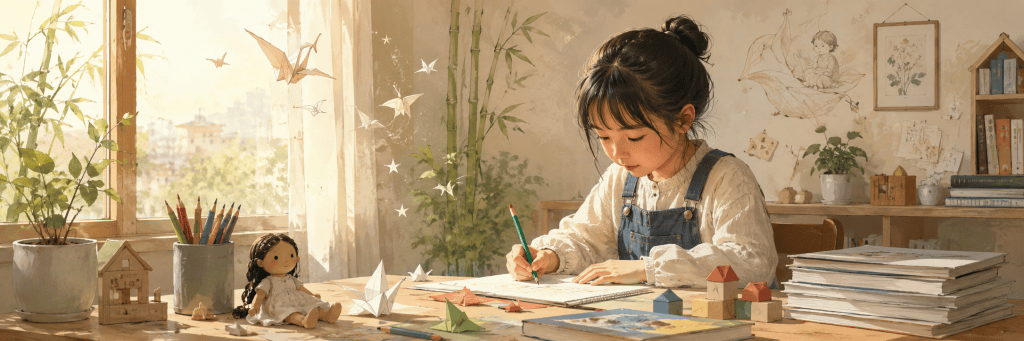
She is nine years old, and she has spent most of this summer playing. She goes swimming and takes part in activities at a youth centre. She draws, makes crafts and folds paper. She and her friends sometimes carry a small table into the garden, arrange it like a picnic and keep themselves busy there for a long time.
Children rarely seem to run out of ideas. Give them a sheet of paper, a few boxes or an empty patch of ground, and they will invent a new way to play.
Of course, we also ask our daughter to do a little studying. She reads some Chinese each day, spends a little time on English and looks through a German book borrowed from the library before bed. Sometimes she completes a page of arithmetic or a simple practice test.
Taken together, it is not very much. Some days she becomes so absorbed in playing that she forgets, and we do not turn the whole evening into a punishment for unfinished work.
Even in such a relaxed environment, however, she still feels that studying is a burden. She may have spent the entire day playing outside, but when she comes home in the evening and sees other children downstairs, she still wants to go back out.
For a nine-year-old, talking with friends, drawing, making things and arranging an imaginary picnic are naturally more attractive than sitting down to solve exercises.
That does not mean that a child is lazy or lacks ambition. It simply shows that play is a natural and important part of childhood.
When I see a child who is free to play most of the time still instinctively resist a small amount of daily study, it becomes even harder for me to imagine what children feel when their entire summer is filled with test papers, exercise books and tutoring classes.
Many people assume that learning needs to be taught, while play does not. Everyone knows how to play, don’t they?
But I have gradually come to believe that play is also an ability that needs room to grow.
When a child draws, makes clothes for a doll, builds with blocks, invents stories or creates a new game with friends, many important things are happening. The child is discovering what they enjoy. They are learning how to begin something and how to turn a vague idea into something real.
They fail and try again. They may spend a long time absorbed in an activity simply because it interests them—not because anyone has promised a grade, certificate or reward.
This ability may not appear especially “useful,” but it shapes whether a person will later be able to form an active relationship with life.
Can they become interested in something on their own? Can they continue exploring when no one is giving them instructions? Can they find satisfaction in making, creating and becoming absorbed in an activity?
These abilities are closely connected to the way a child was once allowed to play.
When I was young, I also liked drawing. I liked making clothes for dolls and sanding or building small objects. But adults saw these activities as useless. They did not improve my grades or help me enter a better school, so I was often stopped from doing them.
Later, when I grew up, no one could stop me anymore. I could buy paints, make things by hand and arrange my own time as I wished.
Yet I discovered that the spontaneous desire I had felt as a child did not return simply because freedom had finally arrived.
When a child’s interests are interrupted again and again, they may not learn, “I will study now and play later.” Instead, they may learn that the things they genuinely enjoy do not matter, and that only goals chosen by adults deserve serious attention.
Then, when they grow up and the external restrictions have weakened, someone may ask them what they truly enjoy—and they may no longer know how to answer.
A few days ago, I read another article.
It was written by a man from Shanghai who had recently completed his doctorate. His dissertation had gone well, and some of his work had been published in respected academic journals. He hoped to remain in Shanghai and find a position at a university, so he submitted applications to a number of institutions.
He did not receive a single offer.
Later, he realised that many universities in Shanghai now preferred candidates who had already completed postdoctoral research. A doctorate no longer seemed to be enough. To remain on the academic path, he might have to spend several more years as a postdoctoral researcher.
Yet he admitted that he did not feel any great passion for academic research. Completing the doctorate had already been difficult. Continuing with several more years of repetitive and demanding research simply to qualify for a university job would be deeply painful for him.
“Prepackaged children” and a doctoral graduate unable to find the university position he hoped for may appear to be two completely separate stories. In fact, they lie along the same road.
As a child, you are told to work hard so that you can enter a good secondary school. Once you are there, you must work towards a good university. At university, you are encouraged to continue to a master’s degree. When a master’s degree is no longer enough, you pursue a doctorate. After completing the doctorate, you discover that some employers would rather hire someone with postdoctoral experience.
The goal begins to resemble a carrot suspended in front of a donkey. It always seems to be within sight, only a few more steps away. But whenever you come close to reaching it, someone moves it farther ahead.
For many people born in the 1980s and 1990s, and for their parents, there was once a relatively clear connection between education and a better life. Many children from ordinary families and small towns genuinely did enter cities through education, find more stable work than their parents had and move noticeably upwards in society.
That generation therefore had reason to believe that enduring more hardship today would lead to a better life tomorrow.
But the world today is no longer quite the same.
As university degrees became more common, a master’s degree became the entry requirement for some jobs. As more people completed master’s degrees, employers began using doctorates as a filter. After the doctorate, some positions continued raising the requirement to postdoctoral experience.
Educational qualifications keep rising. People spend longer and longer inside the education system, but the number of jobs suited to those qualifications has not grown at the same pace.
This does not mean that education or effort has become meaningless. It means that the relationship between effort and reward is no longer as dependable as it once appeared to be.
A person may work hard throughout childhood, give up much of their time for play and rest, and complete one “useful” goal after another—yet still fail to receive the secure life they were promised.
When reality fails to honour the promise that hard work will lead to success, a person may lose more than an ideal job. They may also lose faith in effort itself.
They begin to wonder what all the sacrifice was for. They did not play properly as a child. They never truly relaxed as a teenager. They kept moving through university, postgraduate study and perhaps a doctorate.
What did they receive in return?
This may be one reason some young people today experience such a strong sense of inner emptiness. It is not that they have failed to complete their goals. On the contrary, they may have completed far too many of them.
They have followed the route laid out by parents, schools and society, step after step. Yet they have rarely been given the chance to stop and ask what they themselves genuinely enjoy, what makes life feel meaningful, or where satisfaction might come from beyond grades, qualifications, employment and income.
When a person has never truly experienced the joy of living as a child, what will help them believe that life is worth living when they grow up?
Life cannot remain easy forever. People encounter disappointment, illness, loss and problems that could never have been prepared for in advance. What helps someone continue facing those difficulties is not only a sense of responsibility, and not simply the instruction to “hold on a little longer.”
A person also needs to know that some things in life are genuinely worth holding on to.
Being with someone you care about can be good. Painting, reading, exercising or quietly watching the sky can be good. Completing something you truly wanted to create can be good.
Experiences like these gradually teach us that although life contains suffering, suffering is not all that life contains.
But when a child learns only to sit examinations, compete, endure and complete tasks—without being given the chance to play or discover what they enjoy—then one day, when the external goals stop working, they may genuinely have no idea why they should continue moving forward.
Education, of course, cannot consist only of play. Children need to learn, take responsibility and gradually become capable of doing things they may not enjoy but still need to complete.
Yet education should not turn childhood into a long process of preproduction, as though filling a child in advance with primary-school, secondary-school, high-school and university material could guarantee future security.
Human development is not a production line that can be accelerated without limit. Understanding, emotional maturity, curiosity and knowledge of the world all grow at their own pace.
Knowledge can be placed inside a child early. Their inner life cannot necessarily be made to mature ahead of time.
Perhaps good education is not about shaping a child into a finished product as quickly as possible. Perhaps it means leaving enough space for them to explore, experiment, make mistakes and occasionally do nothing at all. It means allowing them to enjoy things that may not yet appear useful.
Because an interesting soul does not appear out of nowhere.
It needs a childhood in which a person has time to explore the world—and slowly discover who they are.
This essay is also available in other languages:
Chinese version: 有趣的灵魂,也需要一个可以探索的童年
German version: Auch eine interessante Seele braucht eine Kindheit mit Raum zum Entdecken


Leave a Reply