By Jane Sonnenschein · First drafted on February 17, 2026 · Revised on July 25, 2026
Yesterday, my daughter suddenly said to me, “Mum, wouldn’t it be wonderful if we had a special power that let us get anything we wanted straight away?”
She said it with such genuine longing. To a nine-year-old, that probably does sound like the perfect superpower: no waiting, no being told no, no need to think about how much something costs. The moment a wish appeared in your mind, the thing you wanted would appear in front of you.
I did not immediately tell her whether the idea was right or wrong. Instead, I asked, “Have you ever thought that when something is too easy to get, you may not value it as much?”
I used some of her toys as an example. Before buying them, she had sometimes thought about them for a long time. When she finally received them, she really was delighted. But only a few days later, they were often put into a box and rarely thought about again.
It was not because the toys had suddenly become worse. Once the wish had been satisfied, the excitement faded quickly, and another thing she wanted soon took its place.
I told her, “Imagine that you never had to do anything or wait for anything. Whatever you wanted appeared immediately. After a while, getting things might start to feel completely ordinary. You could own a great many things and still not be any happier than you are now.”
She thought about this seriously for a moment and then said, “I think you might actually be right.”
Compared with a few years ago, she has clearly grown. Back then, when I tried to explain something like this, she might have focused mainly on the fact that Mum did not want to buy her what she wanted. Now she can step away from the wish itself for a moment and look at it from a little distance.
Would a person really become happy if they could have everything they wanted?
When “I Want It” Turns into “Happiness”
A few months ago, she said something similar to me: “If I bought that thing, I would be a little happier.”
What made me stop was not that she wanted to buy something. It was that she had used the word happier.
There is nothing wrong with a child wanting a toy, a snack, or a particular experience. But when “I want this” slowly becomes “I will be happy once I have this,” buying something is no longer just an ordinary purchase. It begins to carry a much heavier responsibility.
I did not dismiss her feelings. I simply asked, “Have you ever thought that happiness might also be something that slowly grows inside you?”
When happiness always comes from something outside us, it does not last very long. Today it is a toy. Tomorrow it is a hamburger. The day after that, it may be something new she has just seen.
Each new thing can bring a moment of excitement. But once the novelty wears off, we need another source of stimulation.
That kind of happiness is exhausting. It never truly stays with us. We place it outside ourselves—in the next thing we buy, the next good result, the next compliment, or the next relationship.
We have to keep chasing and replacing one goal with another just to hold on to that brief sense of satisfaction. As soon as we stop, the original emptiness returns.
Children are often more honest about this than adults. They tell us directly what they want, how excited they feel when they receive it, and then quickly put aside something they once loved.
Adults simply give their toys different names. Some place their happiness in money and achievement. Others place it in approval, applause, or relationships.
That is why we sometimes see people who already have so much that others admire, yet still feel anxious and unsettled. It is not always because they do not have enough. Sometimes it is because their happiness has always been borrowed from the outside world.
Desire and Fulfilment Need a Little Distance Between Them
Over the past two years, our family has faced more financial pressure, and I no longer agree as easily when my daughter asks for something.
A few years ago, when our circumstances were more comfortable, I really was a fairly easy-going mother. When I saw that she liked something, I often thought there was no harm in giving it to her as long as we could afford it.
Chris used to remind me that a child should not always receive everything she wanted. At the time, I did not completely agree with him. I thought she was still young, and if our family could afford to give her a little more, why shouldn’t we?
Gradually, though, I began to understand that setting boundaries for a child does not necessarily mean being stingy. Nor does it mean deliberately creating a sense of deprivation.
Some boundaries exist not because parents do not love their children, but because children also need to learn that the world will not immediately satisfy every desire the moment it appears.
I certainly do not believe that people must suffer or work painfully hard before they deserve something. For a child, effort does not have to mean enduring some great hardship.
It may simply mean waiting for a while, saving a little pocket money, choosing between several things she likes, or understanding that if she buys one thing now, she may need to wait before buying another.
Sometimes effort also means using and caring for something after receiving it, rather than forgetting it in a corner as soon as the first excitement has passed.
The point is not to make everything difficult to obtain. It is to leave a little distance between desire and fulfilment.
That distance gives a child time to work out whether she truly likes something or has simply been attracted to it for a moment. It also gives anticipation time to grow and allows the thing she eventually receives to carry a little more meaning.
When every desire is satisfied without resistance, the desires themselves can begin to feel lighter and lighter. A person may own more and more without becoming any happier, because in the process of always being satisfied, they may slowly lose the ability to wait, choose, and value what they have.
Happiness Is Not a Reward, but an Ability That Slowly Takes Shape
I have gradually come to believe that lasting happiness is not only about what a person receives. It is also about the person they slowly become.
When someone can understand their own feelings and accept that a wish may not be fulfilled immediately; when they can enjoy having something but also cope with not having it; when the outside world does not respond at once, yet they can still find some sense of peace in their own life—then happiness is no longer entirely dependent on external things.
This kind of happiness is not constant excitement. Nor does it mean living every day in a lively, cheerful mood.
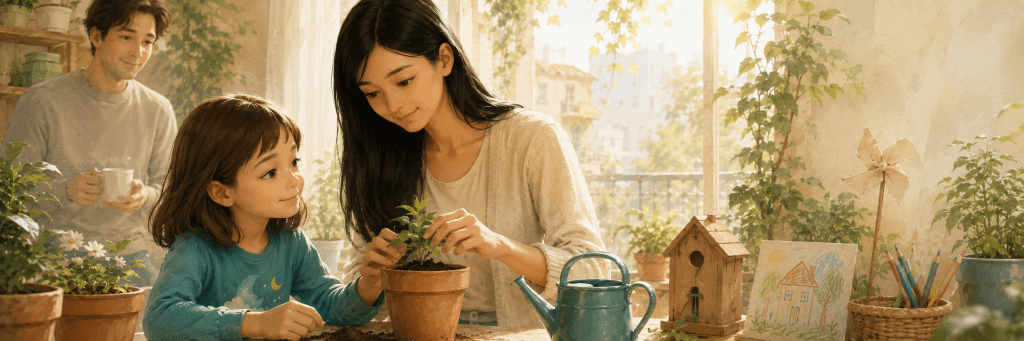
It is more like a quiet sense of contentment. It can come from an ordinary meal, from finishing a craft project with care, from talking with family, from looking after a plant, or from slowly learning how to do something that once felt difficult.
It is like a tree. A tree does not flower every day, but as long as its roots remain in the soil, it is still growing.
I am also less envious than I used to be of lives that appear especially happy from the outside. Liveliness, shopping, and sharing joyful moments can all bring real pleasure. There is nothing wrong with any of them.
But when a person constantly needs new things, more praise, and stronger stimulation to prove that they are doing well, that happiness is often accompanied by quick exhaustion and a deep sense of unease.
What makes me feel comfortable now is something quieter: a person who knows what they want and also knows what they do not need; a life that may not look dramatic but has its own rhythm.
Such a person does not have to keep displaying their happiness to others, because happiness is not an achievement to them. It has slowly become part of the background of everyday life.
What I Want Her to Have Is More Than Things
I am not trying to tell my daughter that she should never buy anything again. Nor do I want to present suffering as a virtue.
It is perfectly natural for a child to enjoy hamburgers, toys, and beautiful things. Owning something we genuinely like is a real and concrete kind of pleasure.
I simply want her to understand, little by little, that things can bring us happiness, but they cannot carry the full responsibility for making us happy.
Today, a person may hand their happiness over to a toy. Tomorrow, they may hand it over to their grades. The day after that, it may depend on what other people think of them.
When someone’s sense of satisfaction depends entirely on the outside world, they will always be pulled around by whatever happens around them.
As my daughter grows, I hope she gradually learns how to be with herself. I hope she can recognise her own feelings and cope with temporary disappointment. I hope she can enjoy receiving something while still knowing how to continue living well when she cannot have it immediately.
That day, I told her, “Happiness isn’t something you buy. It is more like an ability.”
Now I think that ability also includes waiting, choosing, investing care, and valuing what we have. It does not suddenly appear the moment a wish is fulfilled. It grows little by little as we learn to understand ourselves and accept that life will not always give us exactly what we want.
It does not arrive with a bang, and it does not mean feeling excited all the time.
It grows quietly and steadily, like roots settling into the earth, like a tree continuing to grow in places we cannot see.
And that is what I truly hope my daughter will have.
This essay is also available in other languages:
Chinese version: 我对女儿说:快乐不是买来的,是长出来的
German version: Ich sagte zu meiner Tochter: Glück kann man nicht kaufen. Es muss wachsen.


Leave a Reply