— A Note After Building A Chinese Way of Seeing
By Jane Sonnenschein · July 2, 2026
When I wrote this essay, it was already July 2. But I still want to count it as a record of July 1. Because for me, July 1 was the day I finally did something I had postponed for a long time: I registered my own independent website.
If I say it out loud, it may not sound like anything dramatic. It was not a successful business launch. It was not a book suddenly becoming a bestseller. It was not an article unexpectedly going viral. It was simply that I finally opened WordPress, registered a domain, paid for it, chose a theme, and placed a plan I had talked about many times over the past few months into reality.
But for someone with serious procrastination, this was already a very big thing.
A few months ago, I had already said that I wanted to start an independent blog. At that time, I had studied SEO for a while, and I also knew that if a person wants to write for the long term, she cannot rely completely on platforms. Platforms can give you traffic, but they can also drown you at any time. If everything you have written is scattered across WeChat public accounts, Xiaohongshu, Toutiao, Medium, and Moments, those pieces of writing are like leaves floating everywhere. They may look like many, but there is no tree that truly belongs to you.
In theory, I had understood this for a long time.
But knowing is one thing. I still had not done it.
Every day, I felt that I should do it. I thought about it today, tomorrow, next week, at the beginning of the month, and again at the end of the month. Every time I thought about building an independent website, it felt troublesome: I would have to register a domain, choose a plan, build pages, think about the trilingual structure, decide how to write the homepage, and consider the German Impressum and privacy policy. Then, as soon as I thought of all these things, I put it down again.
This is what procrastination really looks like. It is not that you have no idea something is important. It is that you know it is important, but you still cannot reach the point of action. Every day, you do it inside your head, but not in reality. You may even develop a false sense of exhaustion because “I have already thought about it so many times,” as if the thing has already consumed a lot of your energy, when in fact it has not truly begun at all.
Until July 1, when I suddenly felt that I could not delay it anymore. Half of 2026 had already passed. If I still did not start that day, then the next time I said, “I will find a good day to begin,” who knew when that would be? So I finally sat down, started registering, started choosing a domain, and completed it step by step.
In the end, I named the website: A Chinese Way of Seeing.
The domain is chinesewayofseeing.com.
The name did not come to me at the last minute. Behind it is a feeling that has become clearer and clearer during these months of writing: I am not a particularly “vertical” person. According to the logic of Chinese platforms, an account should be vertical. It should have a clear persona and keep writing within one fixed field. But I discovered that I cannot write in such a narrow way. I write about parenting, but I also write about family. I write about Chinese parents, life in Germany, platform anxiety, women, marriage, writing, and self-rebuilding. On the surface, it may look scattered. But in fact, all these topics grow from the same place: how an ordinary Chinese mother who has lived in Germany for more than twenty years uses her own life experience to understand the world.
What I want to create is not a website for selling things. It is not an entrance to a course. It is not a personal brand page where I package myself as someone impressive.
What I want to create is a quiet space for essays.
Through my writing, I hope foreign readers can slowly see how a Chinese person thinks about family, education, relationships, the times we live in, language, and life.
China is now more and more visible to the world. But being seen is not the same as being understood. When many foreigners mention China, what comes to mind may be the economy, politics, technology, manufacturing, short videos, e-commerce, or international news. But the life logic of an ordinary Chinese person, the complicated love and control inside a Chinese family, why Chinese parents feel anxious, why a child is expected to be “sensible,” why a person endures, why people care about mianzi, why many things are not said directly — these cannot be understood through news alone.
Having lived in Germany for more than twenty years, I deeply feel that the gap between East and West is sometimes not a gap of language, but a completely different angle from which people look at the same thing. Very often, it is not about who is good or bad, who is advanced or backward. It is that everyone is standing inside their own history, family, system, culture, and lived experience when they look at the world. You may think you are discussing the same question, but the logic behind each person may be separated by a very deep river.
Many conversations between my husband and me have often made me realize this. Sometimes it is only a very ordinary sentence in daily life, a discussion about a child, school, family, or social rules, and yet it is enough for me to see the subtle but very real collision between Chinese and Western cultures. These collisions are not concepts in a book. They happen in the kitchen, in the living room, beside a child’s homework, and inside the everyday conversations of a family.
So for me, this independent website is not just a website. It is more like a home I have found for these observations.
After finishing the registration, I began choosing a theme. I looked at many themes, and many of them did not feel right. Some were too flashy. Some were too commercial. Some looked like course-selling pages. Some looked like photography portfolios. Some felt noisy the moment I opened them.
Later, I saw a theme called Tronar. Its homepage has a large header image. The picture is clean, with forest and mist, and it gives a feeling of quietly walking inward. Below it are several articles. When you click into an article, the article page is also comfortable: a header image at the top, the text below, the font not too crowded, the line spacing not messy, with plenty of white space. It does not feel tiring to read.
At that moment, I suddenly thought: Isn’t this exactly the kind of feeling I want for my blog?
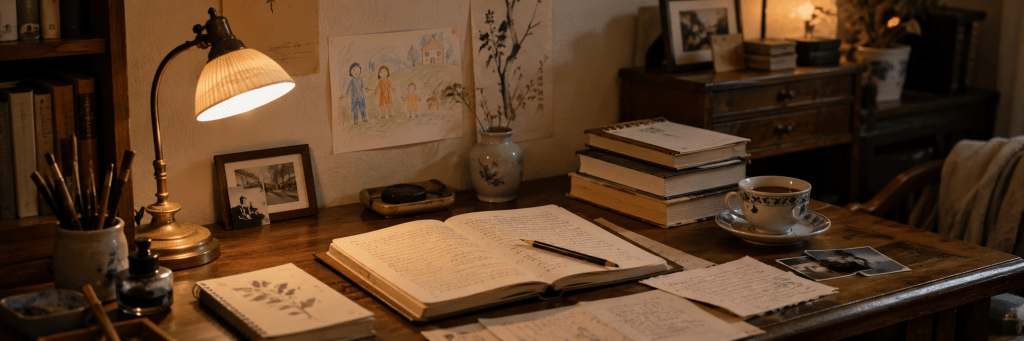
I do not want to build a busy website. I want to build a quiet library. Like someone sitting by a window while it rains outside, with a row of books in front of her and a lamp on the desk. When readers click in, they are not chased by pop-ups, advertisements, subscription boxes, or marketing buttons. They can simply read an essay quietly.
It was also while looking at this theme that I suddenly thought: writing itself should probably be like this too.
Simple, clear, quiet, and able to make people willing to stop for a while.
When I studied in Germany, I was once tormented by many German academic texts. Especially in some humanities papers, certain sentences were so long that they almost made me collapse. One sentence contained subordinate clauses, and inside the subordinate clauses there were qualifications, and inside those qualifications there were citations, and after the citations came another turn, and the verb would not appear until the very end. After reading an entire paragraph, you might still not know what the author was trying to say.
At that time, there were no AI tools like now to help you break down a sentence, explain it, or rewrite it. You could only force yourself to chew through it alone. For a foreign student, that was not only a language difficulty, but also a kind of mental exhaustion.
Perhaps precisely because I experienced that pain, I now believe more and more that the most important thing in writing is not making sentences complicated, but making meaning clear.
This is especially true because my independent website will later have English and German versions. I am not an English writer, and I am not a German writer. I do not need to use complicated sentence structures to prove that I have literary quality. My goal is not to make readers think, “This person has a very advanced vocabulary.” My goal is that after reading, they understand: so this is how a Chinese mother sees this issue; so this is the logic behind Chinese families; so many things that once felt strange to me can be understood when placed inside her lived experience.
A truly good essay should contain a person.
It should not be empty grand talk. It should not be a pile of beautiful sentences. It should not begin by throwing out a large abstract truth. It should grow out of a real story, a conversation, or a scene from life. Thoughts do not fall from the sky. They need to come from somewhere.
I increasingly dislike those essays that look beautiful, mature, and well-packaged. Some writers are attractive at first because their sentences are polished, their structure is complete, and every essay seems to contain a moment of revelation. But after reading more, you discover that they are always writing about meeting some important person today, talking with some impressive person tomorrow, and then drawing from these experiences a set of “life methods.” In the end, no matter where the essay begins, it always circles back to their method, their book, their course, or their system.
Once readers see this pattern, it becomes hard to believe anymore. Because it no longer feels like life. It feels like a sales path. The story is only an entrance. The idea is only packaging. Everything finally leads toward something that is meant to be sold.
I do not want to write that kind of essay.
I believe more in a slower, clumsier, more honest way of writing: first see a person, see a thing, hear a sentence, and then ask myself why it made me stop. Is there something more general behind it? What does it have to do with my life, my childhood, my culture, and my situation? If there is something there, I write it down.
Such essays may not go viral quickly, and they may not fit the rhythm that platform algorithms prefer. But they have roots. They are not born from concepts. They grow out of life.
This also makes me think of another question: how do reading and theory truly enter a person’s life?
In the past, I always thought that if a person read many psychology books, history books, philosophy books, and education books, and if she mastered many theories, then when she truly faced difficulties, depression, anxiety, procrastination, and self-doubt, those theories would naturally come into use. She would stand on the shoulders of giants, see farther, and live with more clarity.
But now I increasingly realize that things are not like that.
If theory has only been read, it is still dead. It can be very clear in a book, very beautiful in notes, and very reasonable when quoted on social media. But when life truly arrives, it may not necessarily be useful. Many people read one hundred books a year, or even several hundred books. They listen to many courses and collect many golden sentences. But life remains the same. It is not because books are useless. It is because those theories have not connected with their own life experience.
Real life is not an exam paper. It will not tell you: this question is about Adler, this one is about family of origin, this one is about attachment theory, and this one is about trauma response.
Reality only appears in a very messy way: a child’s sentence hurts you; a partner’s reaction makes you feel wronged; a phone call from your mother sends you back to the past; you wake up one morning with a very low mood; a plan has been delayed for months and still has not begun. You clearly know many truths, but you still cannot do what you know.
So the question is not whether you have read theory. The question is whether theory has been lit up again by your life.
After these months of writing, I have had a very strong feeling: when I began to observe life seriously and write life down seriously, it was as if a new way of seeing opened inside me. In the past, many things simply happened and then passed. At most, they left behind an emotion. But now, I begin to ask: Why did this make me react? What is behind it? Does it belong only to me, or does it point to something larger? Is there some wider cultural, family, or psychological structure inside it?
Some things I had never systematically read theories about before. For example, questions about children’s learning, attention, family control, highly intelligent children, and how platforms train human emotions — at first, I did not know these things from books. I saw them in Mido, in myself, in other people’s stories, and in the comment sections of platforms. Then one day, when I read a certain theory, I suddenly realized: so this is what it was talking about. It was exactly the thing I had observed.
At that moment, theory truly became alive.
Because it was no longer external knowledge. It was naming something I had already seen. I was not memorizing a concept, nor was I forcing theory onto life. My lived experience had grown first, and then theory came to help me organize, deepen, and expand it.
This is almost the opposite of the order in which many people learn. We often think that we should first study theory and then apply it to life. But very often, truly deep understanding comes only after life has hit us first. We first have confusion, observation, and expression. Then, when we return to theory, we suddenly discover that it has warmth.
Those who truly built theories did not sit in a study at the beginning and invent concepts out of nothing. They also observed people, society, children, patients, families, and history. Then, little by little, they refined what they saw, and only afterward turned the phenomena of life into theory.
Theory is actually life that has been refined. But when we read books later, we often reverse the order. We imagine theory as something high above, and life as merely material used to prove theory.
But for an ordinary person, real growth may not lie in how many books she has read. It may lie in whether she has begun to look seriously at her own life.
Input is certainly important. Reading is certainly important. Theory is certainly important. Without the work of those before us, many of our observations might remain at a very shallow level. But if a person only takes things in, without observing, digesting, expressing, or bringing theory back into her own life to test it, that knowledge will be very difficult to truly become her own.
It will pile up inside the mind and become a kind of satisfaction: “I seem to understand so much.”
But when she truly encounters the difficulties of life, that knowledge may not help her walk through the hardest part. Sometimes, it may even become a new form of self-blame: I clearly know all this, so why can I still not do it?
So now I increasingly feel that writing, for me, is not only expression. Writing itself is a way of understanding life.
I do not write because I have already figured everything out. I write because I need to slowly see clearly, through writing, some things that were once vague. A child who stops watching short videos and begins to play again; a German person asking why German homes do not have air conditioners; a Chinese mother who does not say “I love you” but fills her child’s bag with things; a person who finally registers an independent website after postponing it for several months — these all look like small things. But if you are willing to stop, each of them can become an entrance into understanding.
Life is not without theory. Life is full of the shadows of theory. It is only that if you do not observe, they are just things. If you begin to observe, think, and write them down, they slowly become your understanding.
On July 1, I registered an independent website. On the surface, this was only a technical action: buying a domain, choosing a theme, setting a title, and preparing to publish essays in the future. But for me, it was also a reminder: many things do not begin only after we have thought them through. Very often, we truly understand them only in the process of beginning.
I had studied SEO before. I had listened to many things about independent websites, keywords, content structure, and search traffic. At that time, I seemed to understand many of them. But because I had not truly done them, many things quickly scattered. Only when I really sat down to register a website, really saw the theme, really thought about the homepage, article pages, language entrances, and how readers would read, did those theories suddenly take shape.
Only then did I truly understand: website structure is not an abstract concept. It concerns how readers enter your writing. Font and white space are not small aesthetic matters. They concern whether a person is willing to keep reading. A homepage should not be filled with information. It should give readers a quiet and clear entrance. A trilingual blog is not simple translation. It is retelling one kind of lived experience to people in different languages.
Theory does not enter life first. Theory needs to be lit up again by life.
Perhaps this is what I most want to record today.
I hope that when I look back on this day in the future, I will remember this evening. I will remember a person who had delayed for a long time, and who finally, halfway through 2026, registered the independent website she had thought about for months. I hope I will remember that she did not begin because she was perfectly prepared, but because she finally understood that if she kept waiting until everything was completely ready, many things might never truly happen.
I also hope that this website can really become the kind of quiet place I imagine.
Not a noisy traffic entrance. Not a display cabinet eager to prove itself. Not a sales page that packages everything into a method.
But a small study.
Someone clicks in, sits down, and slowly reads an essay. As they read, perhaps they will see the life of a Chinese person, a way of thinking different from their own, and also certain shared human confusions, pains, and tenderness.
If it can do that, then I think this independent website already has a reason to exist.
This essay is also available in other languages:
Chinese version: 理论不是先进入生活的,是被生活重新点亮的
German version: Theorie tritt nicht zuerst ins Leben ein; sie wird durch das Leben neu entzündet


Leave a Reply